Economy
Business and investment
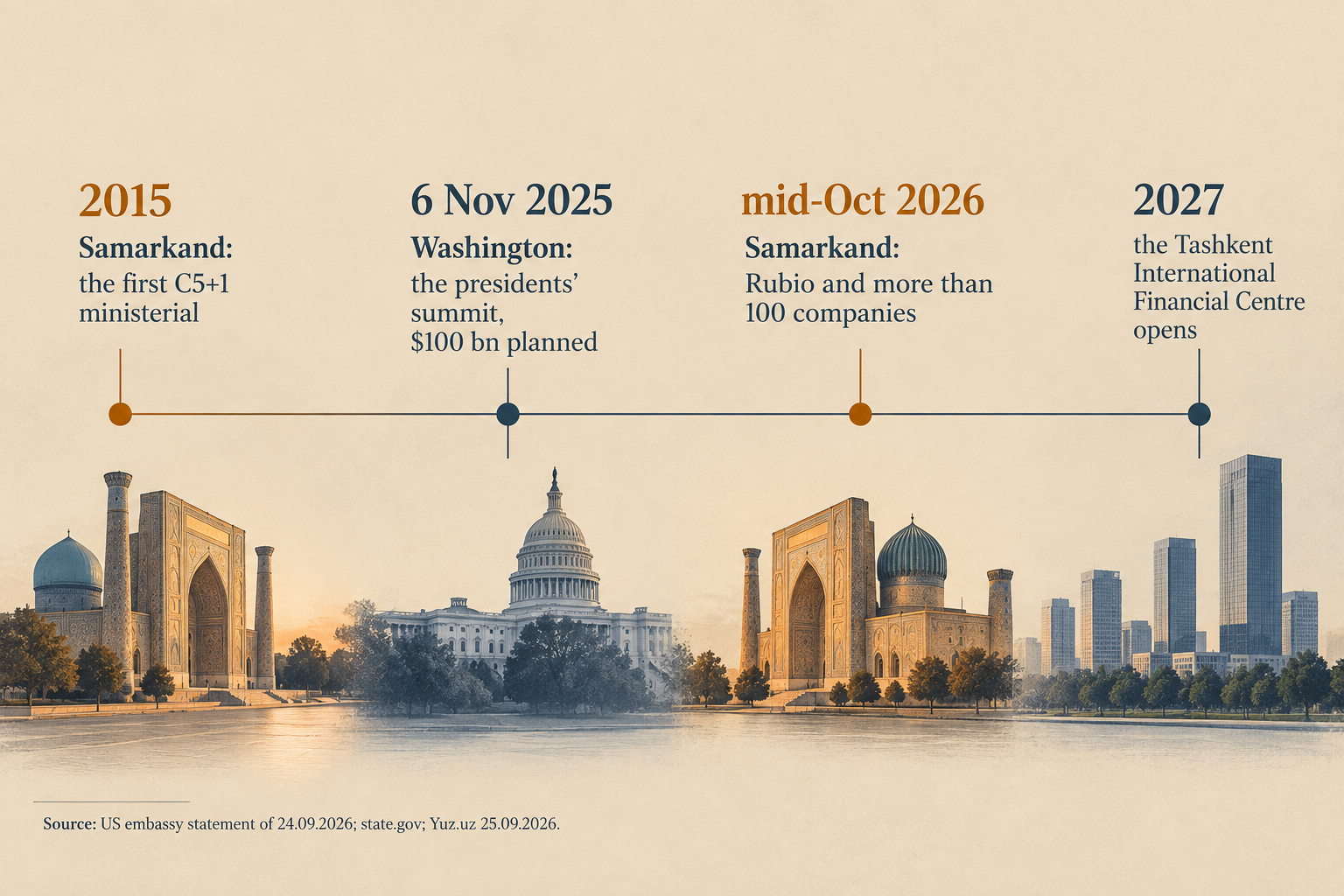
Washington books Samarkand for October while BlackRock draws Tashkent’s financial centre: Rubio’s 100 companies, a C5+1 back where it began in 2015, a launch date of 2027
Secretary of State Marco Rubio will bring “a historic business delegation of more than 100 American companies” to Samarkand in mid-October for the C5+1 ministerial with the five Central Asian foreign ministers, the US special envoy for South and Central Asia Sergio Gor announced on Thursday in a statement the Tashkent press relayed on Friday. The same morning Saida Mirziyoyeva, head of the presidential administration and since 10 September secretary general of the Tashkent International Financial Centre’s council, met BlackRock’s president Robert Kapito and vice chairman Thomas Donilon in New York on the centre’s launch in 2027, with BlackRock “assisting in forming the concept and structure of the Centre”.

Azerbaijan’s second investment forum closes on 12 documents by APA’s list and 11 by Report.az’s: an Azerbaijani-Omani fund into Azer-Turk Bank, SOCAR into water, no sums printed
The second Azerbaijan International Investment Forum in Baku, held under President Aliyev’s patronage, produced a signing list of 12 documents in APA’s count at 12:47 and 11 in Report.az’s at 14:10, with no sum attached to any of them. The one ownership line is the Azerbaijani-Omani investment fund’s non-controlling stake in Azer-Turk Bank, signed for the Azerbaijani side by Deyanet Sadullayev, acting chief executive of the Azerbaijan Investment Holding; SOCAR’s line is a cooperation agreement with the State Water Resources Agency and Esyasoft.
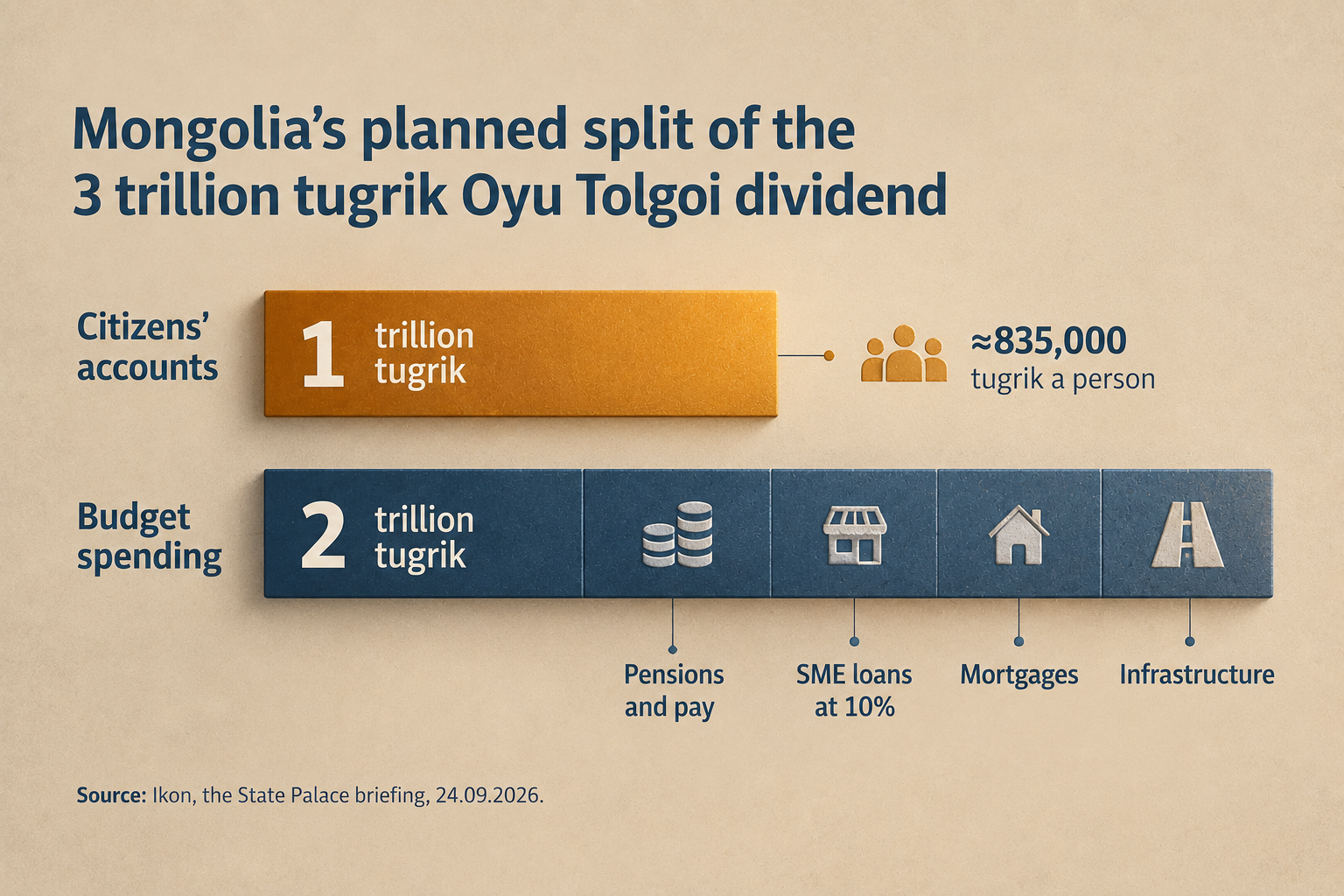
Mongolia’s finance minister splits the 3 trillion tugrik Oyu Tolgoi dividend before it arrives: 1 trillion to citizens’ accounts, 2 trillion to the budget, by a one-off law
Finance minister Z. Mendsaikhan told a briefing at the State Palace on Thursday that the 3 trillion tugrik dividend expected from Oyu Tolgoi in 2027 will be spent under a one-off law, since the dividend is not a permanent budget revenue: 1 trillion into citizens’ named accounts in the accumulation fund and 2 trillion into current budget spending, on pensions, civil servants’ pay, loans to small business at 10%, mortgages and infrastructure, Ikon reported at 14:48 Ulaanbaatar time. MP G. Ganbaatar had said in the same building at 12:05 that the National Wealth Fund law of 19 April 2024 sends the dividend to citizens’ accounts, about 835,000 tugrik a person, and that “assorted thieving projects” cannot be financed from it.

The EU Council adopts 2 years of duty-free entry for about 80% of Armenia’s exports, the only such regime for a country with neither candidate status nor a free-trade area with the EU
The Council of the European Union formally adopted on Thursday the temporary trade-liberalisation measures for Armenian goods, suspending import duties on about 80% of Armenia’s exports to the EU for 2 years from the day after the regulation’s publication in the Official Journal, Armenpress reported at 14:34. Ireland’s foreign minister Helen McEntee, for the presidency: “We are stepping up our support for Armenia and its people, who have clearly chosen a pro-European path in spite of foreign pressures. Today’s decision will help Armenia’s economy hit by trade restrictions”. Ani Badalyan, the foreign ministry’s spokeswoman, said Armenia becomes the only country that, “without EU candidate status or a Deep and Comprehensive Free Trade Area agreement with the EU, receives such an economic benefit”.
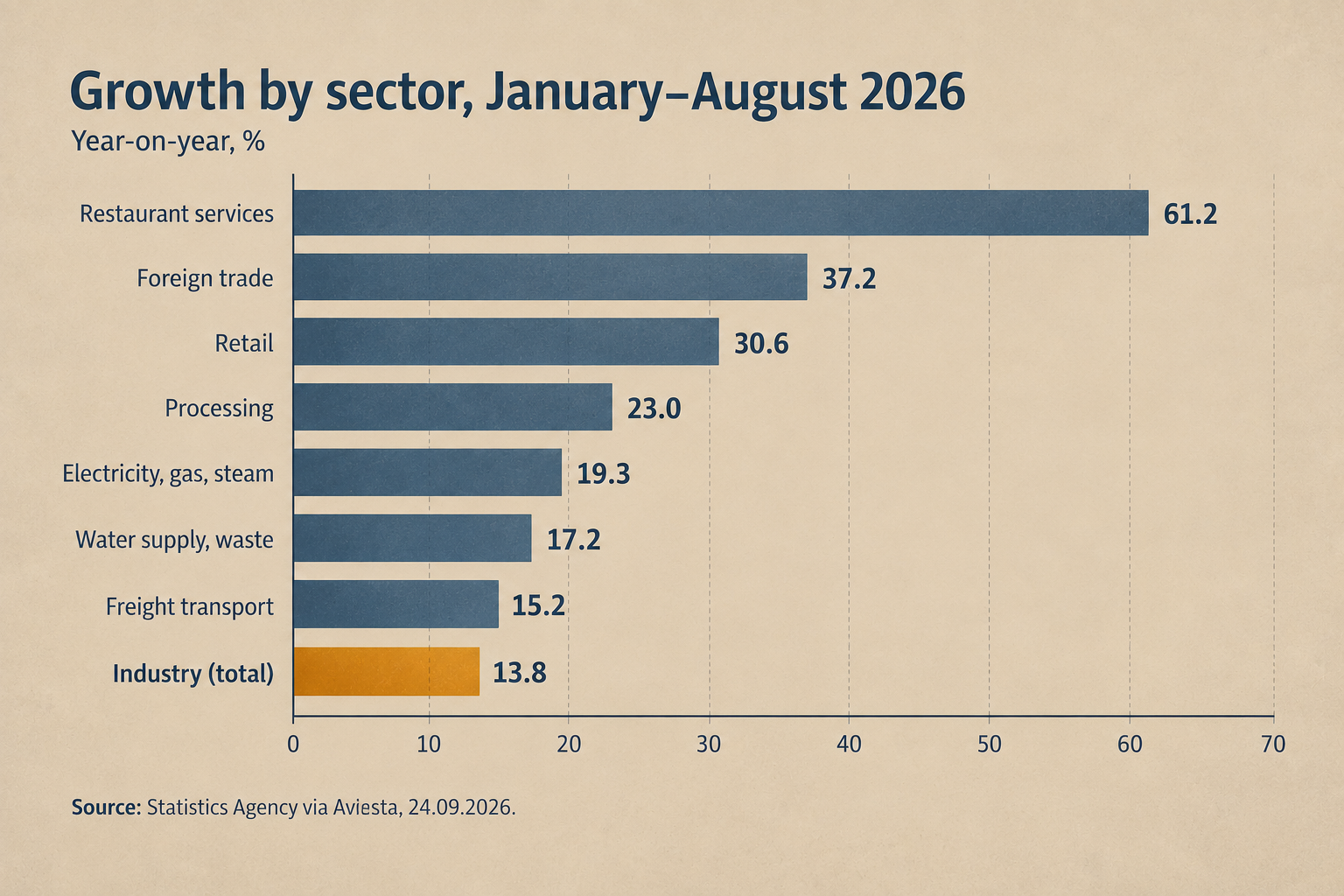
Tajikistan’s industry grows 13.8% in 8 months to 45.37 billion somoni and its trade 37.2%, with imports running at 3.7 times exports
Industrial output in Tajikistan reached 45.37 billion somoni in January to August, 13.8% more than a year earlier, the Statistics Agency under the President reported on Thursday through Avesta: processing up 23%, electricity, gas and steam up 19.3%, water and waste up 17.2%. Foreign trade rose 37.2% to $9.23 billion, exports of $1.97 billion against imports of $7.26 billion; freight carried rose 15.2% to 113.7 million tonnes; retail trade grew 30.6% and the services of restaurants, cafes and canteens 61.2%.

Mirziyoyev’s Andijan day: 500,000 sum a tonne for cotton sold through the exchange and a crossing to Kyrgyzstan twice the size of Dustlik
President Mirziyoyev, at a meeting in Andijan on Thursday, ordered a subsidy of 500,000 sum for every tonne of cotton that farmers sell through the commodity exchange, paid also to the clusters that buy it there, and 1.5 million sum a hectare for clusters growing cotton on their own land, Gazeta.uz reported at 14:55; the interest on textile exporters’ loans is proposed to be compensated above 5% in foreign currency and above 14% in sum for 3 years, and the government is to draft a refund of 3% of the value of goods sold through marketplaces. Out of the same day in Andijan came a border post: Keskanyor, agreed with the Kyrgyz side, twice the size of Dustlik, to be designed and started within 3 months.
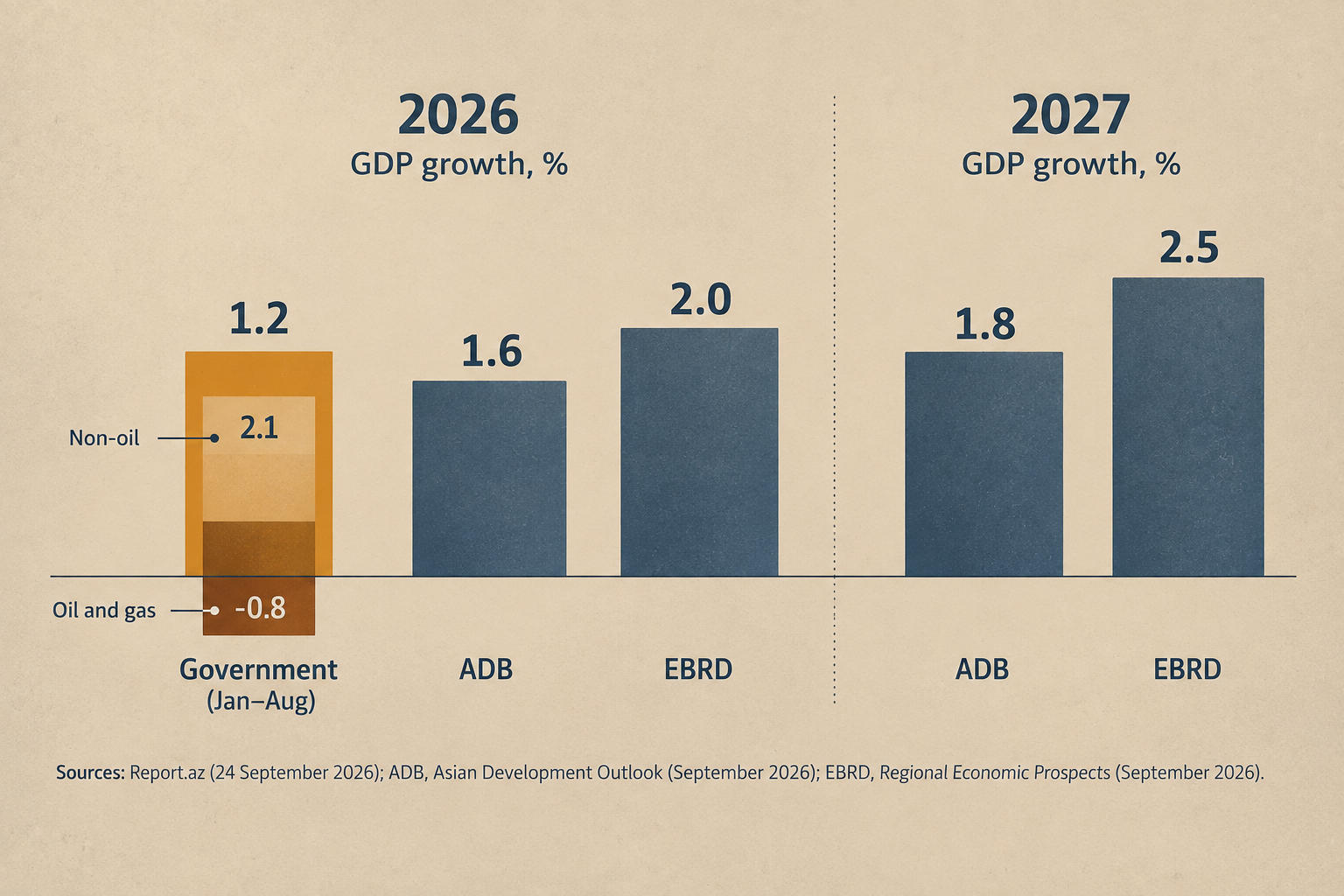
Azerbaijan drafts its 2027 to 2030 strategy on a 1.2% year, with $91 billion in reserve, 5.6% of GDP in debt and 8.8 billion manat for defence
The drafts of a new development strategy for 2027 to 2030 and of the second State Programme of the Great Return have been discussed at the Economic Council and presented to President Aliyev, Report.az wrote on Thursday at 15:44, quoting prime minister Ali Asadov, and the numbers around them describe the year the strategy is written in: growth of 1.2% in January to August, 2.1% outside oil and gas and a fall of 0.8% inside it, strategic currency reserves of about $91 billion, external state debt of $4.5 billion or 5.6% of projected GDP, a trade surplus above $10 billion in 8 months and inflation of 5.7%, with 5.3% forecast for 2027. Approval is expected in the coming months, Report.az wrote.
Berdimuhamedov gives the Halk Maslahaty a 6.3% year, 41.2 billion manat of investment and 5,300 jobs and asks it for an industrial strategy to 2045
President Serdar Berdimuhamedov told the Halk Maslahaty’s session in Ashgabat that Turkmenistan’s growth “will amount to 6.3 percent” by the end of the year, that capital investment “will amount to over 41 billion 200 million manat” and that the jobs created by the year’s end “will amount to about 5 thousand 300”, the state portal’s text of the speech published late on Wednesday shows. The grain harvest delivered “over 1 million 400 thousand tonnes”, the cotton growers “will deliver 1 million 250 thousand tonnes”, the silk farms produced “over 2 thousand 100 tonnes of cocoons”, and the independence holiday will run 3 days, “27, 28 and 29 September”. He asked the session to adopt a National Strategy of Industrial Development for 2030 to 2045.
Kazakhstan’s Kurultai ratifies a framework with the AIIB for about $6 billion of concessional money over 5 years, at 1 to 1.5% a year, for 3 roads and a railway
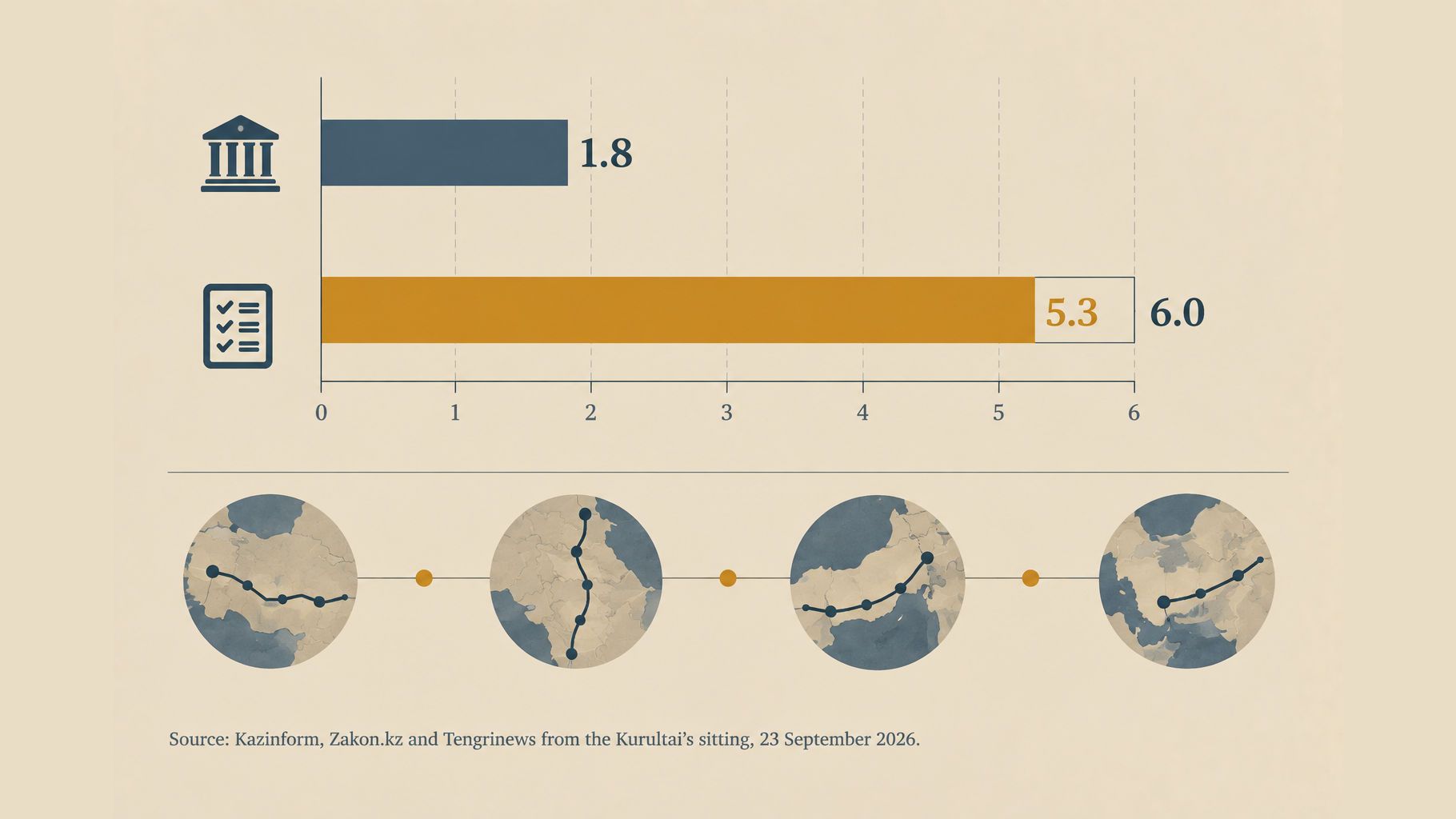
The Kurultai adopted in 2 readings on Wednesday the law ratifying Kazakhstan’s framework partnership agreement with the Asian Infrastructure Investment Bank, signed in February during the visit of the bank’s president Zou Jiayi, Kazinform and Zakon.kz reported. Deputy prime minister and national economy minister Serik Zhumangarin told the deputies the agreement lets the government draw “long money” on concessional terms of about $6 billion in the first 5 years after ratification, at 1 to 1.5% a year, for 17 projects worth $5.3 billion in transport, energy, health and green finance: the Zhezkazgan-Karaganda, Aktobe-Karabutak-Ulgaisyn and Atyrau-Dossor roads and the Moyynty-Kyzylzhar railway among them.
The ADB and the EBRD publish their autumn forecasts a day apart: Central Asia and Mongolia grow 5.8% on one count while the Caucasus slips on the other
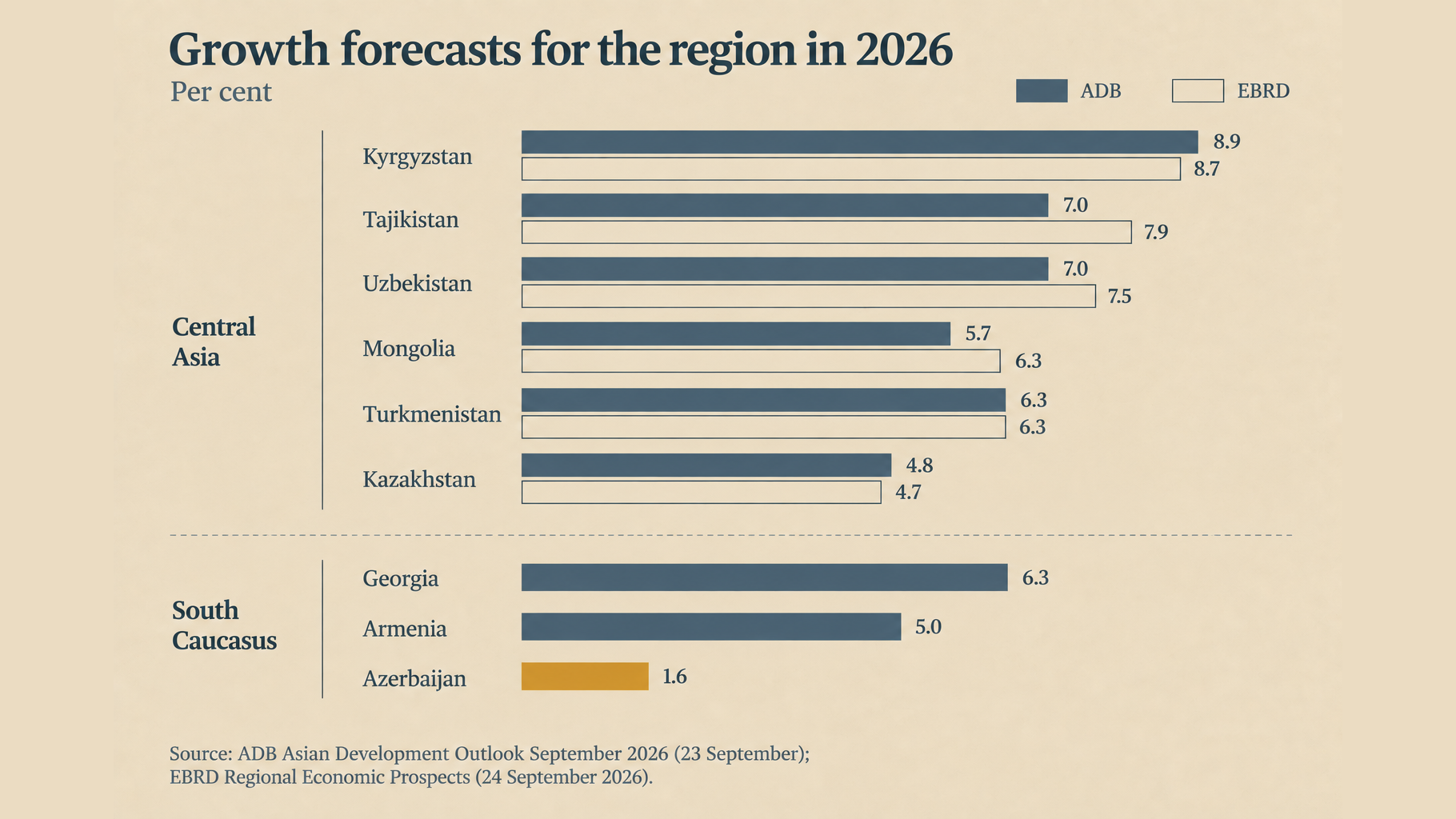
The European Bank for Reconstruction and Development put Central Asia and Mongolia at 5.8% growth in 2026 and 5.3% in 2027 in its Regional Economic Prospects published on Thursday: Kyrgyzstan 8.7% this year, Tajikistan 7.9%, Uzbekistan 7.5%, Mongolia and Turkmenistan 6.3%, Kazakhstan 4.7%. The Asian Development Bank’s September Outlook, published on Wednesday, raised Uzbekistan to 7.0% from 6.7% after an 8.5% first half and Georgia to 6.3% from 5.5%, cut Tajikistan to 7.0% from 7.3% and Azerbaijan to 1.6% from 2.0%, and left Kazakhstan at 4.8%, Kyrgyzstan at 8.9%, Turkmenistan at 6.3%, Armenia at 5.0% and Mongolia at 5.7%. Its subregion, the Caucasus and Central and West Asia, slips to 3.7% for 2026 and 4.1% for 2027, a tenth of a point down on July on both years.
Remittances to Kyrgyzstan fall to $279.5 million in July, 12% below a year earlier, with Russia sending 9 dollars in 10
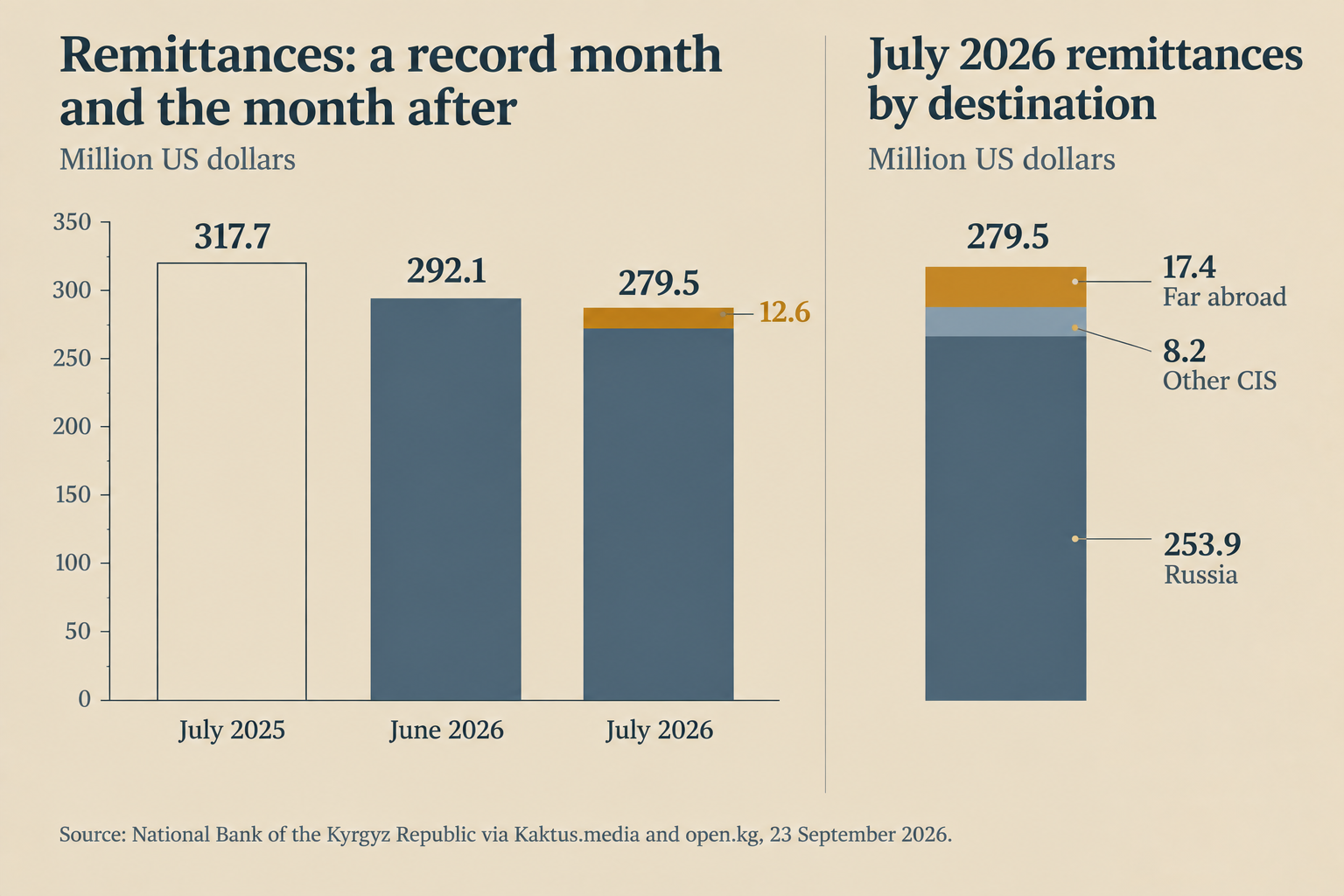
Individuals sent $279.5 million to Kyrgyzstan in July, the National Bank’s figures show: $262.1 million from CIS countries, $253.9 million of it from Russia, and $17.4 million from further abroad. The month is $12.6 million below June’s record of $292.1 million and $38.2 million below the $317.7 million of July 2025, a fall of 12% on the year; money sent out of the country fell to $24.4 million from $35.5 million in June, $21.8 million of it to the CIS.
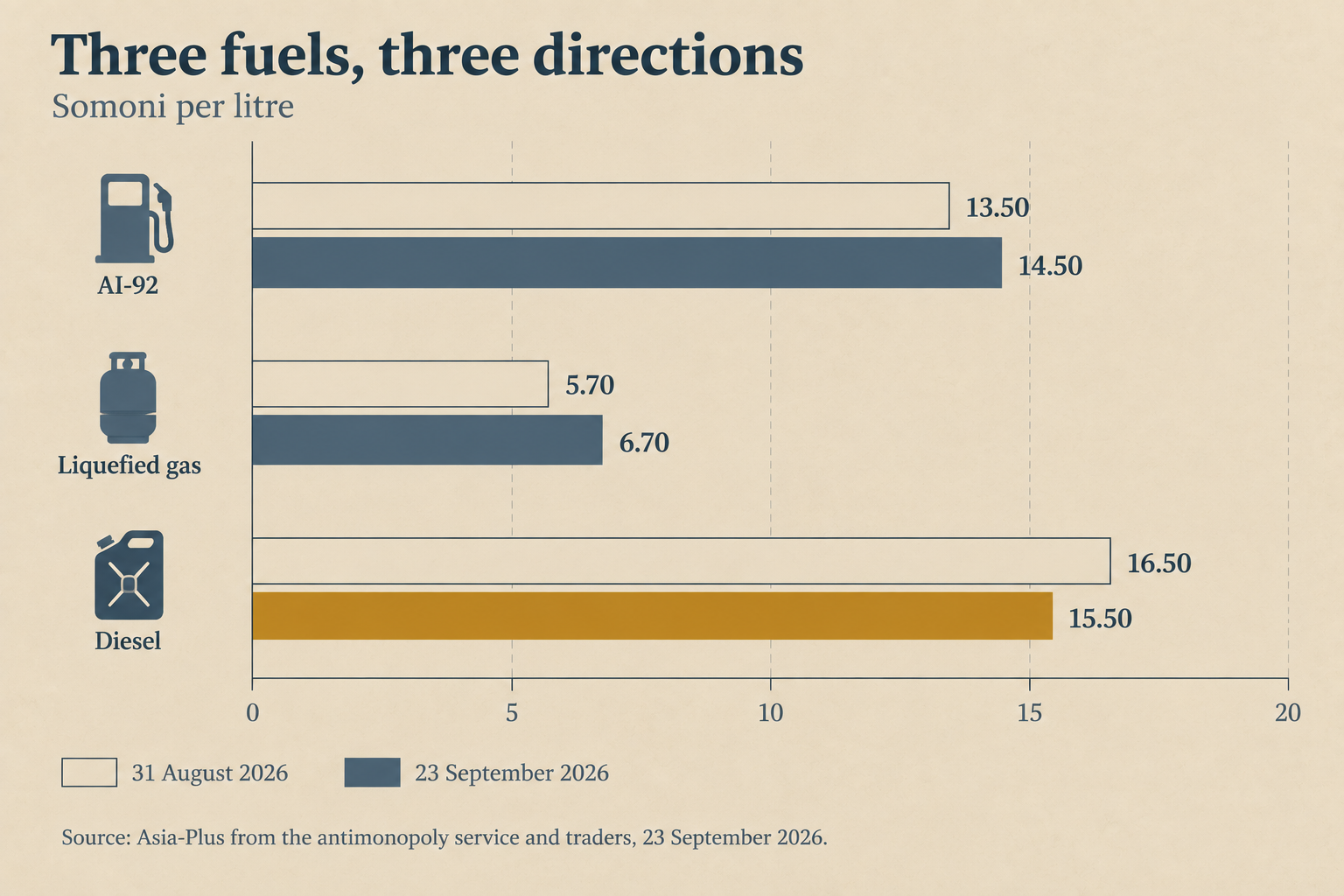
Diesel in Dushanbe falls 6% as Russian deliveries triple, while petrol rises 7.4% and liquefied gas 18% in 3 weeks
AI-92 petrol in Dushanbe costs about 14.50 somoni a litre against 13.50 at the end of August, liquefied gas 6.70 against 5.70 and diesel 15.50 against 16.50, Asia-Plus reported on Wednesday: petrol up about 7.4% in under a month, gas up about 18%, diesel down about 6%. The diesel fall follows Russia’s August deliveries of more than 56,000 tonnes against about 16,000 in July, a 3.5-fold rise; the reasons the authorities have given for the petrol rise are the world market, export restrictions in producing countries and transport costs.
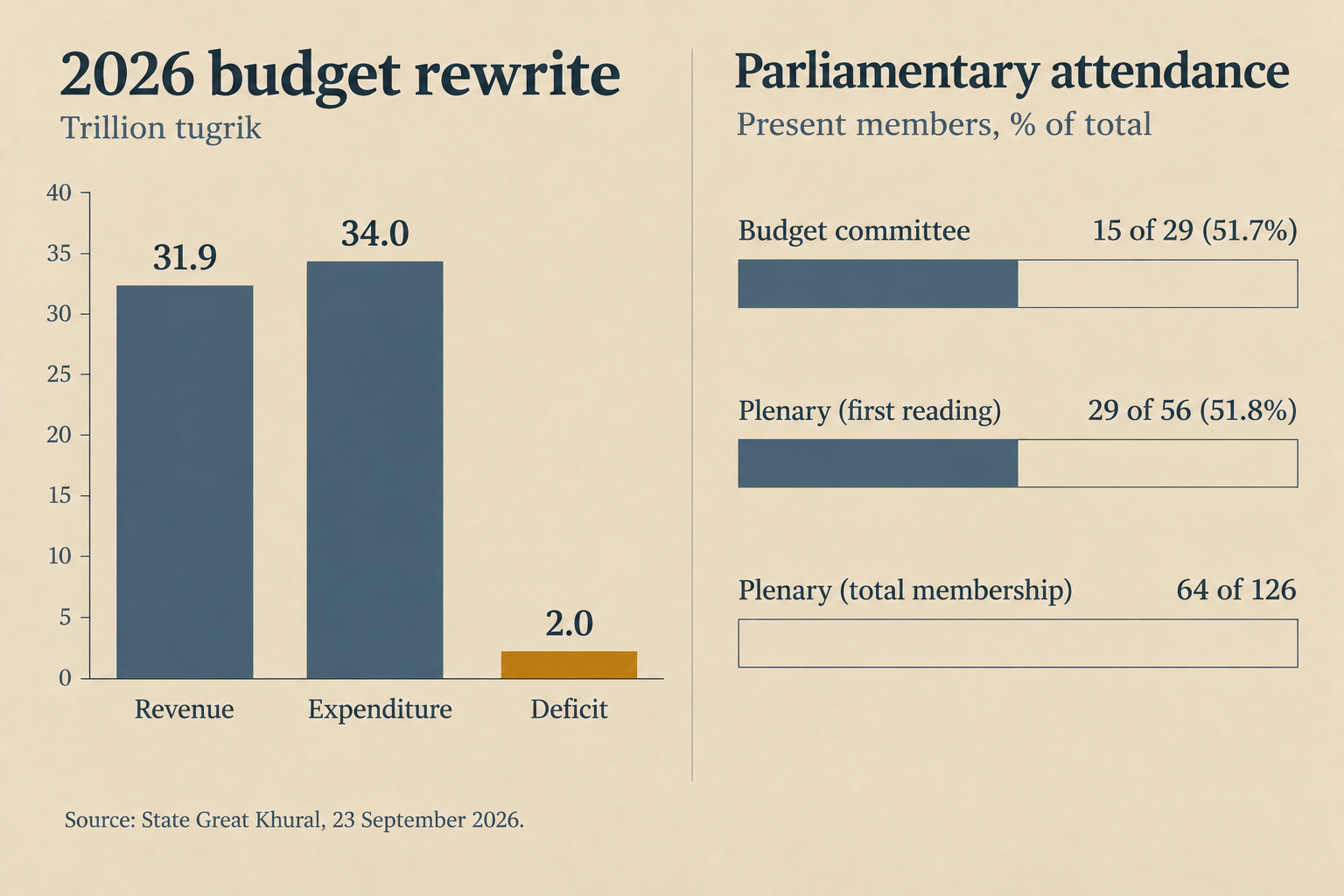
Mongolia’s committees clear the 2026 budget rewrite’s third reading with a 2 trillion tugrik deficit and back $450 million from the ADB and the ¥158.3 billion airport loan on one day
The State Great Khural’s security and foreign policy committee took the third reading of the 2026 budget amendment on Wednesday with 15 of its 29 members present and sent its conclusions to the budget committee, the parliament’s site reported: balanced revenue of 31.9 trillion tugrik, expenditure of 34.0 trillion and a deficit of 2.0 trillion, with 107.3 billion for tariff-loss subsidies, 92.7 billion for power stations, 150.0 billion for food reserves, 170.1 billion for wage rises and 1,440.9 billion in savings. On the same day a joint sitting of the budget and security committees, 29 of 56 members present, backed the government’s 2 loan drafts, the Asian Development Bank’s $450 million “financing general programme” by 56.3% of those present and Japan’s ¥158.3 billion loan for the Chinggis Khaan airport by 66.7%, and sent its minutes and conclusions to the government.
Mongolia’s parliament committee backs a 158 billion yen Japanese loan at 1.1% to expand the Chinggis Khaan airport by 2034
The State Great Khural’s economic standing committee voted on Wednesday to support the government’s request to negotiate an exchange of notes with Japan and a loan agreement of up to 158,284,000,000 yen at 1.1% a year, with the principal free of repayment for the first 10 years, for the expansion of the Chinggis Khaan International Airport, the parliament’s site reported. It adds 81,900 square metres to the airport and is timed for operation in 2034; finance minister Z. Mendsaikhan presented it, and 59.4% of the members present supported it. From the committee its opinion goes to the budget committee and to the security and foreign policy committee.

Aliyev weighs a 5.3 billion manat mining programme to 2030 that must first re-count reserves last measured 40 years ago
President Ilham Aliyev chaired a meeting on Tuesday on the draft State Programme for the development of the mining and metallurgical industry for 2027 to 2030, AZERTAC reported at 14:35. Economy minister Mikayil Jabbarov put the investment at 5.3 billion manats over the 4 years, 1.1 billion from the state budget, 2.2 billion from state companies and 2 billion from private funds, with the sector’s contribution to GDP to rise from 700 million to 1.8 billion manats and its exports from 1.3 billion to 3.4 billion by 2030. The president’s own condition came before the targets: the reserve figures date from Soviet times, about 40 years ago, and are out of date.
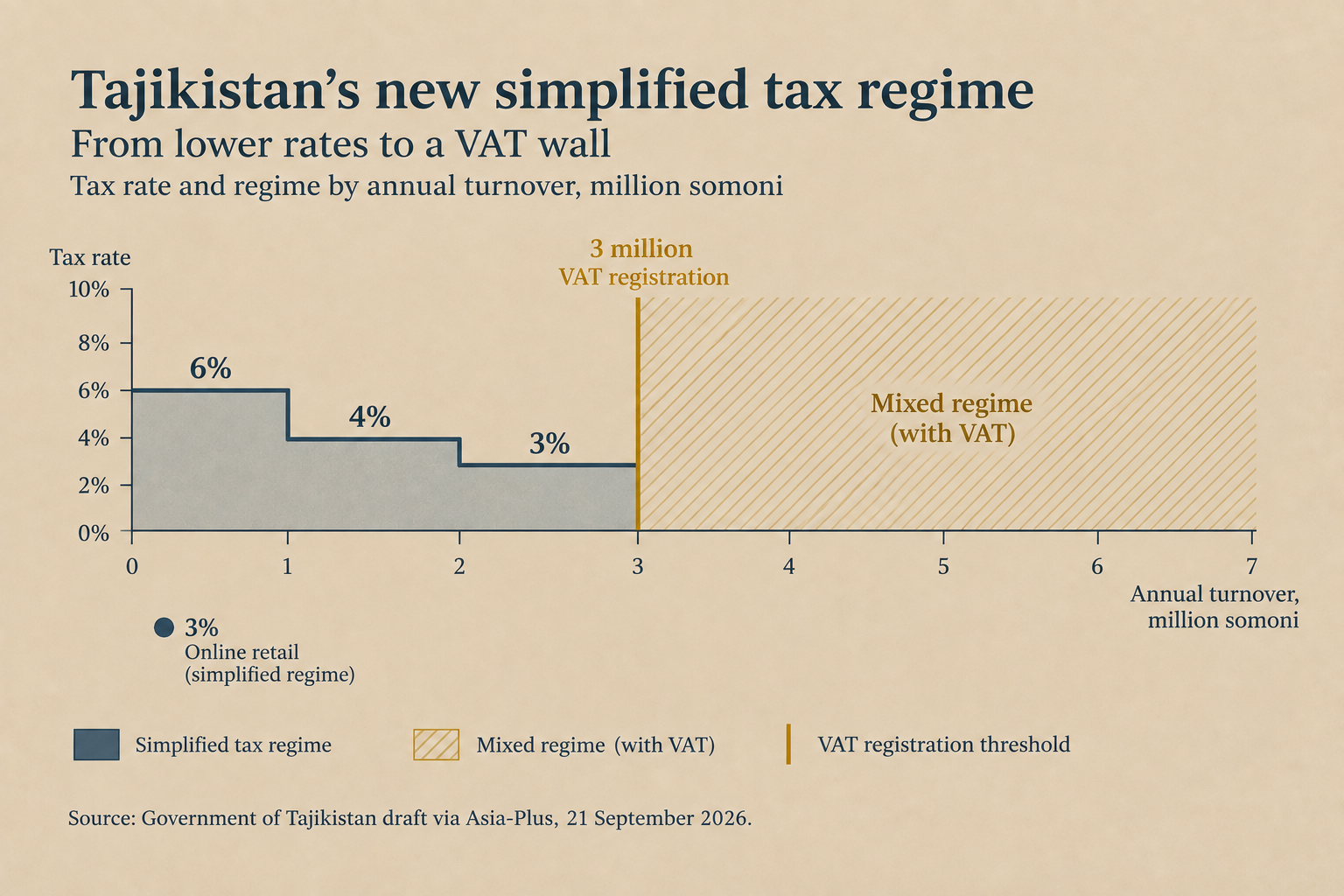
Dushanbe’s tax bill triples the VAT threshold and taxes online shops at 3%, and 12 trades lose the simplified regime
Tajikistan’s government has sent parliament a package of Tax Code amendments that raises the turnover at which a business must register for VAT from 1 million to 3 million somoni, sets 3% as the simplified rate for firms between 2 and 3 million, puts a 3% turnover tax on online retail and removes construction, consulting, audit, medicines, markets and 7 other lines of business from the simplified regime altogether, Asia-Plus reported on Monday. The package arrives 10 days after the World Bank published a framework under which its grants to Dushanbe are expected to become credits from the fiscal year that began in July.
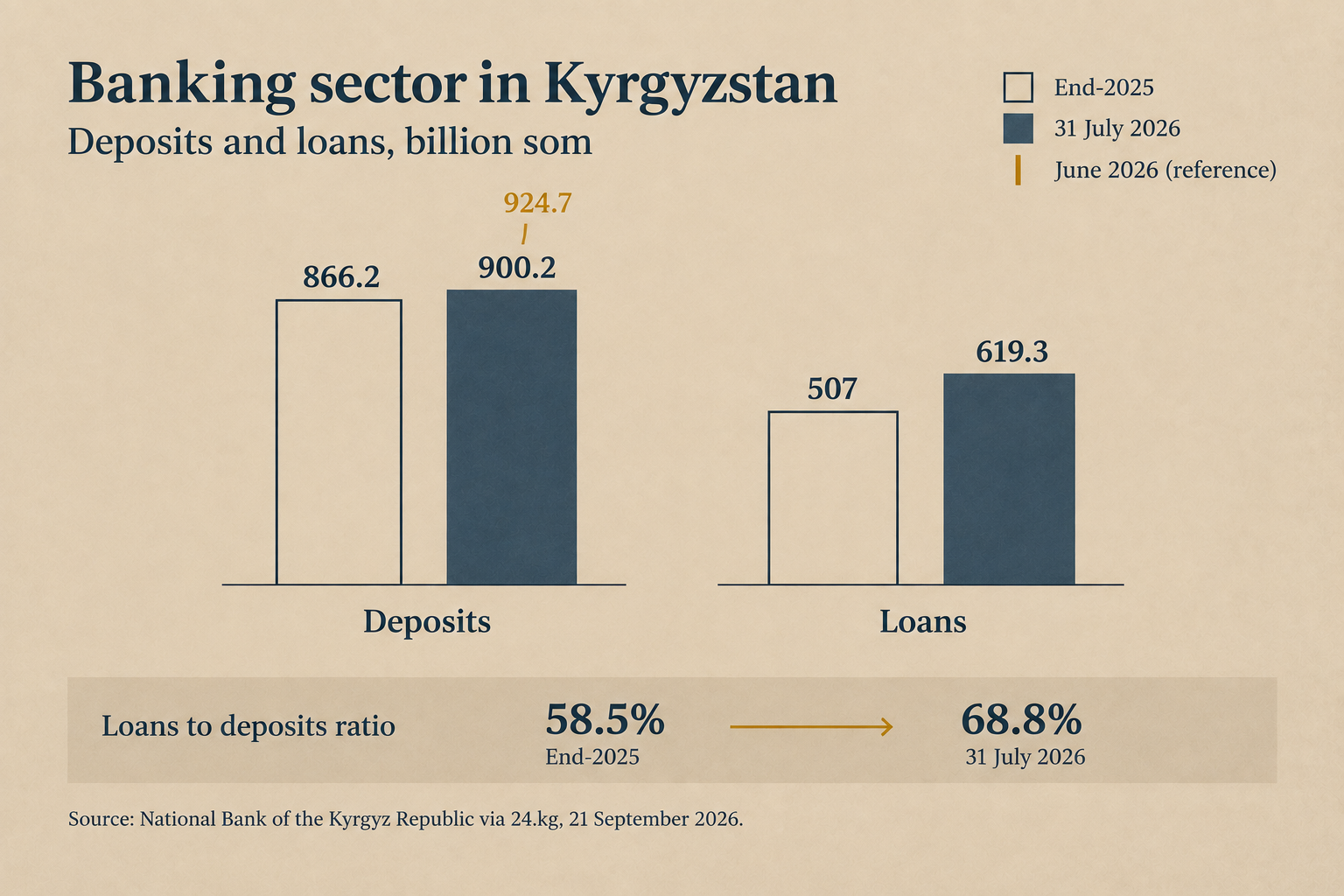
Kyrgyz banks lost 24.5 billion som of deposits in a month; the central bank calls it company payments as lending runs 22% above December
Deposits in Kyrgyzstan’s banks stood at 900.2 billion som on 31 July, 24.5 billion or 2.7% below June, and the sector’s assets fell 6.4% in the month. The National Bank told 24.kg on Monday that scheduled payments by companies and the state explain the moves and that the banks hold “a substantial margin of safety”.
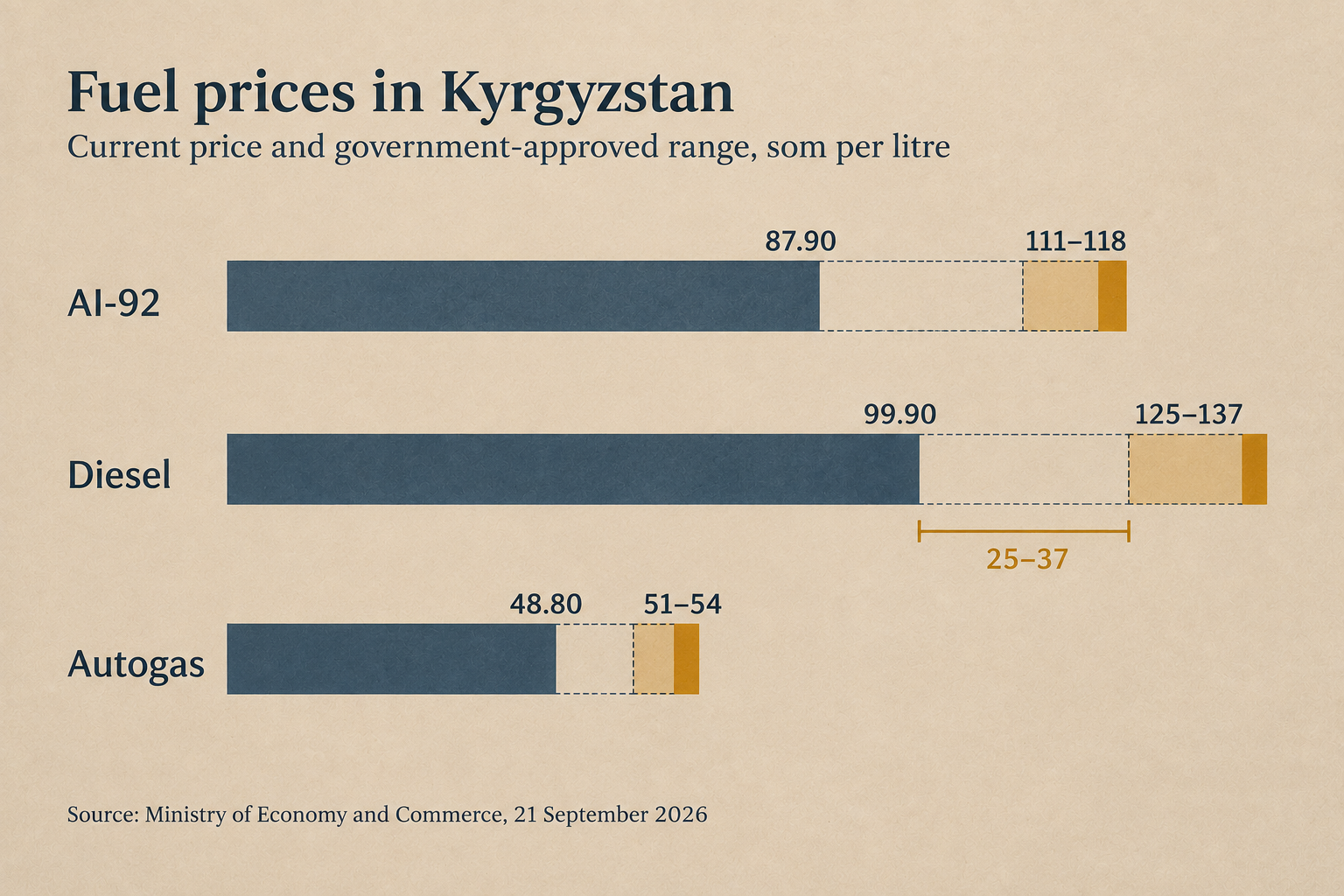
Bishkek tells parliament it cannot hold pump prices next year, with 39 billion som pledged against inflation and an election on 27 January
Kyrgyzstan’s first deputy cabinet chairman, Daniyar Amangeldiev, told a parliamentary committee on Monday that the state pays “practically 40%” of the fuel price and that “next year we will not be able to hold it and will reduce it”. At the same sitting he put 39 billion som, about $446 million at Monday’s official rate, against inflation in 2027, naming fuel first. The compensation scheme that keeps AI-92 petrol at 87.90 som a litre runs to 31 December, 27 days before the presidential election.

A Rio Tinto mine outlives a government: Mongolia and the second deal
Mongolia’s parliament formally instructed the government to secure at least 53% of the economic benefit from the Rio Tinto-operated Oyu Tolgoi mine. Months later Rio Tinto and Ulaanbaatar agreed to cut financing and management costs and set 2027 as the target for the first dividends, and the public documents do not yet show the parliamentary requirement met in full. Madagascar, Bougainville and Juukan Gorge place the Mongolian case inside a wider pattern: Rio Tinto’s mines run for decades while the governments, contracts and communities around them change.
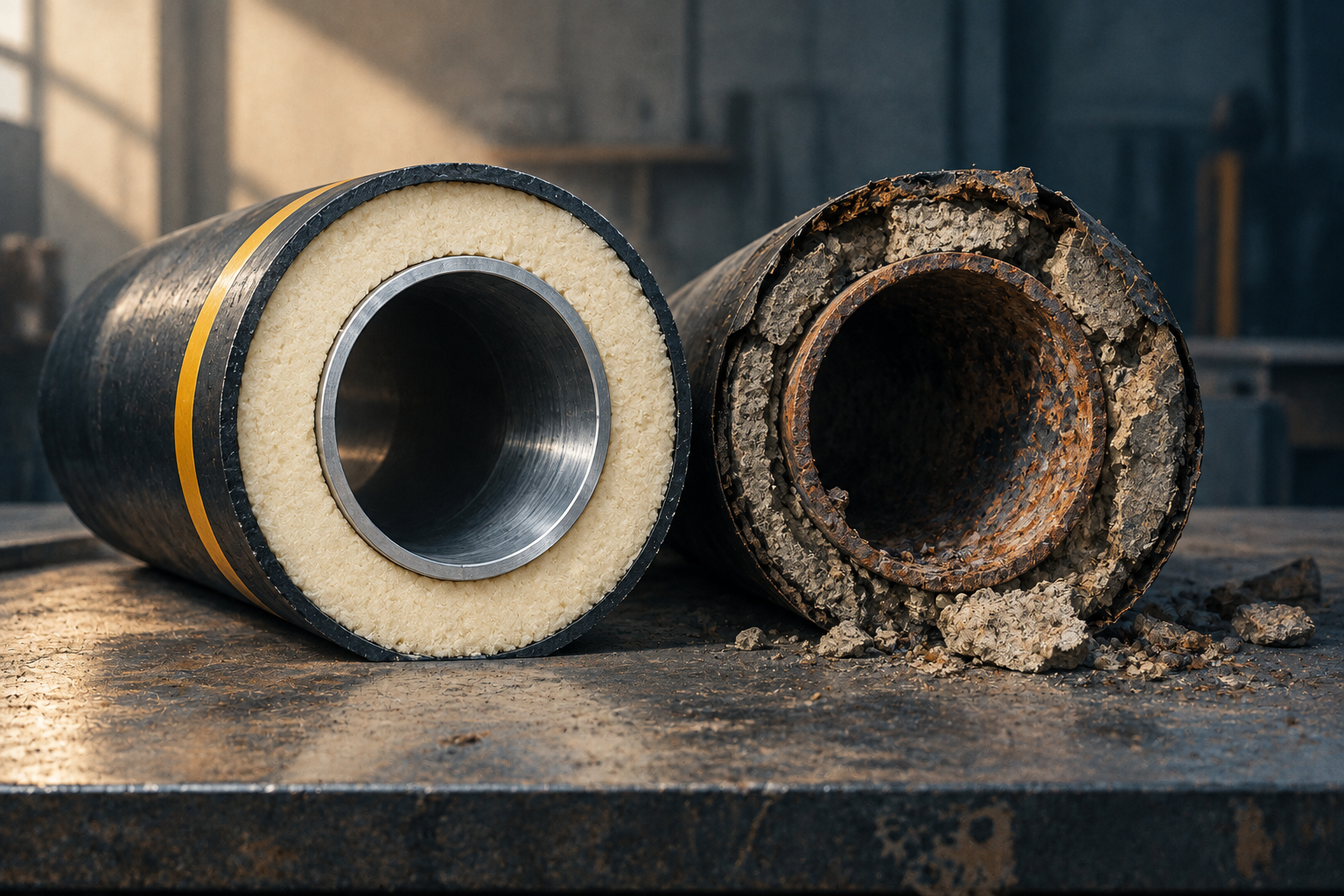
Kazakhstan's utilities overhaul has finished 14 of 347 projects as contractors win 112 complaints against its tenders
A deputy prime minister's review on Friday put the government's own numbers on the national project meant to renew Kazakhstan's utility and power networks by 2029. They show a programme budgeted at 13 trillion tenge and held up at the tender stage.