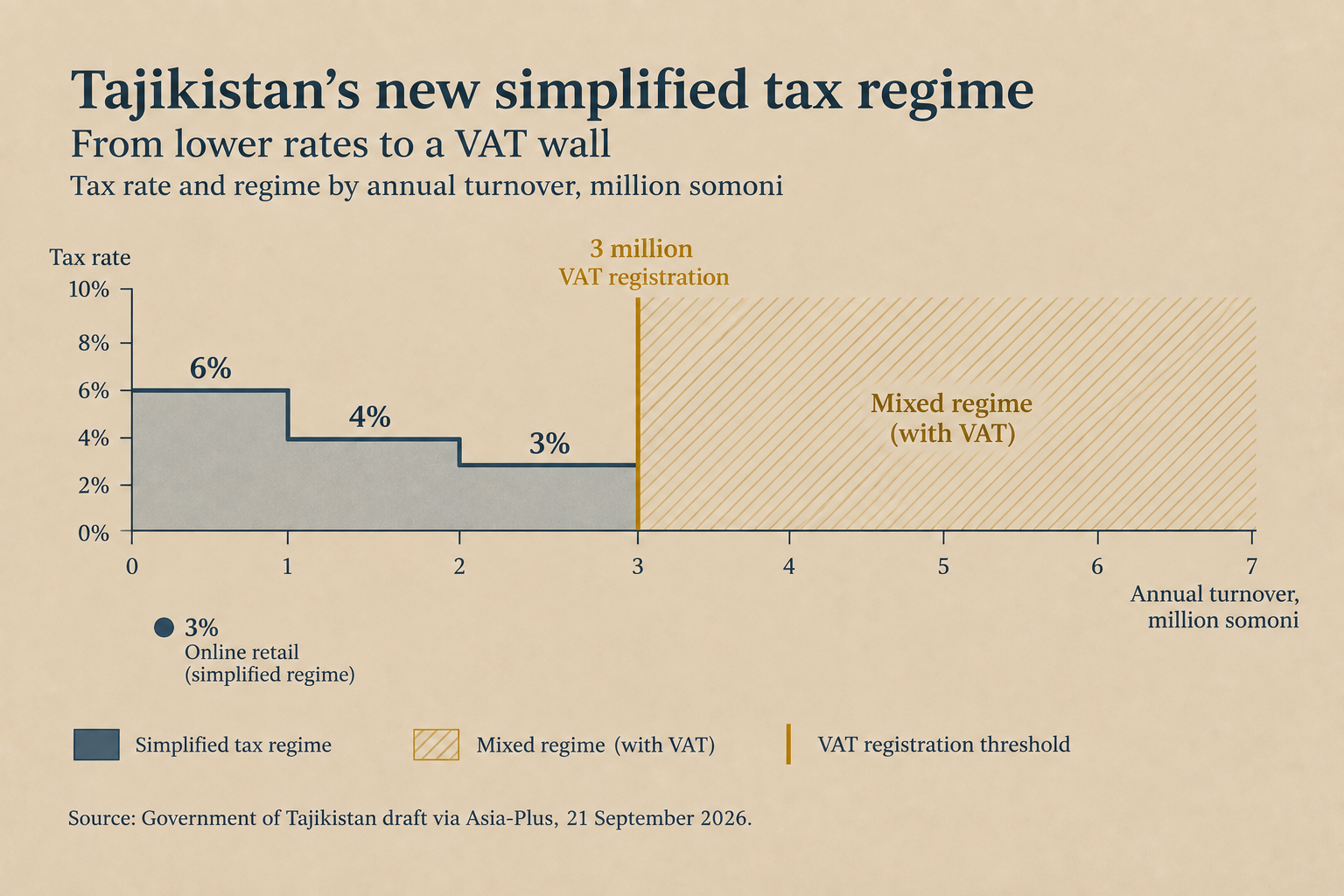
A government resolution approved the draft and sent it to parliament; the changes are proposals until the deputies vote, Asia-Plus noted in its account of the text. The core is a new staircase for the simplified regime: 6% of turnover up to 500,000 somoni a year, 4% between 500,000 and 2 million, and 3% between 2 and 3 million, the band that would end at the new VAT threshold. Above 3 million a firm registers for VAT; between 3 and 7 million a mixed regime of income and documented expenses applies.
The other half of the package narrows who may use the staircase at all. Residential and non-residential construction, consulting, audit, marketing, leasing, security services, the production and sale of medicines, manufacturing, markets and shopping centres, transport and logistics, and parts of retail and catering would leave the simplified regime and pay the general taxes. Online retail gets its own line: 3% of turnover.
Read together, the 2 halves move in opposite directions on purpose: a small trader with 2.5 million somoni of sales would pay 3% instead of registering for VAT, and a construction firm of any size would leave the flat rate. The state is giving up a little on the smallest businesses and reaching for the sectors where the money is.
The timing is the World Bank’s. On 11 September the Bank published the conditions of its partnership framework for 2026 to 2032: up to $1.8 billion over 7 years, of which $1 billion to $1.2 billion from the International Development Association, and from the Bank’s 2027 fiscal year, which began on 1 July, that money is expected to come as credits, because Tajikistan’s income per head “has risen to a level at which it no longer qualifies for the previous grant-financing regime”, Asia-Plus quoted the framework as saying. Tax and financial-sector reform sit in the framework’s list of priorities beside Rogun and Nurek.
The state is giving up a little on the smallest businesses and reaching for the sectors where the money is.
The revenue side of Rogun is already priced. Electricity tariffs rose on 1 February, to 41.37 dirams a kilowatt-hour for households from 35.38, and to 94.65 dirams for industry from 80.90; the IMF’s staff wrote in December that a further rise was expected in 2026 “as part of their effort to reach cost recovery by 2027”. The tax package is the other side of the same ledger: a state moving from grants to credits is widening the base that pays for them.
What the package does not say is what it yields. The government’s text as reported carries no estimate of the revenue the new bands, the online-retail tax or the sector exclusions would bring in, and no date for the changes beyond parliament’s vote.