The ADB programme is 2 instruments in one: $200 million of budget support and a $250 million credit line for disaster contingencies. Finance minister Z. Mendsaikhan told the joint sitting that the bank had lent Mongolia up to $100 million in budget support until now and that the talks had doubled it to $200 million, with $50 million of that on highly concessional terms. The airport loan, which the economic committee had backed by 59.4% in the morning, is Japanese money on STEP terms: 40 years, the first 10 free of principal, 1.10% a year, for a passenger terminal of 81,900 square metres to be built between 2028 and 2033.
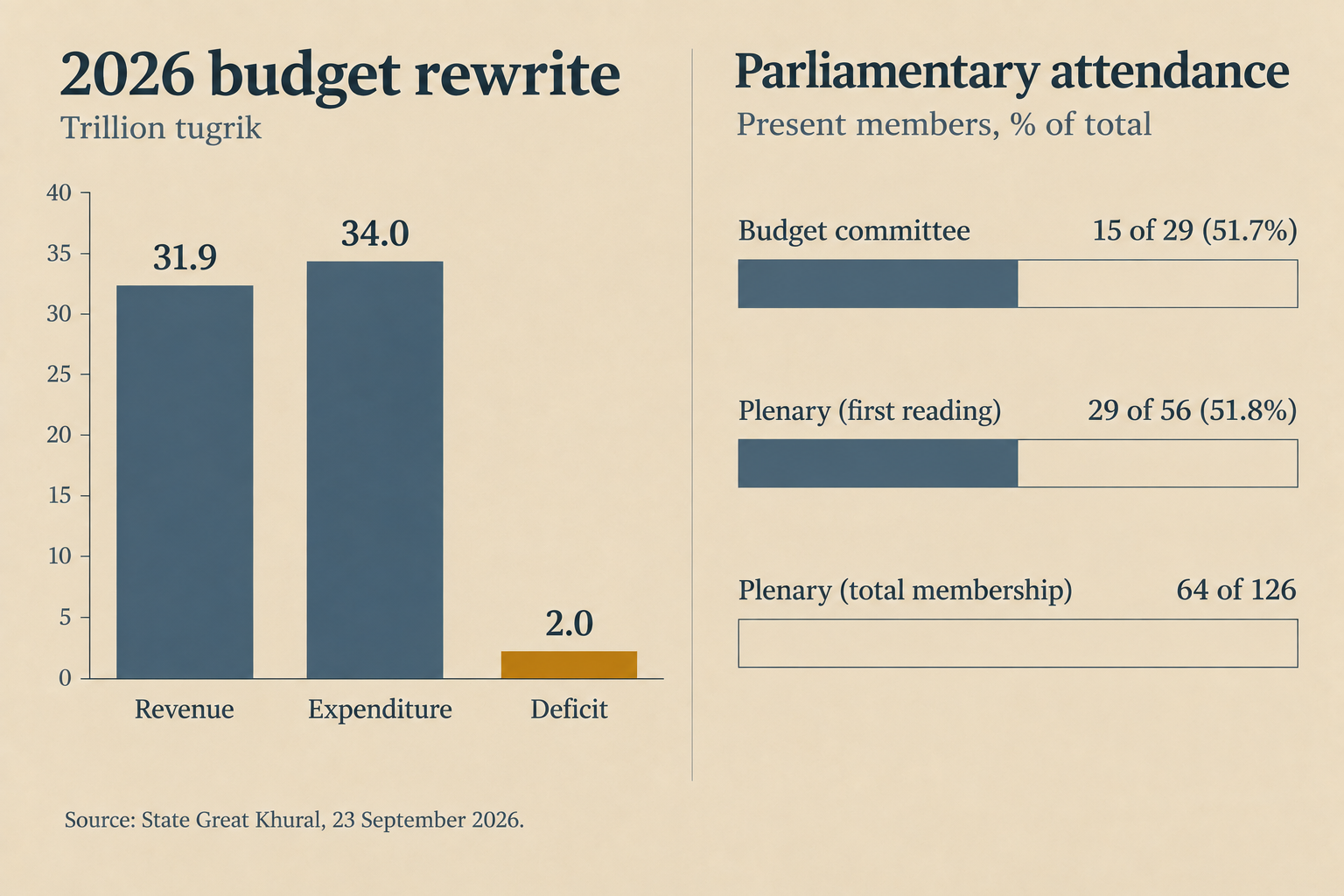
The rewrite these committees are clearing is the one the plenary could not reach for a week. Twice the house failed to make its quorum of 64, on Thursday and on Monday; it opened on Tuesday with 75 registered, seated a justice minister and did not get to the budget; on Wednesday the committees sat at 51.7% and 51.8% and voted. Every vote on Wednesday was taken at half attendance. The security committee’s sitting also ran the first reading of a separate amending law and forwarded 2 labour-convention bills to its next sitting, where the vote on them is due.
The deficit of 2.0 trillion is 5.9% of the 34.0 trillion the rewrite spends, and the 4 allocations the committee listed come to 520.1 billion against 1,440.9 billion of savings the page records without itemising. Of the 4, the tariff-loss line, 107.3 billion, is what the budget pays the power companies for the gap between their tariffs and their costs; the 150.0 billion for meat, wheat and vegetable reserves is the state’s stock against winter prices; the 170.1 billion for wages and the pension rise dated 1 November, which the government has said the coal company’s 1.5 trillion tugrik dividend pays for, are the items the quorum fight has held up.
Every vote on Wednesday was taken at half attendance.
The same day’s cabinet session heard deputy prime minister Dorjkhand Togmid present a plan to lift foreign direct investment to $5.5 billion a year by 2028, in 5 lines of work from the legal environment to an “aftercare” system for investors, Montsame reported; the cabinet’s page records the presentation and no decision. The 2 loans, $450 million and ¥158.3 billion, are the foreign money the parliament can count this week; the plan is the money it hopes for in 2 years.
From here the budget goes to the budget committee and then to the floor, where the third reading needs the 64 members the house has found once in 3 attempts; the loan drafts go to the government to sign. A committee majority at half attendance is a reading, and a plenary majority is a law. The distance between the two is the 30 Mongolian People’s Party members whose former Speaker counts them as his.