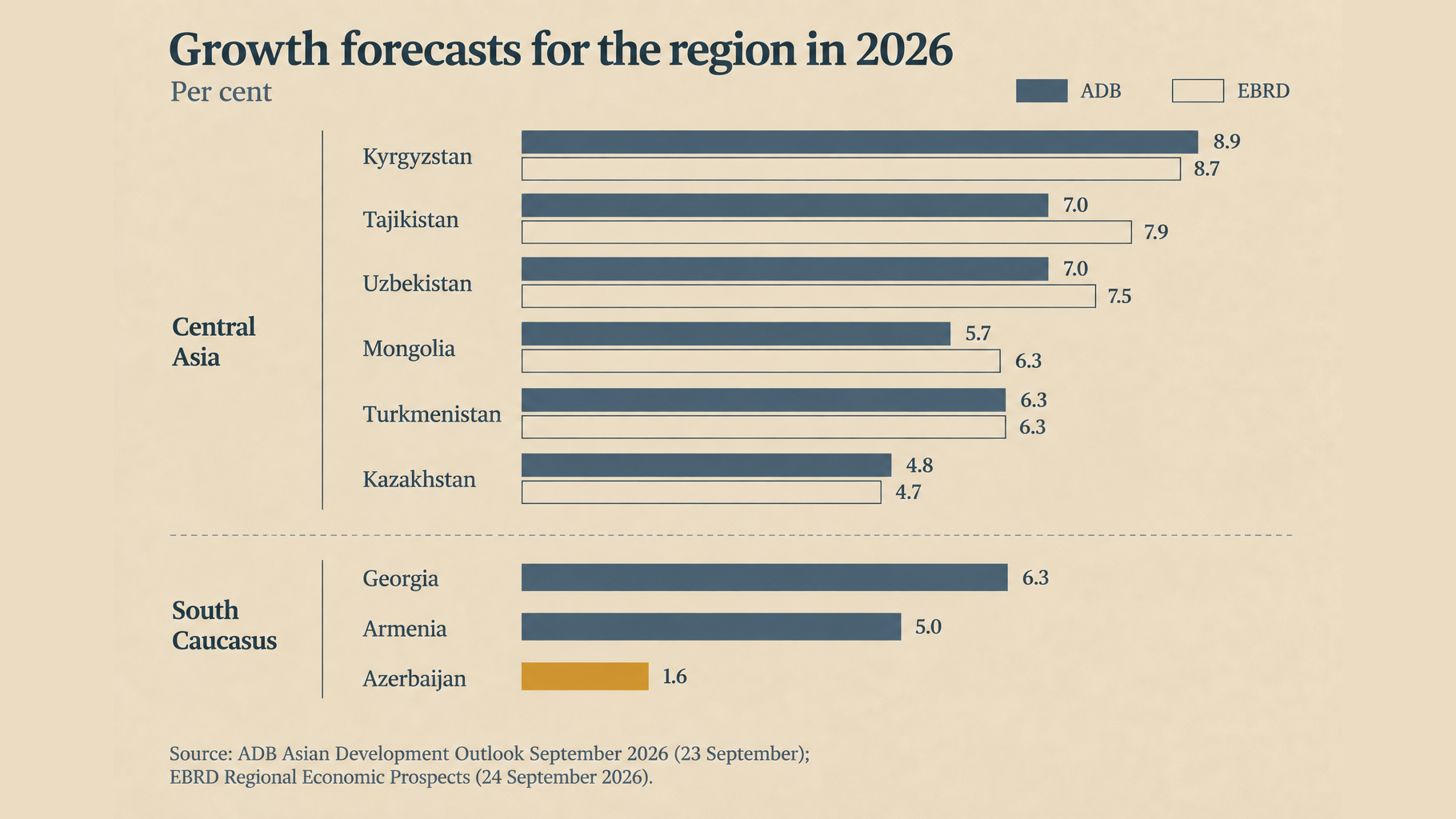
For 2026 the 2 banks agree on Turkmenistan to the decimal and on nothing else. Where they differ they name the reason. The EBRD holds Kazakhstan a tenth below the ADB and writes the Caspian Pipeline Consortium into the sentence: “Disruptions along the Caspian Pipeline Consortium export route” affected output, the country’s oil going to market through Novorossiysk, where the tankers have been loading between drone strikes since August. It puts Uzbekistan half a point above the ADB, at 7.5%, and lists “prolonged disruptions to Russian fuel supplies” as the risk on the downside; it puts Tajikistan 9 tenths above, at 7.9%, on remittances and on exports that “increased significantly, by 57.2 per cent year on year”, and Mongolia 6 tenths above, at 6.3%, on coal output up 52.4% and with “weaker demand from China” as the risk.
The ADB’s revisions are the Caucasus’s. Azerbaijan loses 4 tenths for 2026 because “contraction in the oil sector has also lowered Azerbaijan’s growth projection”, its 2027 held at 1.8%; Georgia gains 8 tenths because “activity exceeding expectations and regional spillovers remaining limited” lifted the year to 6.3%, its 2027 held at 5.2%; Armenia stays at 5.0% and 5.5%. The subregion’s downgrade, the bank says, “reflect[s] lower growth projections for Azerbaijan, Tajikistan, and Türkiye”. Tajikistan’s cut, to 7.0%, comes “amid the impact of Russia’s war in Ukraine”, the one revision the bank attributes to the war.
For 2026 the 2 banks agree on Turkmenistan to the decimal and on nothing else.
Inflation is where the ADB’s table is least kind: Kyrgyzstan 11.2% this year, Kazakhstan 10.4%, Uzbekistan raised to 6.7%, Turkmenistan 6.0%, Azerbaijan raised to 5.9%, Georgia raised to 5.2%, Tajikistan 4.5%, Armenia 4.2%. For developing Asia as a whole the bank sees 5% growth this year and 5.1% next, from 5.5% in 2025, and its president, Masato Kanda, put the mood in a sentence: “The region has remained resilient, but the risks are growing.”
The 2 documents are read in the same finance ministries, and the gap between them is the size of a policy argument. A Tajik budget written to 7.9% and one written to 7.0% are different budgets; an Uzbek plan at 7.5% needs the Russian fuel the EBRD warns about, and a Mongolian one at 6.3% needs the Chinese coal demand the same bank flags. Kazakhstan is the country both banks read the same way, within a tenth, and the EBRD writes the reason into its sentence: the pipeline to Novorossiysk, which no bank controls.