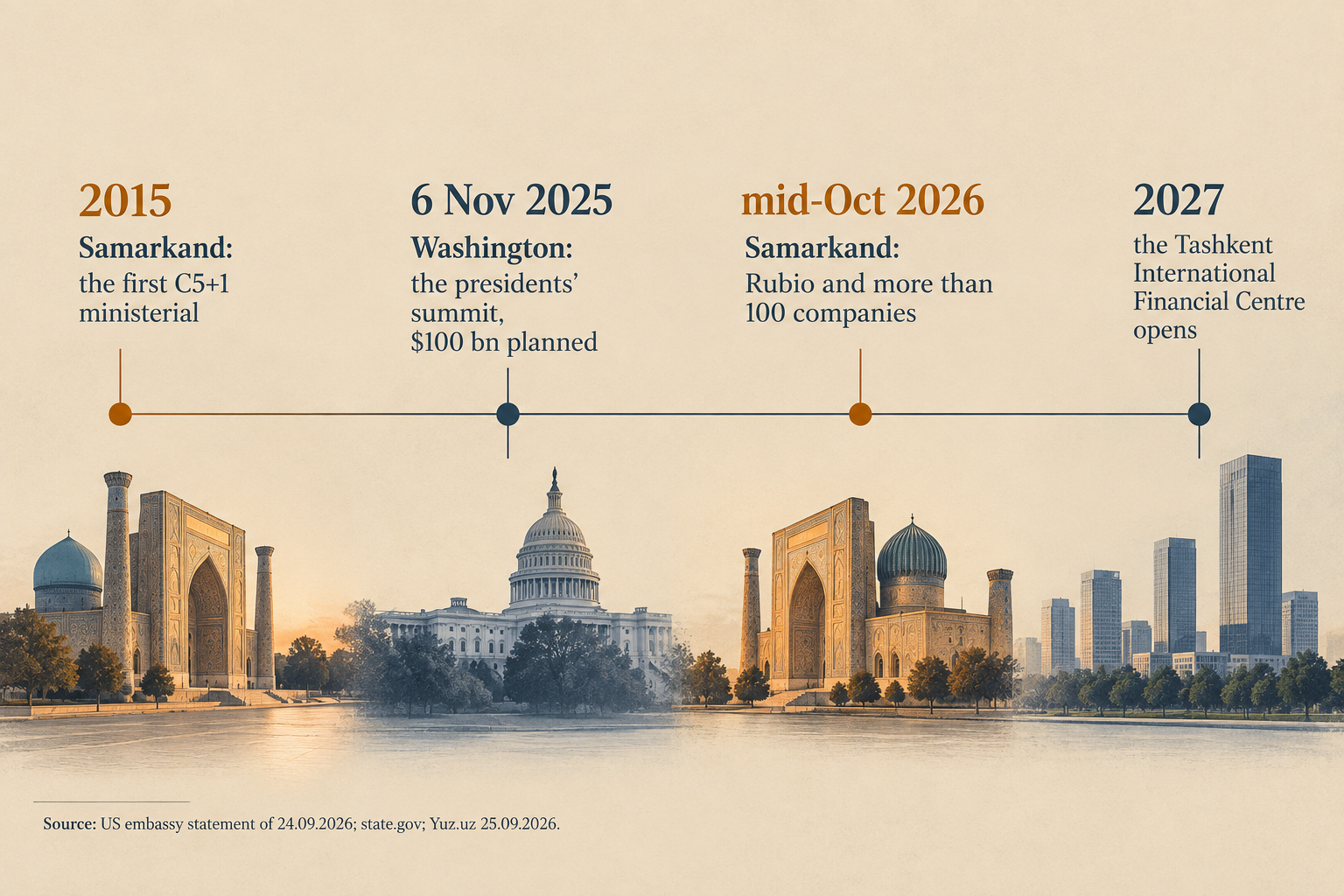
Gor’s statement, posted by the US embassy in India on Thursday, gives the ministerial’s agenda in three phrases, “deepening regional economic connectivity, enhancing energy security, and promoting collaborative solutions to shared regional priorities”, and adds meetings with “Uzbekistani leadership and regional counterparts” on trade, private investment and “economic modernization across Central Asia”. Samarkand is where the format held its inaugural foreign ministers’ meeting in 2015, by the State Department’s own page, and the presidents met at the White House on 6 November 2025 with “over $100 billion in planned trade and investments” on the table. More than 100 companies follow the secretary of state to Samarkand.
The Times of Central Asia’s account of the same announcement recalls the “Deal Zone” of that summit, “more than $25 billion in announced commercial deals” with Boeing orders and mining investments among them, and dates the Samarkand meeting to mid-October without a day. A ministerial with a trade delegation of that size is the format’s return to its first city in its eleventh year, and the embassy’s own word for it is “historic”.
More than 100 companies follow the secretary of state to Samarkand.
BlackRock’s side of the morning came through the state outlet Yuz.uz at 08:32 Tashkent time and Spot at 09:31: Mirziyoyeva met Kapito, Donilon, Charles Hatami, who runs the firm’s Financial and Strategic Investors group, and Adebayo Ogunlesi, chairman and chief executive of Global Infrastructure Partners, and “the sides discussed the launch of the Tashkent International Financial Centre in 2027”. The centre she has run since 10 September was created by decree on 30 March and given its constitutional law on 10 July: the principles, legislation and precedents of England and Wales, a Tashkent International Commercial Court with exclusive jurisdiction, its own Financial Services Authority, a tax regime to 1 January 2076 and obligations that may be settled in foreign currency or crypto-assets, on the Tashkent City site. She had visited Astana’s AIFC in June, and her line to the Americans was that “Uzbekistan is opening up for large, high-quality investments”.
Friday put the region’s two suitors on one page. In Almaty, 300 Chinese companies watched 10 agreements signed with Kazakh regions and state companies and heard a president propose an annual dialogue; in Tashkent’s morning papers, the American calendar filled with a secretary of state, 100 companies, a ministerial and an asset manager drawing the legal architecture of a financial centre that may settle in foreign currency or crypto-assets under English law. The C5+1 that began in Samarkand in 2015 as a foreign ministers’ table returns as a trade mission, in the week after the sanctions act of 18 September gave Washington tariff authority over third countries’ purchases of Russian energy and a Tehran to Dushanbe flight was turned back from Turkmen airspace with, in the airline’s words, the new American sanctions as the reason.