Central Asia Wire
Independent Central Asia Monitor
Breaking
The UK sanctions 4 Georgians for Kremlin disinformation and names Tskhinvali’s leadersKazakhstan’s inflation slows to 9.3% in September as the tenge opens the week at 447.73Turkmenistan reports 6.3% growth for 9 months and a budget collected to 100.1% of planFour German party foundations stop work in Georgia after Tbilisi rejects their grants
Economy

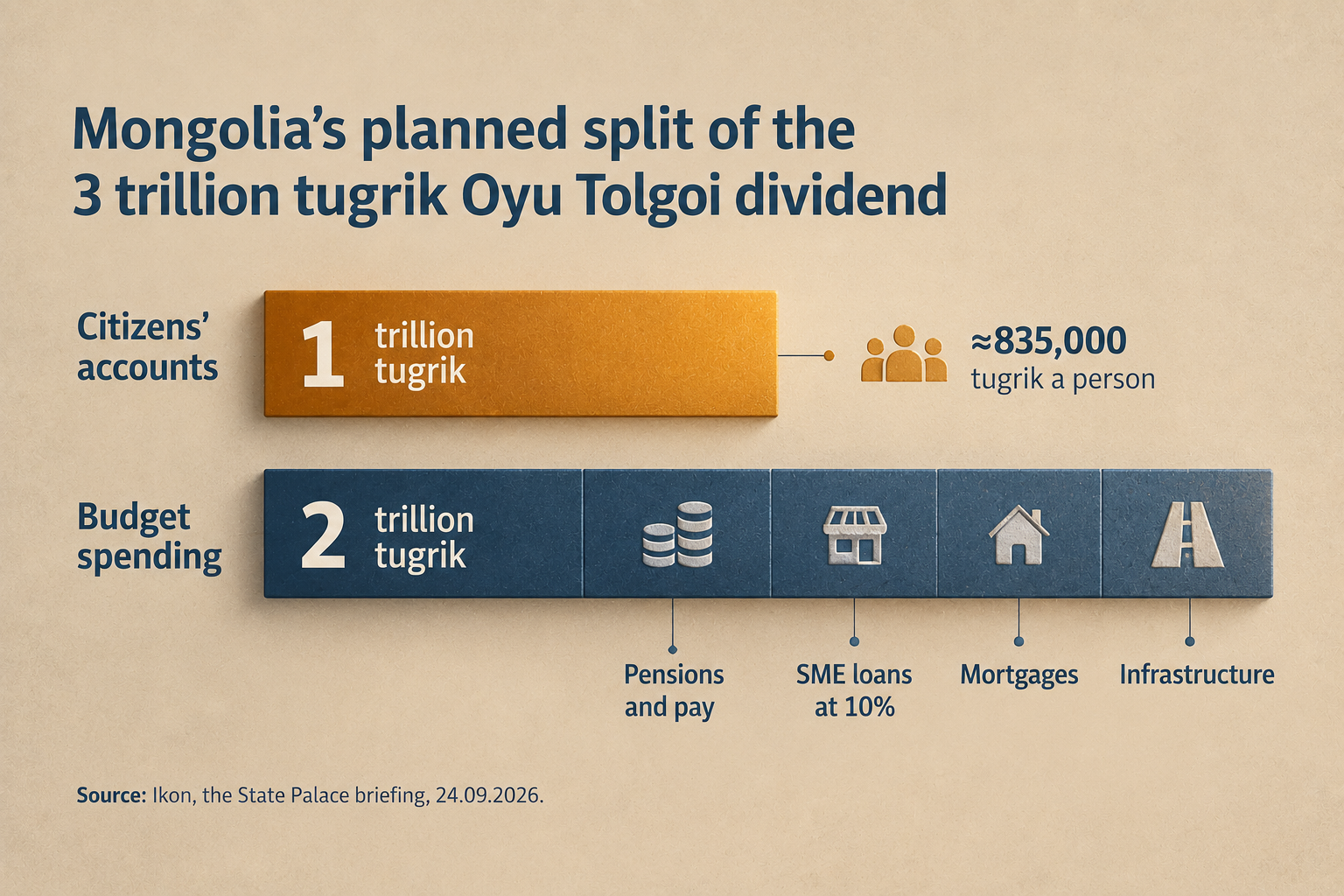
Mongolia’s finance minister splits the 3 trillion tugrik Oyu Tolgoi dividend before it arrives: 1 trillion to citizens’ accounts, 2 trillion to the budget, by a one-off law

Finance minister Z. Mendsaikhan told a briefing at the State Palace on Thursday that the 3 trillion tugrik dividend expected from Oyu Tolgoi in 2027 will be spent under a one-off law, since the dividend is not a permanent budget revenue: 1 trillion into citizens’ named accounts in the accumulation fund and 2 trillion into current budget spending, on pensions, civil servants’ pay, loans to small business at 10%, mortgages and infrastructure, Ikon reported at 14:48 Ulaanbaatar time. MP G. Ganbaatar had said in the same building at 12:05 that the National Wealth Fund law of 19 April 2024 sends the dividend to citizens’ accounts, about 835,000 tugrik a person, and that “assorted thieving projects” cannot be financed from it.

Bar chart of Mongolia's planned split of the 3 trillion tugrik Oyu Tolgoi dividend, 1 trillion to citizens' accounts in amber and 2 trillion to budget spending in slate, with a marker of about 835,000 tugrik a person.

Three trillion tugrik is about $835 million at the Mongolbank rate, and 835,000 a person is that sum divided by the population; the minister’s split would leave each citizen a third of it. Two trillion of the three would pass the fund by a law written for one year. The precedent is this year’s Erdenes Tavan Tolgoi money, where the dividend’s total, the budget’s earmark and the citizens’ share were 3 different figures.

The dividend itself is a date the government has moved more than once, from 2051 in the 2009 investment agreement to “autumn 2026” and now 2027, after the June rate adjustment that cut the interest on Rio Tinto’s shareholder loans. Ganbaatar’s objection is the fund law’s text; the minister’s answer is that a payment that does not recur should not be built into the budget’s base. Both are arguing over money that Oyu Tolgoi has not yet declared.

Two trillion of the three would pass the fund by a law written for one year.

The Khural that will vote the one-off law is the one that lost its quorum twice in the last 10 days and has not yet given the 2026 budget rewrite its third reading. A 2027 dividend split in a September briefing is a political document as much as a fiscal one, and the 835,000 tugrik a person is the figure the argument will be fought in.