He spoke in committee. The Jogorku Kenesh panel on industrial policy, transport, fuel and energy had him for questions on Monday. “You know very well what the real price of fuel is,” Kaktus quotes him as telling deputies. “The subsidy is practically 40% of the price. Next year we will not be able to hold it and will reduce it, depending on how the market develops.” 24.kg renders the same answer as: “next year we will not be able to contain the rise in prices, and we intend to lower the level of state support gradually”.
The money came second. The cabinet intends to hold inflation at 8% to 9%, he said, under a programme whose first line is fuel: “39 billion som we intend to direct to continuing to subsidise fuel prices. Thanks to these subsidies the difference in fuel prices with other countries is 50 som.” Support for farmers, a VAT exemption for grain and subsidies for logistics centres follow in the same quotation. The headlines of 24.kg and Tazabek put the 39 billion against the anti-inflation measures as a whole, and the split inside the sum is not on the record.
Either way it is a large number for this budget. The 2027 draft that the finance ministry took to public hearings last week has revenue of 727.3 billion som, spending of 694.8 billion and a surplus of 32.5 billion, economist.kg reported on 17 September. Thirty-nine billion is 5.6% of that spending and more than the whole surplus.
What the subsidy has cost so far is known for one date. By 24 to 25 August the state had allocated 956.1 million som to fuel importers to cover the gap between their costs and the capped pump price, the economy ministry says. The cabinet, announcing that allocation on 24 August, put the gap at about 20 to 40 som a litre depending on the product. Since then the mechanism has been extended to 31 December.
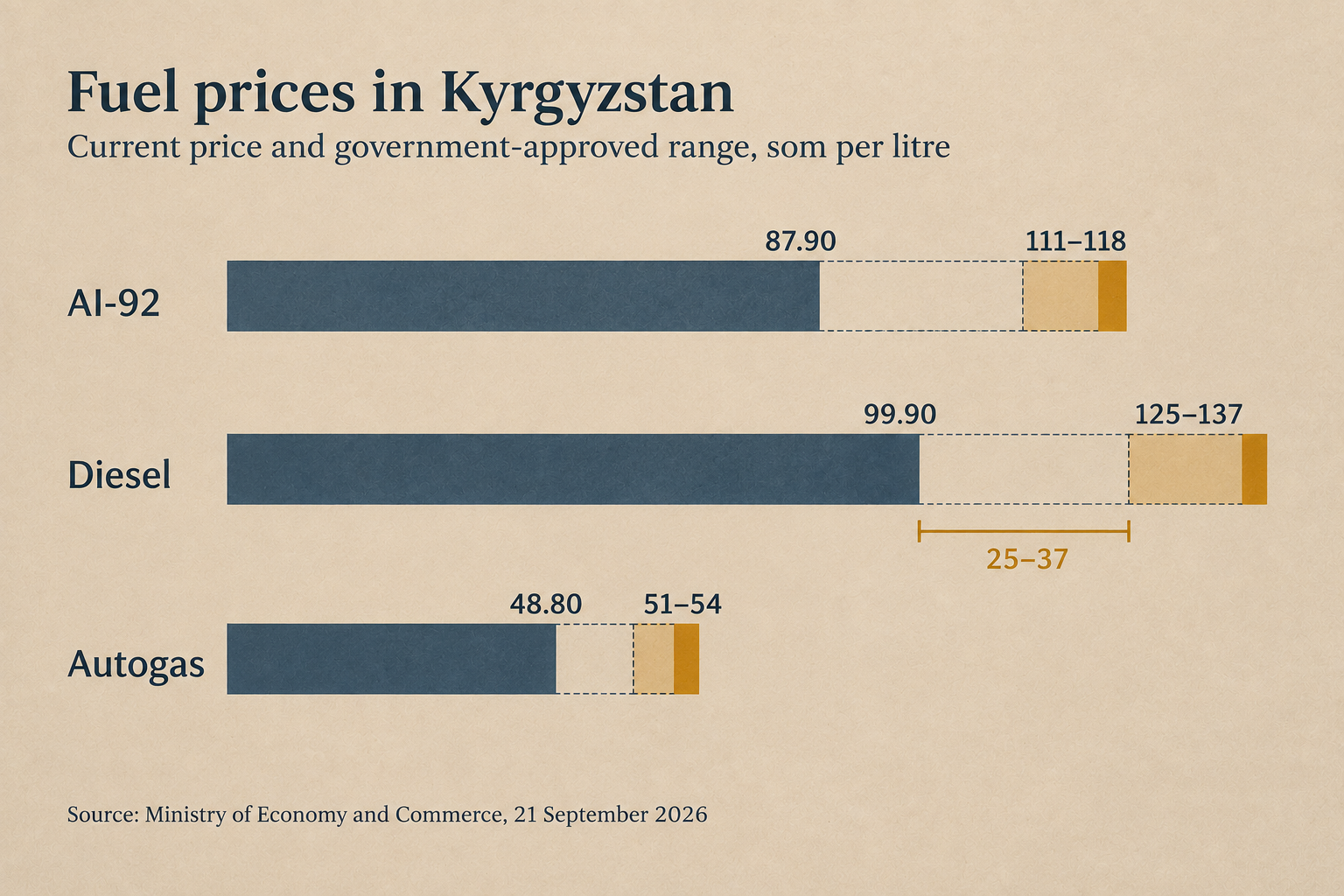
The ministry’s own figures, relayed by Kyrgyz outlets on Monday, price the gap product by product. Without support AI-92 would cost 111 to 118 som a litre against 87.90 at the pump, diesel 125 to 137 som against 99.90, and autogas 51 to 54 som against 48.80. On those figures the state covers 23 to 30 som of a litre of petrol and 25 to 37 som of a litre of diesel, CAW calculates, or 20% to 27% of the unsubsidised price. Measured against the pump price, only the top of the diesel range, 37%, comes near Amangeldiev’s 40%.
Thirty-nine billion is 5.6% of that spending and more than the whole surplus.
The calendar turns the arithmetic into a decision. Compensation ends on 31 December. The presidential election, which the amended parliamentary rules fix on the fourth Wednesday of January, falls on 27 January 2027. A government that has told deputies it cannot hold the price next year has 27 midwinter days between the 2 dates and 2 ways through them. It can extend the mechanism into the campaign and pay from the 39 billion, or let petrol move toward the ministry’s 111 to 118 som before the vote.
Three numbers would settle the size of the bill: the period the 956 million som covers, the fuel share of the 39 billion, and the line, if there is one, in the 2027 draft.