Mongolia
Mongolia drops its Oyu Tolgoi dividend spending bill, citing an e-Mongolia poll
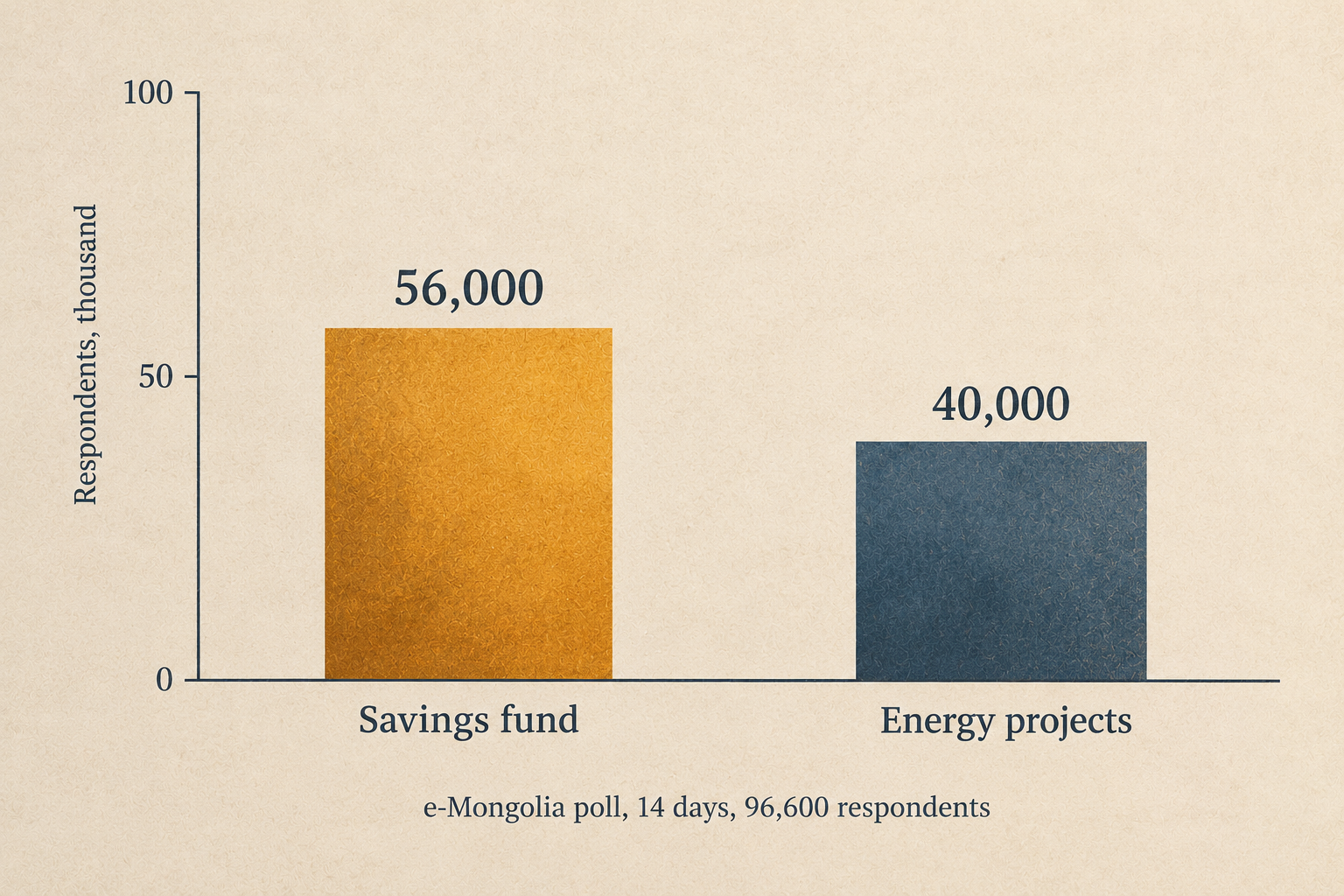
On 23 October the government withdrew the one-off bill that would have put ₮2 trillion of the ₮3 trillion Oyu Tolgoi dividend expected in 2027 into a 300 MW power plant, ten provincial heating plants and dormitories. Finance Minister Mendsaikhan gave two reasons: a budget the debate was making unrecognisable, and an e-Mongolia poll in which about 56,000 of 96,600 respondents chose the Savings Fund over energy projects.

Mongolia’s Democrats ask whether Oyu Tolgoi’s ₮3 trillion is a dividend at all
The Democratic Party group in Mongolia’s parliament said on 22 October that the ₮3 trillion the government expects from Oyu Tolgoi in 2027 has not been shown to be a dividend by the mine’s board or in its accounts, that a dividend of that size to the state’s 34% would imply ₮6 trillion for Rio Tinto’s 66%, and that the money, if it comes, belongs in the Wealth Fund.
Ten years of UK memoranda on Mongolian mines end in a working group and an unfunded list
Mongolia’s mining sector was put before London on 21 October at a Mongolian-British Chamber of Commerce conference during LME Week. The state’s list of mines seeking investment holds 67 projects asking for ₮3.5 trillion, about $970 million, two thirds of it one Australian-owned coal deposit. Britain’s record since the first mining memorandum of 2016 is a working group, a metro memorandum and a listing programme without an issuer.

Khurelsukh’s Berlin visit yields a declaration, a Frankfurt consulate and mutual driving licences
Foreign minister Batmunkh Battsetseg and state secretary Bernhard Kotsch of the Federal Foreign Office signed the Mongolia-Germany joint declaration in Berlin on Tuesday during the president’s state visit, Montsame reported. It puts renewable energy and the green transition first among economic priorities, keeps the joint university of minerals and technology and adds UN peacekeeping and mountain-infantry training to defence cooperation.
SCO governments sign four documents in Dushanbe and hand the council’s chair to Uzbekistan
The 25th Council of Heads of Government signed a joint communiqué, a 2026-2030 trade and economic action plan, a digital freight platform concept and a decision on the regulation of a data bank of investment projects in industry on Tuesday, by the Russian government’s list. Russia’s deputy prime minister Alexei Overchuk said the meeting was “to a greater degree” about a new SCO bank, on whose shares it is “still too early to speak”.
Mongolia’s finance minister defends ₮2 trillion of Oyu Tolgoi’s dividend for power plants
Finance minister Z. Mendsaikhan told the Khural’s budget committee on Tuesday that ₮1 trillion of next year’s Oyu Tolgoi dividend goes to the savings fund under the National Wealth Fund law and ₮2 trillion to a stalled project to build thermal power plants in ten provinces. A deputy asked by what legal basis the ₮2 trillion had been put on the spending side.
The second China-Mongolia railway has its last beam in place and a 30 million tonne design
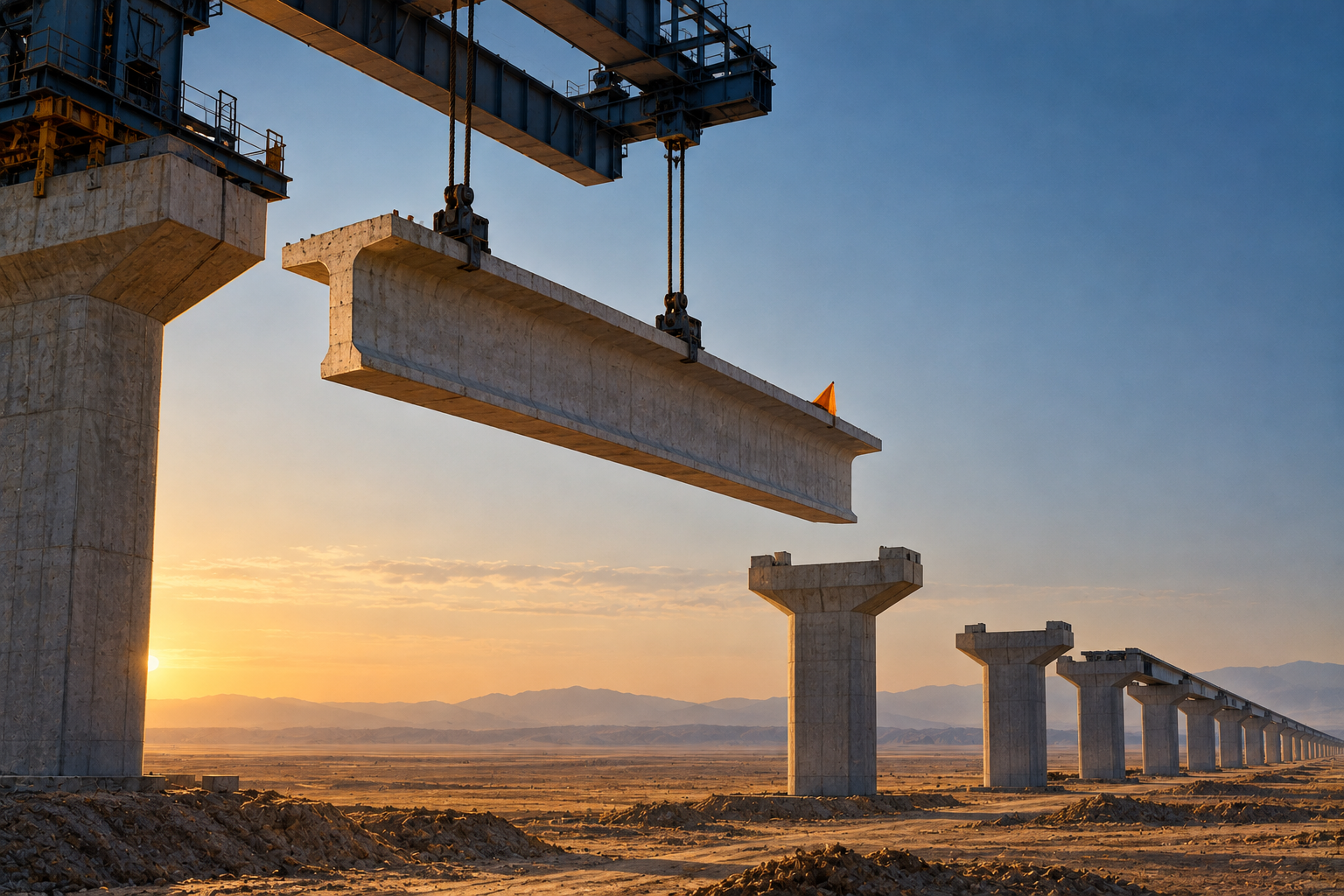
The last of 760 prefabricated T-beams was set on Friday 16 October on the Gantsmod-Gashuunsukhait railway, the second cross-border rail link between China and Mongolia after the Erenhot-Zamiin-Uud line of 1956, Xinhua reported from Ulaanbaatar the same day. The 9.91 km route, 6.08 km of it a cross-border bridge, has been under construction since May 2025 and is designed for 30 million tonnes of cargo a year.
Mongolia holds 10 days of AI-92 and 27 of diesel as police log 431 fuel-queue disputes
Mongolia’s national stock stood at 22,000 tonnes of AI-92 petrol, or 10 days of consumption, and 108,000 tonnes of diesel, or 27 days, the deputy minister of industry and mineral resources, B. Munkhtamir, said on Monday, in ikon.mn’s account at 14:12 Ulaanbaatar time. Of 78,000 tonnes contracted from Russia, China and third countries, 38,000 had arrived.
Mongolia amends its Minerals Law and votes a 2 trillion tugrik deficit in the same sitting
The State Great Khural finally approved on 16 October Minerals Law amendments that, by the ministry’s summary, double the local share of royalties, bring the copper royalty into line with international benchmarks and strengthen the legal basis for a critical minerals policy. The sitting also adopted the 2026 budget revision, with spending of 33.9 trillion tugrik and a 2 trillion deficit, four days before the ruling party’s deadline.

Five Years Ahead: Mongolia books its first Oyu Tolgoi dividend before the mine has paid it
A ₮3 trillion line in the 2027 budget rests on a dividend the company says it will weigh against its year-end cash. The law that was meant to keep such money out of current spending is to be set aside by a one-off law still being drafted. Five years out, the question is what Mongolia does when the copper price sets the number and the Khural has already spent it.
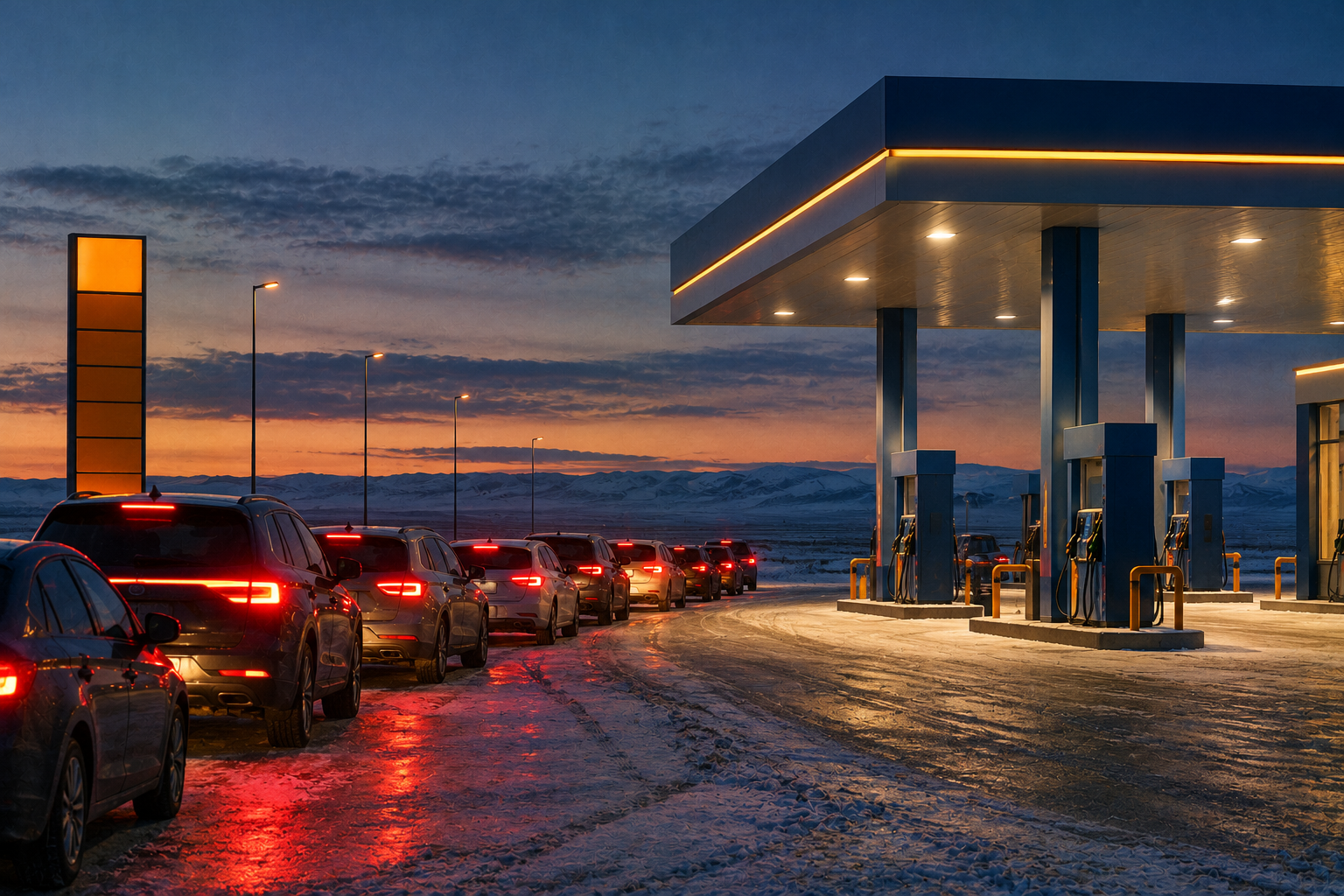
Mongolia’s AI-92 rises 500 to 550 tugrik a litre on dearer Russian supply, with 14 days of stock
Filling stations in Mongolia raised AI-92 petrol by 500 to 550 tugrik a litre on Monday, the government’s fuel task force said, because the price of supplies from Russia rose by $190 this month against last. Deputy industry minister B. Munkhtamir put the country’s stocks at 14 days of AI-92 and 31 days of diesel, with 78,000 tonnes of petrol contracted for October.
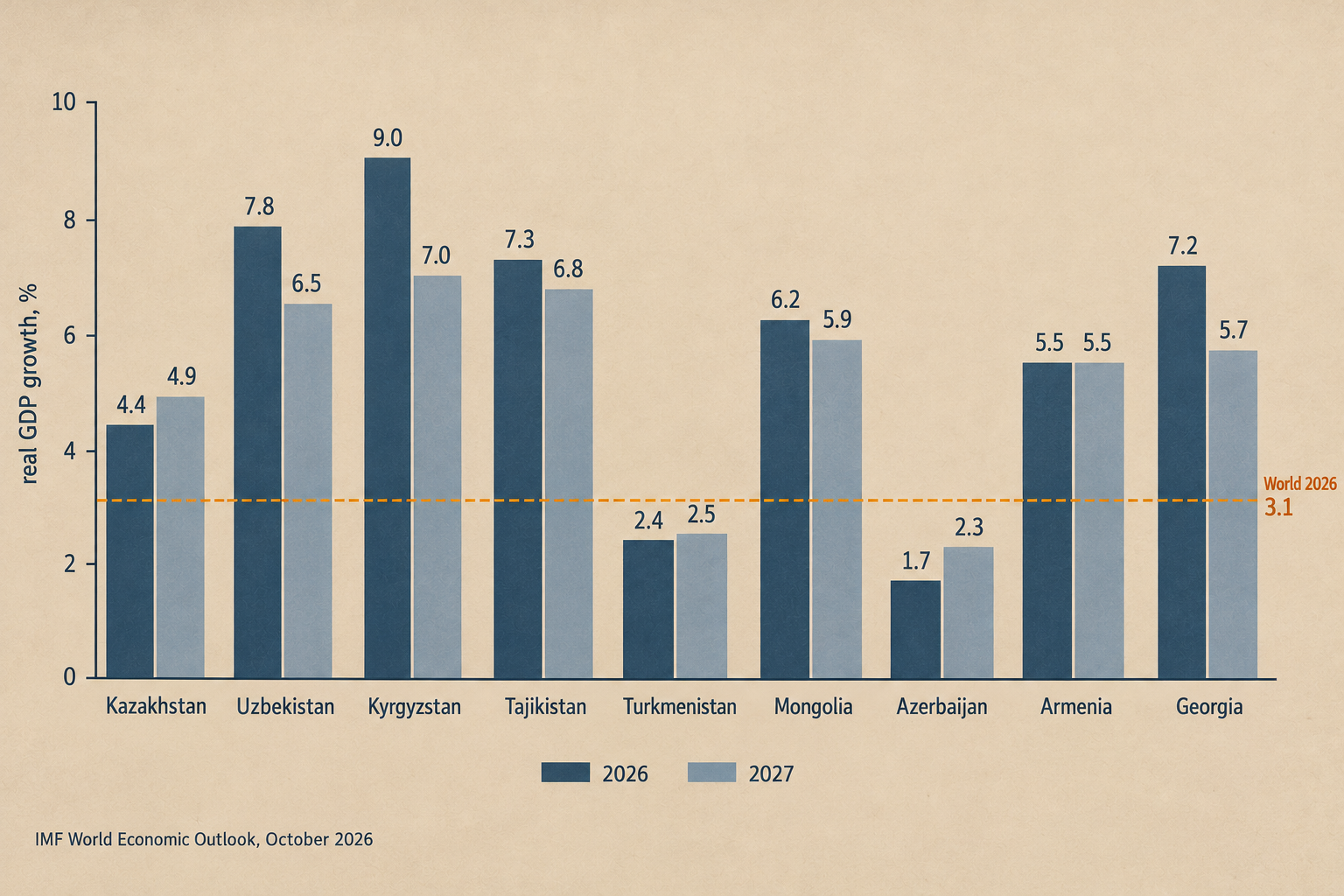
The IMF slows seven of nine regional economies in 2026 and lifts Uzbekistan and Azerbaijan
The IMF’s October World Economic Outlook, published on Tuesday, has growth slowing this year in seven of the nine economies CAW covers, with Kyrgyzstan still the fastest at 9% and Azerbaijan the slowest at 1.7%. Uzbekistan edges up to 7.8% and Azerbaijan gains too, from 1.4%. World growth slows to 3.1% in 2026 and recovers to 3.4% in 2027, the Fund says.
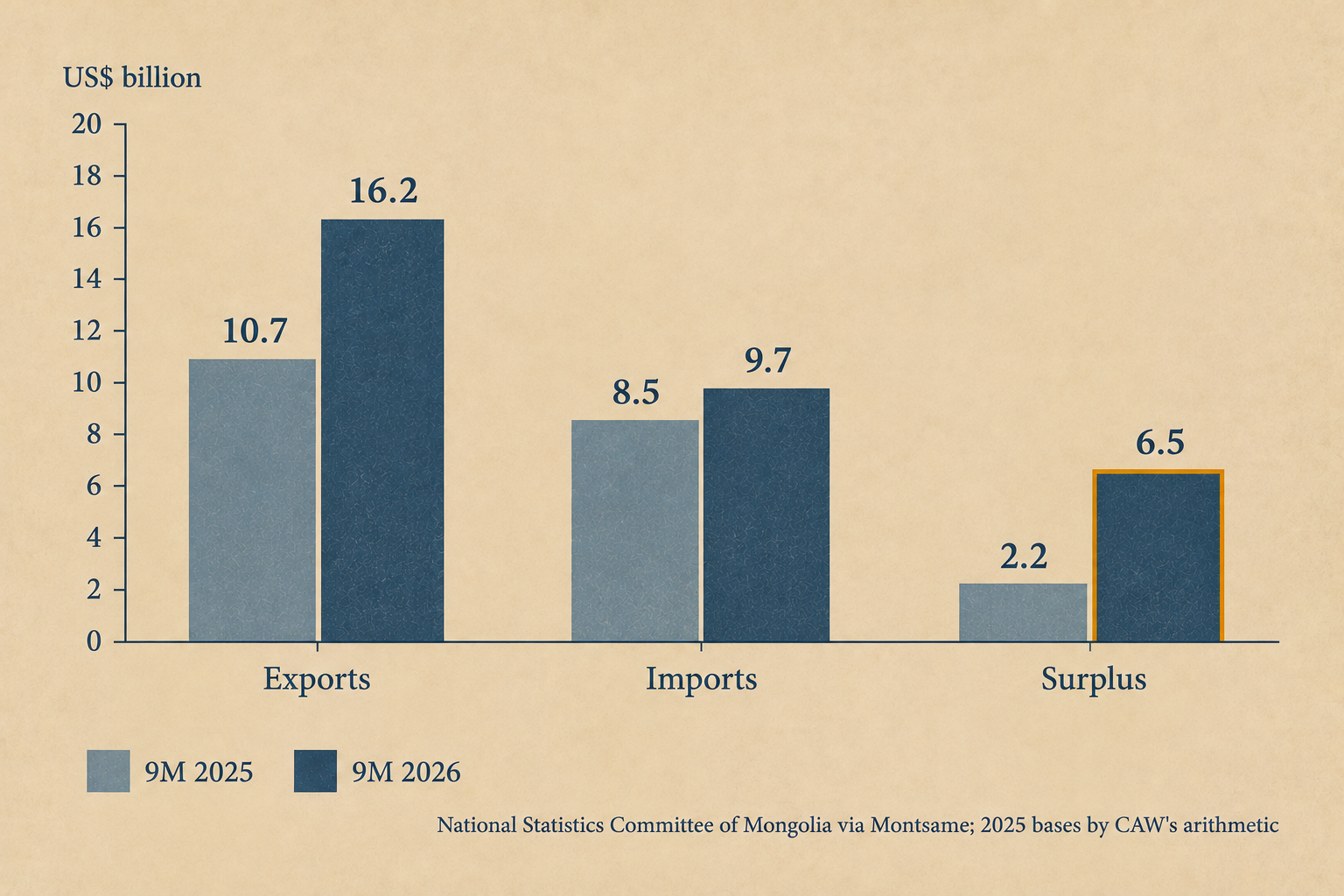
Mongolia’s exports rise 51% in nine months to $16.2 billion on copper and coal
Mongolia sold $16.2 billion of goods abroad in January to September, 51.2% or $5.5 billion more than a year earlier, the National Statistics Committee reported through Montsame on Monday. Imports rose 13.8% to $9.7 billion and the trade surplus tripled to $6.5 billion. Copper ore and concentrate supplied $3.1 billion of the increase and coal $2 billion.

WHO leaves the Irkutsk death unexplained while the region’s plague watch stays on
The World Health Organization’s outbreak notice of 10 October classifies the death of a laboratory worker in Irkutsk as pneumonia of undetermined aetiology, finds no evidence of transmission and says a laboratory exposure “cannot be fully excluded”. Kazakhstan, Kyrgyzstan and Mongolia kept border controls and anti-plague stations on alert for a week. That watch is a Soviet inheritance, and its running cost is the figure the open record lacks.

Russia reopens diesel exports for 500,000 tonnes while a US licence runs to April
Russia’s government partly lifted its diesel export ban on Saturday, for 500,000 tonnes from 10 October, to carry out what Putin and Trump agreed by telephone on Friday. OFAC had licensed the sale, delivery and import of Russian-origin diesel the day before, through 7 April 2027. Neither document says whether the 500,000 tonnes stand beside or count against the duty-free balances under which Russian fuel reaches Kazakhstan.
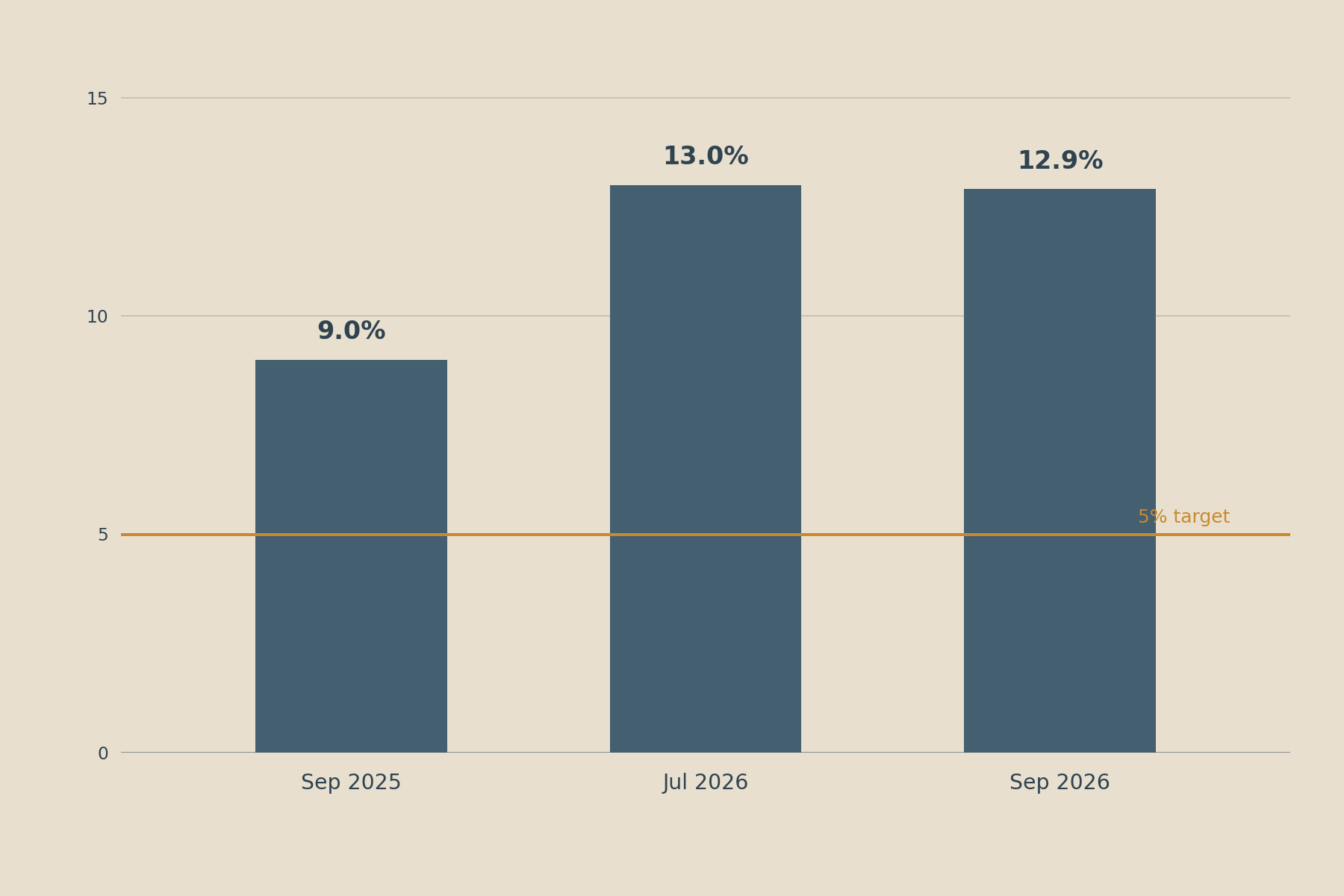
S&P affirms Mongolia at BB- as the central bank tells MPs inflation hit 13% in July
S&P affirmed Mongolia’s BB- rating with a stable outlook on 8 October, the government’s communications office reported on Friday, with net external debt seen falling from 184 per cent of current account receipts in 2020 to 58 per cent this year. A day earlier central bank governor Narantsogt told MPs inflation reached 13 per cent in July and policy stays tight until it returns to about 5.
Mongolia opens the 450 MW Tavan Tolgoi plant to private builders on a 30 to 70 split
Tavan Tolgoi’s 450 MW thermal power plant will be built as a public-private partnership in which the state-owned Tavan Tolgoi company invests up to 30 per cent and private capital the rest, with the selection to go to the Cabinet next week, Economy and Development Minister J. Enkhbayar told the Economic Standing Committee on Thursday, by ikon.mn. On Wednesday the Cabinet backed investment agreements for three more plants.
Mongolia drops the fuel duty to zero at three Chinese crossings through the end of 2028
The Cabinet approved on Wednesday a resolution setting the customs duty on 92-octane petrol and diesel imported through Zamyn-Üüd, Bulgan and Shiveekhuren at zero from 21 October 2026 to 31 December 2028, by the government’s readout on the public broadcaster MNB. At the same sitting export revenue was reported at $16.6 billion for nine months, up 54%, and reserves at a record $8.9 billion.
Three ministers answer the Irkutsk laboratory death as Moscow clears 90% of contacts
The death of a laboratory worker at Irkutsk’s anti-plague institute, pneumonia of unspecified etiology to Rospotrebnadzor and suspected pneumonic plague to ECDC, drew three answers on Wednesday: Mongolia’s health minister said temperatures are taken at the border and isolation rooms stand ready, Armenia’s minister told parliament arrivals face enhanced checks, and Georgia’s said there is no reason for panic. Moscow reported more than 90% of contacts released from observation.