Uzbekistan

Uzbekistan’s Senate lets the Central Bank write its rules without the chamber of commerce
Senators approved on Friday a law that frees the Central Bank’s regulations from consent by the chamber of commerce and the business ombudsman, registers its prudential and monetary-policy acts at the justice ministry within 10 working days and lifts the 3-month wait before they take effect, Gazeta.uz reported. Checks on the regulator will need a Senate decision, and the drafting followed the IMF and World Bank’s FSAP advice.

At the EAEU council, Lukashenko asks Armenia where its brandy will go if it chooses the EU
The Eurasian Intergovernmental Council met in Minsk on Friday under Kazakhstan’s chairmanship, with Pashinyan on a video link. Bektenov put the union’s first-half growth at 1.1% and its investment at $244.5 billion, Mishustin said mutual trade rose 10% from January to July, and Lukashenko told the heads of delegations that Armenia should work out where its brandy and fruit will go before it hurries to the EU.
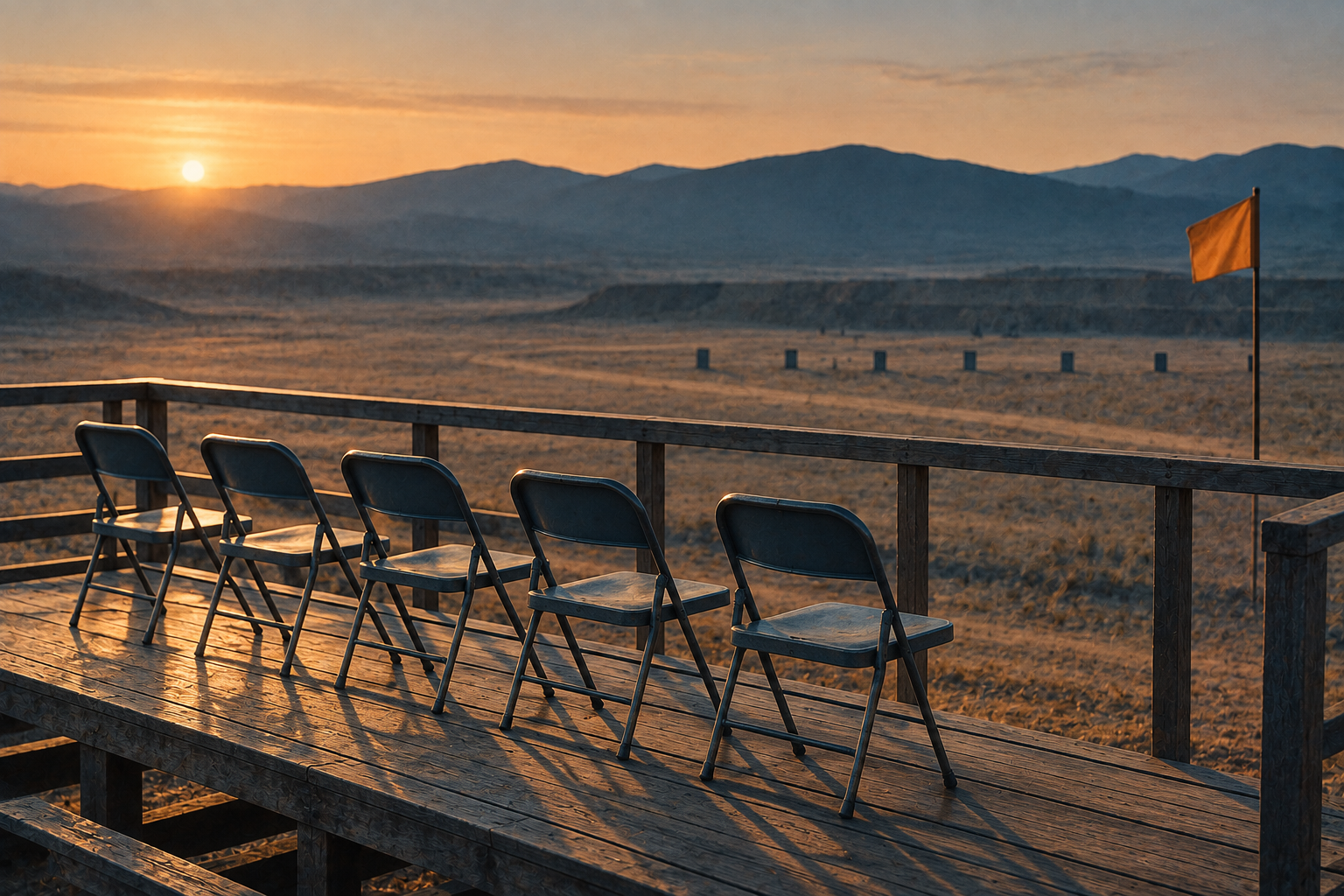
Guler expects Kyrgyz and Kazakh troops at larger drills as 3 armies train in Khojavend
The Strength of Unity 2026 exercise of Azerbaijan, Türkiye and Uzbekistan held its observer day at the Qizilqaya range in Khojavend district on Thursday, with the participating countries' defence ministers and chiefs of general staff present, Azerbaijan's defence ministry said. Türkiye's Yasar Guler said he believes the Kyrgyz and the Kazakhs will join for larger exercises, and Uzbekistan and Azerbaijan signed a 2027 military cooperation plan in Baku.
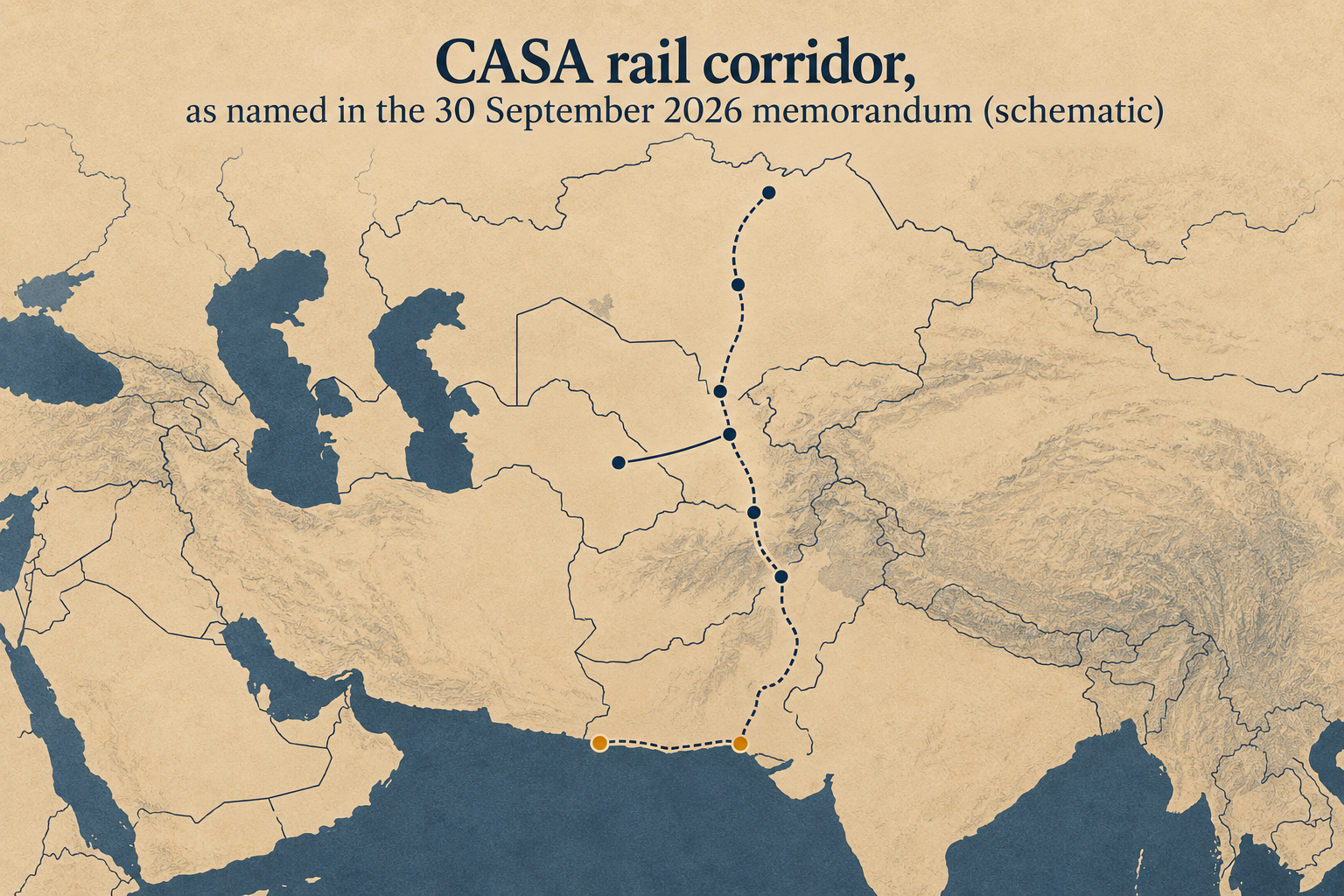
Kazakhstan, Uzbekistan and the UAE sign a memorandum on a rail route to Pakistan's ports
The transport ministries of Kazakhstan and Uzbekistan and the UAE's Ministry of Energy and Infrastructure signed a memorandum on 30 September to study a new railway, named CASA, running from Kazakhstan through Uzbekistan and Afghanistan to Pakistan's seaports, the Kazakh government said. The parties will run technical and economic studies and are considering a working group on the project's financing.

Mirziyoyev sets out 100 English-language STEM schools and 300 foreign campuses
Meeting teachers ahead of Teachers' Day on 30 September, President Shavkat Mirziyoyev said 40,000 Uzbek teachers now earn $1,000 a month and 1,500 more than $2,000. He set new targets: 100 schools teaching mathematics, informatics and science entirely in English from next year, branches of 300 leading universities, subsidised private schools in 52 overloaded districts and a doubled tax-free income threshold for private-school parents.
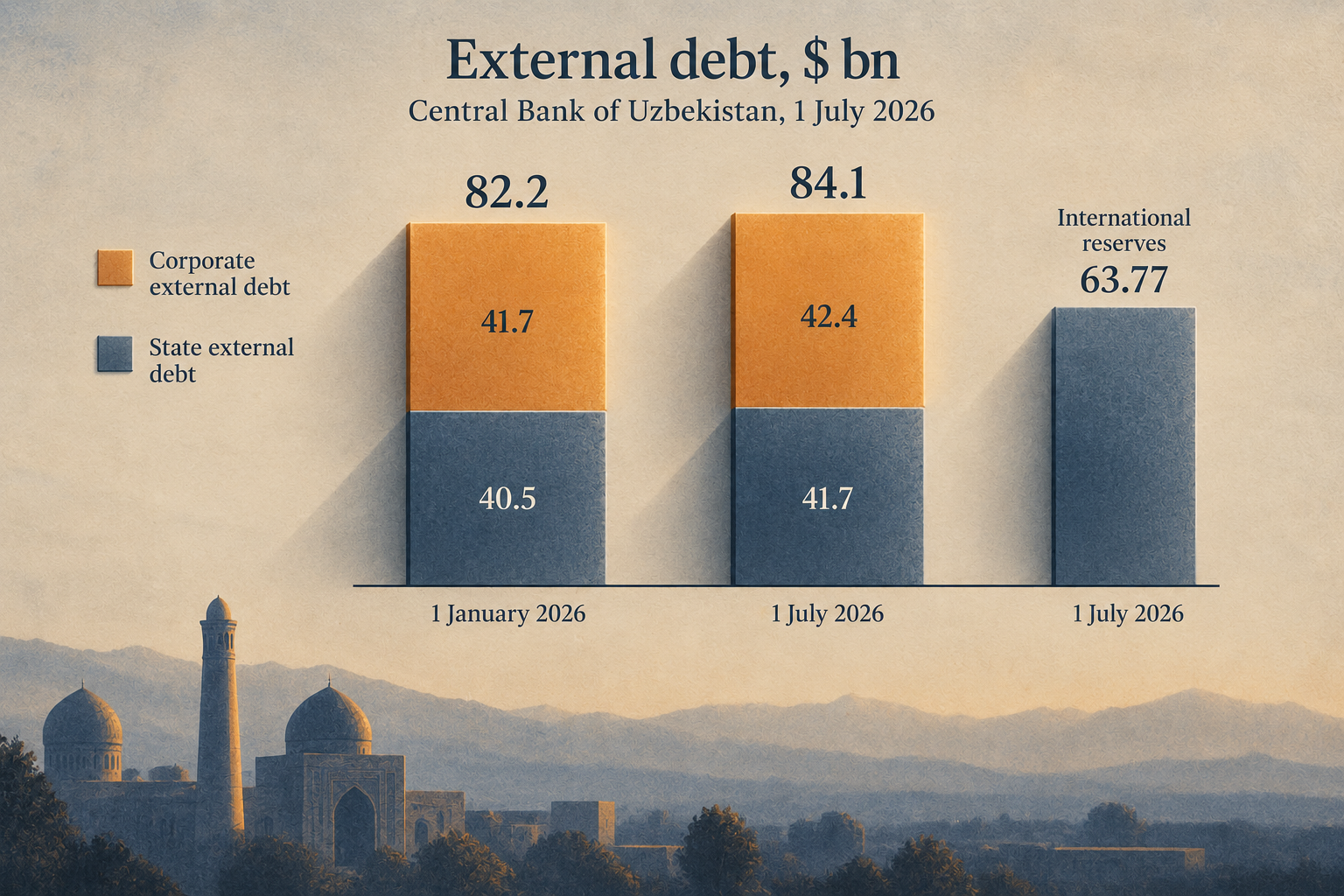
Uzbekistan’s external debt reaches $84.1 billion as imports run 24% ahead of a year earlier
Uzbekistan’s total external debt stood at $84.1 billion on 1 July, $1.9 billion more than on 1 January, the Central Bank’s half-year review of the balance of payments says. Of that, the state owed $41.7 billion and companies and banks $42.4 billion. The current account ran a deficit of about $6.2 billion in the first half, with exports of goods down 8.6% and imports up 24%.

Russia caps cash roubles for 7 neighbours at 1 million a head and bans firms from carrying any
A decree Vladimir Putin signed on Tuesday bans anyone from carrying more than 1 million roubles in cash out of Russia into the other 4 members of the Eurasian Economic Union, Azerbaijan, Tajikistan or Uzbekistan. Companies and sole traders may carry none, with 3 exceptions. The $100,000 ceiling that had applied since April is gone, and cash above the limit is confiscated at the border.
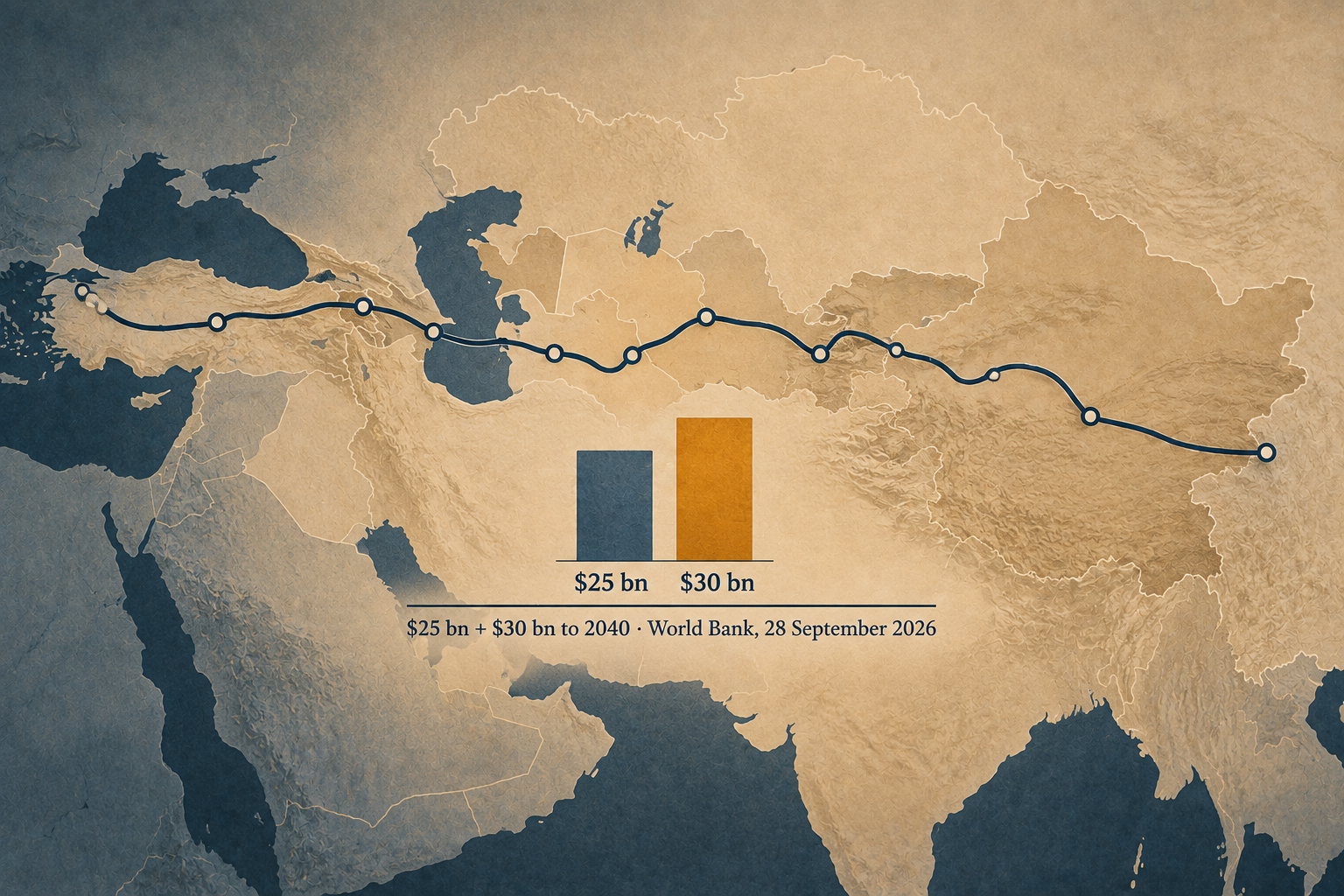
The World Bank prices the corridor at $55 billion to 2040, with $30 billion of it beyond the track
A World Bank report published on Monday says the Trans-Caspian corridor’s development could triple its volumes, halve its travel times, add 3.3% to the 9 countries’ GDP and create 2 million jobs by 2040. The bill it attaches is at least $25 billion of physical infrastructure and an estimated $30 billion of enabling investment. With reforms, the Bank says, the volumes would quadruple.
Five Years Ahead: the dawn that will come every dawn
Uzbekistan has approved 57.2 gigawatts of generating capacity for 2035. On Friday the region's grid showed what one new plant does to 4 countries before breakfast.
2 Uzbek-Kazakh border posts go round the clock as trucks through Syrdarya rise 10%
Uzbekistan's Customs Committee said on Monday evening that the Malik-Syrdarya and Ok Oltin-Tselinny crossings with Kazakhstan will move to 24-hour operation and that the Gishtkuprik customs post is to open in the fourth quarter of 2026. More than 9,200 trucks passed through Syrdarya in September, 10% more than a year earlier, Spot reported at 20:43 Tashkent time.
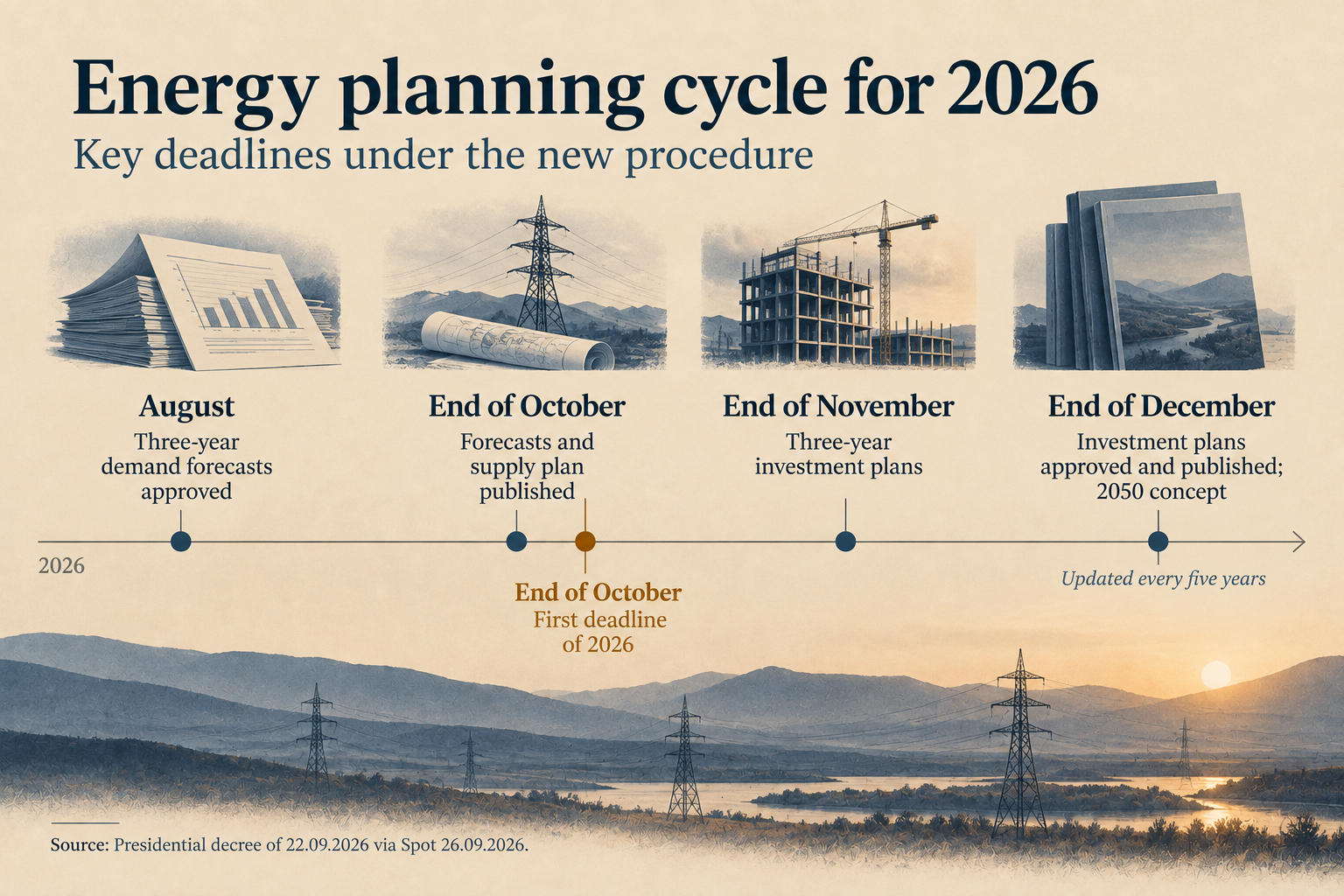
Uzbekistan puts its energy sector on three-year plans and bars projects outside them
A presidential decree of 22 September, reported by Spot on Saturday, makes the energy ministry, the economy and finance ministry and the energy market regulator publish three-year demand forecasts and a three-year supply plan by the end of every October, with investment plans to follow by the end of November. No individual privileges may be granted inside the projects, and no project outside the plan may be run.

Uzbekistan moves funded pensions out of Xalq Bank in 2027 and hands them to hired managers
The draft decree under public discussion until Wednesday transfers the funded pension system from Xalq Bank to the Pension Fund from 2027, the fund’s executive director Murodbek Otajonov said on Friday, and the money will then go to investment managers chosen by competition. A separate supervisory board, with foreign experts on it, will take the investment decisions instead of the government.
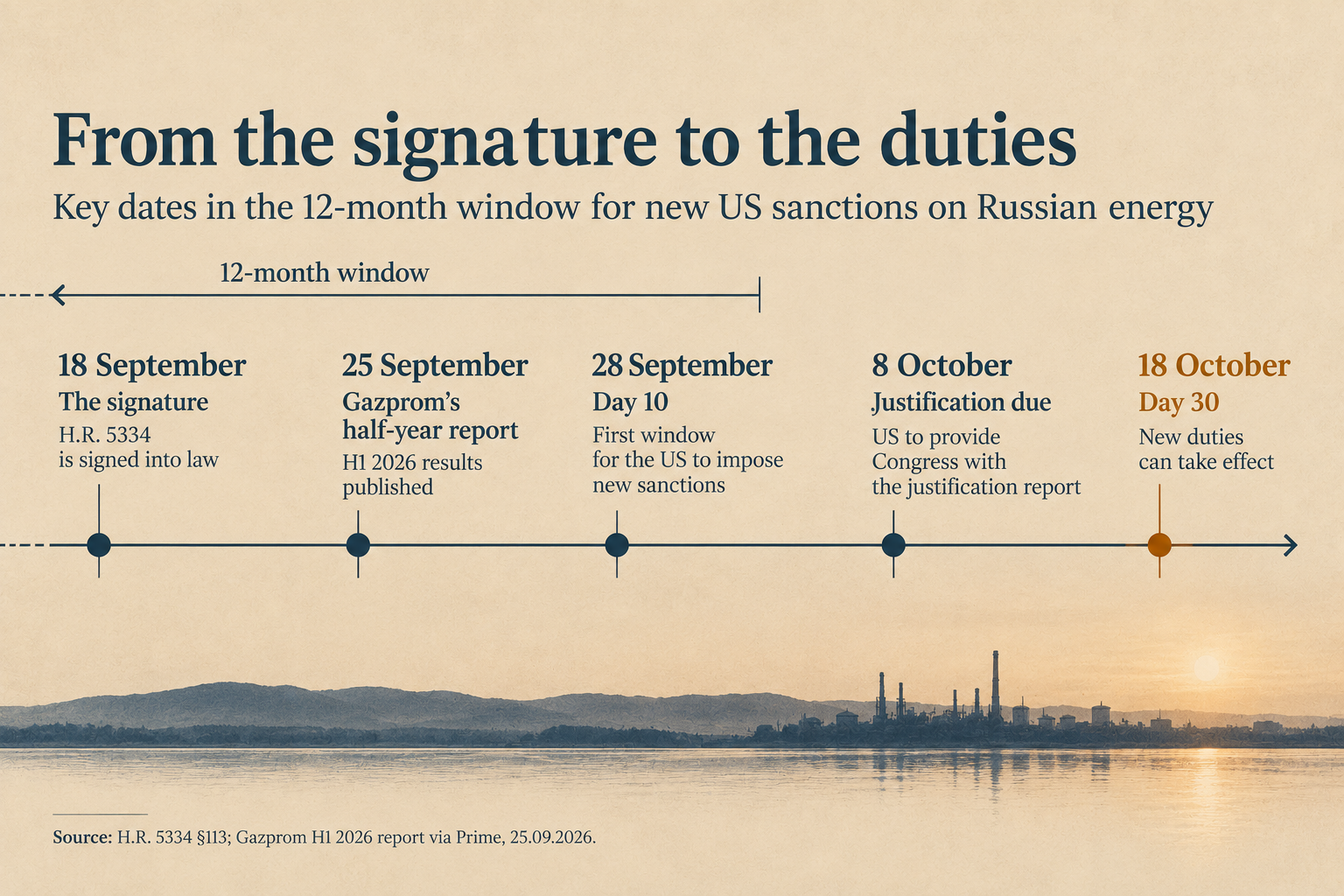
Gazprom says its growth is Kazakhstan, and the USTR has 10 days to show its count
Gazprom’s half-year report, as Prime quoted it on Friday afternoon, says its pipeline sales to the near abroad rose 29% in the first half of 2026 mainly because of Kazakhstan, and prints no volume. Monday is day 10 of the law that ranks Russia’s gas buyers; the US Trade Representative’s written justification is due by 8 October, and its press page through 27 September carries nothing on it.
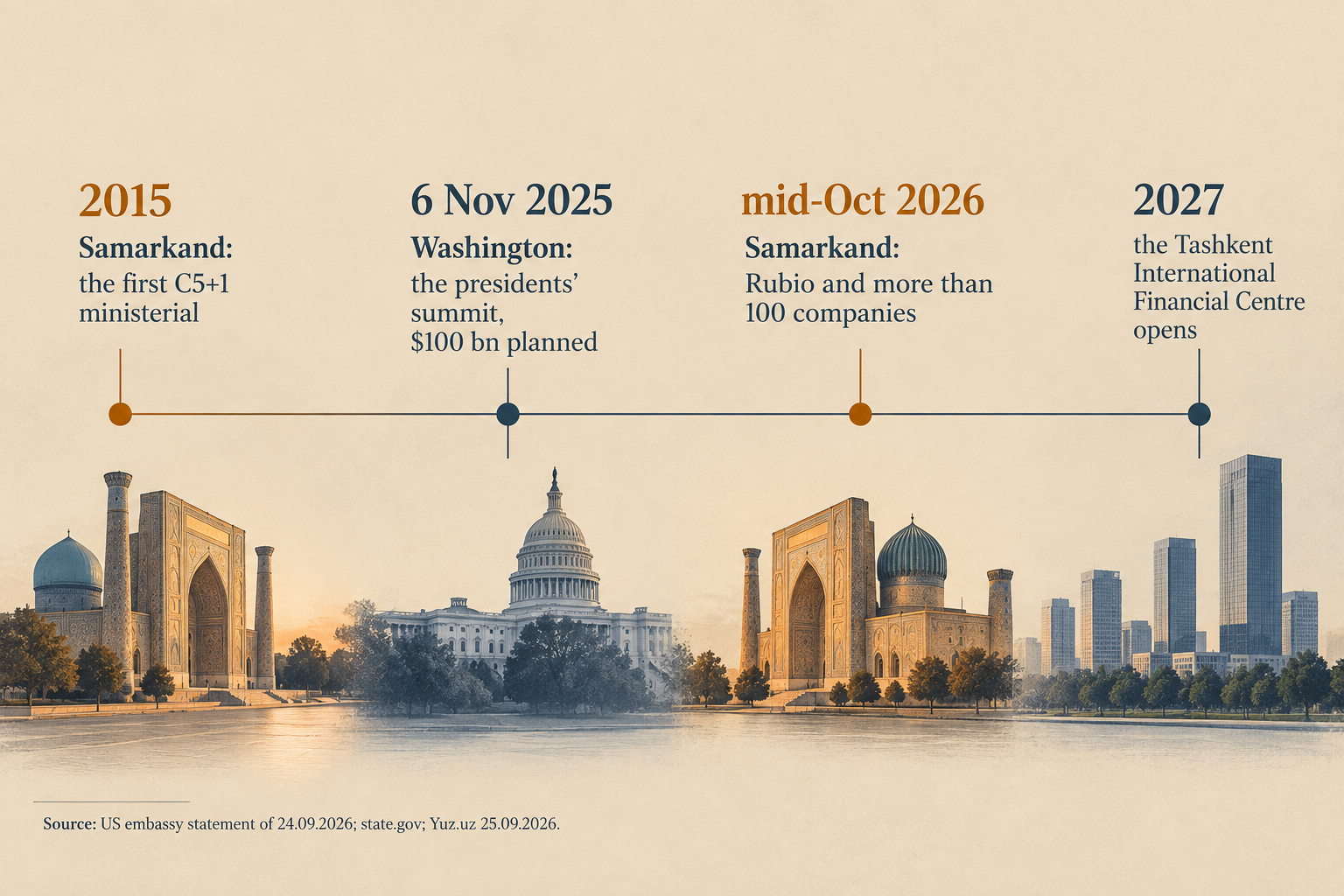
Washington books Samarkand for October while BlackRock draws Tashkent’s financial centre: Rubio’s 100 companies, a C5+1 back where it began in 2015, a launch date of 2027
Secretary of State Marco Rubio will bring “a historic business delegation of more than 100 American companies” to Samarkand in mid-October for the C5+1 ministerial with the five Central Asian foreign ministers, the US special envoy for South and Central Asia Sergio Gor announced on Thursday in a statement the Tashkent press relayed on Friday. The same morning Saida Mirziyoyeva, head of the presidential administration and since 10 September secretary general of the Tashkent International Financial Centre’s council, met BlackRock’s president Robert Kapito and vice chairman Thomas Donilon in New York on the centre’s launch in 2027, with BlackRock “assisting in forming the concept and structure of the Centre”.

A dawn test at the new Syrdarya plant knocks 1,600 MW off Uzbekistan’s grid, splits Kazakhstan’s north-south transit and sheds 962 MW in the south for 41 minutes
At 05:05 on Friday, during commissioning tests at the new 1,573 MW thermal plant in Bayavut district of Syrdarya region, built by the consortium of France’s EDF, Qatar’s Nebras Power and Japan’s Sojitz and Kyuden, 1,600 MW of capacity dropped out of Uzbekistan’s grid and households and farm water pumps in several regions lost power, the energy ministry said through its Telegram channel; reserves at other plants and the storage systems were brought in, every consumer was back by 07:27, and the ministry apologised, Spot reported at 07:54. Kazakhstan’s grid operator KEGOC put the loss at 1,516 MW at 05:02, said the surge of power flow split its north-south transit, restricted 962 MW of consumption, and restored the southern zone’s parallel operation with the Central Asian systems at 05:43, Forbes.kz reported.

Three governments spend 3 days in Almaty on the Kambar-Ata-1 agreement: the World Bank watches and the only sum on the table is Kazakhstan’s plan to borrow $500 million for its third of the dam
Kyrgyzstan, Kazakhstan and Uzbekistan held the third round of talks on the intergovernmental agreement on Kambar-Ata-1 in Almaty from 21 to 23 September, the Kyrgyz energy ministry said on Thursday through Economist.kg: deputy energy minister Salaat Sadyrakunov for Bishkek, first vice-minister of water resources and irrigation Nurlan Aldamzharov for Astana, first deputy energy minister Umid Mamadaminov for Tashkent, with the World Bank’s representatives in the room as observers. That document is to define the joint construction and management of the plant, the approach to financing it and the coordination between the 3 states, and the sum in the room is Kazakhstan’s plan, first reported by Economist.kg in March, to borrow about $500 million from the bank’s structures for the construction.

Mirziyoyev’s Andijan day: 500,000 sum a tonne for cotton sold through the exchange and a crossing to Kyrgyzstan twice the size of Dustlik
President Mirziyoyev, at a meeting in Andijan on Thursday, ordered a subsidy of 500,000 sum for every tonne of cotton that farmers sell through the commodity exchange, paid also to the clusters that buy it there, and 1.5 million sum a hectare for clusters growing cotton on their own land, Gazeta.uz reported at 14:55; the interest on textile exporters’ loans is proposed to be compensated above 5% in foreign currency and above 14% in sum for 3 years, and the government is to draft a refund of 3% of the value of goods sold through marketplaces. Out of the same day in Andijan came a border post: Keskanyor, agreed with the Kyrgyz side, twice the size of Dustlik, to be designed and started within 3 months.
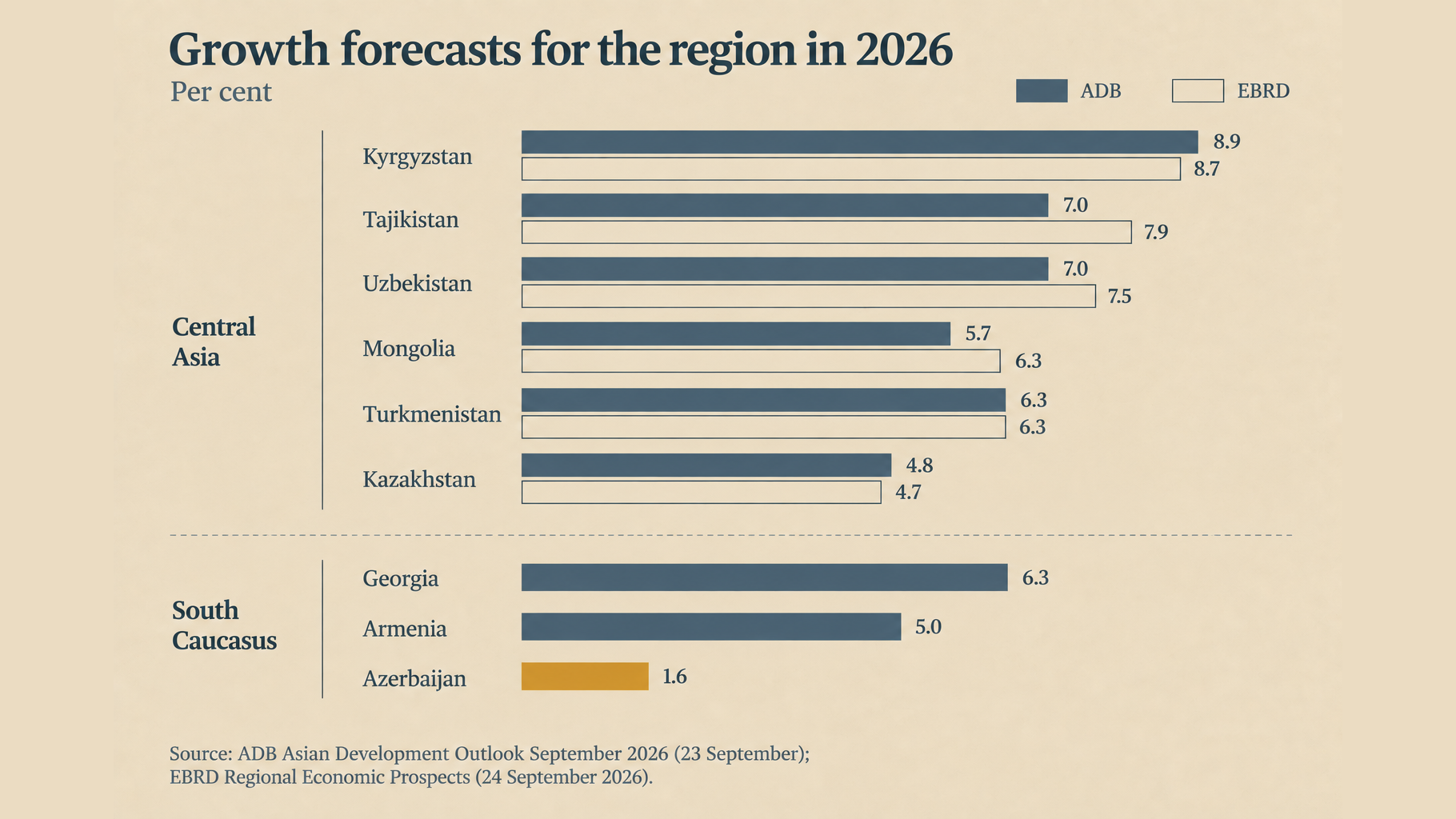
The ADB and the EBRD publish their autumn forecasts a day apart: Central Asia and Mongolia grow 5.8% on one count while the Caucasus slips on the other
The European Bank for Reconstruction and Development put Central Asia and Mongolia at 5.8% growth in 2026 and 5.3% in 2027 in its Regional Economic Prospects published on Thursday: Kyrgyzstan 8.7% this year, Tajikistan 7.9%, Uzbekistan 7.5%, Mongolia and Turkmenistan 6.3%, Kazakhstan 4.7%. The Asian Development Bank’s September Outlook, published on Wednesday, raised Uzbekistan to 7.0% from 6.7% after an 8.5% first half and Georgia to 6.3% from 5.5%, cut Tajikistan to 7.0% from 7.3% and Azerbaijan to 1.6% from 2.0%, and left Kazakhstan at 4.8%, Kyrgyzstan at 8.9%, Turkmenistan at 6.3%, Armenia at 5.0% and Mongolia at 5.7%. Its subregion, the Caucasus and Central and West Asia, slips to 3.7% for 2026 and 4.1% for 2027, a tenth of a point down on July on both years.
Tashkent plans 57.2 GW by 2035 with 26 storage projects and nearly 5,000 km of new lines behind a grid it says will now be built from demand
President Shavkat Mirziyoyev reviewed a plan on Tuesday that takes Uzbekistan’s generating capacity to 46.1 GW by 2030, for about 129 billion kWh a year, and to 57.2 GW by 2035, for 154.7 billion, the presidential press service reported. The plan counts 6.3 GW of solar and wind already built, more than 100 hydro plants at close to 2.5 GW, 26 storage projects of 4.2 GW with 17 under way, and, by 2030, 9 new 220 kV substations, 7 at 500 kV and almost 5,000 km of new transmission lines. Its stated method is new: demand is set first, then the plants and the wires.

Uzbekistan’s statement to the UN General Assembly goes to Saida Mirziyoyeva, the head of the presidential administration, a year after the president gave it himself
Saida Mirziyoyeva, head of the Presidential Administration, will speak for Uzbekistan in the general debate of the 81st General Assembly, which runs from Tuesday to Saturday and on Monday 28 September, Gazeta.uz reported on Tuesday, citing its sources. She met the UN Secretary-General, António Guterres, on the session’s sidelines on Monday, the state daily Yangi O’zbekiston reported at 08:15 on Tuesday; a year ago the 80th session’s debate heard President Shavkat Mirziyoyev.