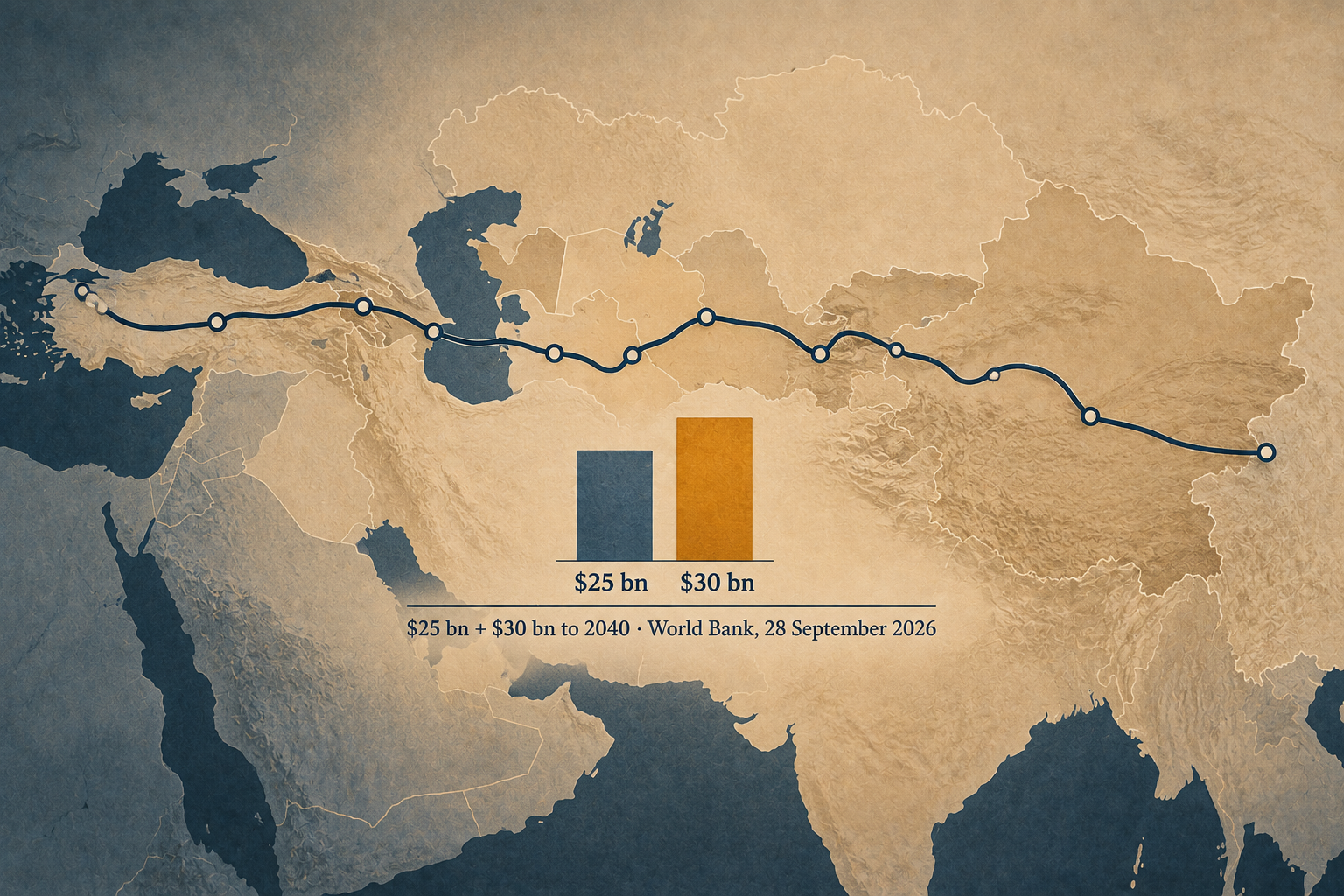
The report, Integration: World-Class Trade Logistics Along the Trans-Caspian Transport Corridor, dated 28 September, covers Armenia, Azerbaijan, Georgia, Kazakhstan, Kyrgyzstan, Tajikistan, Türkiye, Turkmenistan and Uzbekistan, nearly 200 million people. The Bank’s release attaches 4 results to the corridor’s development by 2040, trade volumes more than tripled, travel times halved, GDP 3.3% higher and 2 million more jobs. It names two bills: at least $25 billion of physical infrastructure through 2040 to clear the route’s bottlenecks, and an estimated $30 billion for what it calls enabling investments.
A second scenario sits beside the first: with policy, institutional and operational reforms added to the infrastructure, the volumes quadruple and the travel times fall by two thirds against 2023. Business Media Georgia’s reading of the report ties the 3.3% to that combined case and gives Georgia’s own line as 3.61% of output and 0.79% of employment in the long term; the release itself prints no country table.
The Bank’s release attaches 4 results to the corridor’s development by 2040, trade volumes more than tripled, travel times halved, GDP 3.3% higher and 2 million more jobs.
Of the two, the larger bill is the less visible. Its $30 billion is filed under the digital systems, logistics hubs and border procedures that the Bank’s regional infrastructure director Charles Cormier lists beside railways and ports, and none of it is the kind of money a summit signs. The Bank’s own line on the route so far is the $372 million it approved on 2 June for Georgia’s Trans-Caspian Transport Corridor project, of which the AIIB signed its €158 million share in Doha on Monday.
The report arrives in a month when everyone on the route has quoted a different number. Irakli Kobakhidze told the UN General Assembly on 24 September that Georgia would spend $7 billion on transit infrastructure to 2032; Tokayev’s target is 100 million tonnes of transit through Kazakhstan on all routes and 20 million tonnes across the Caspian in the foreseeable future, he said on 16 September; the European Commission’s State of the Union promise is to crowd in up to €12 billion of public and private money; Armenia’s share of the TRIPP company is 26%, rising to 49%. The Bank’s $55 billion covers all 9 at once and is spread over 14 years.
Two things the release does not price. The Black Sea leg sits inside the war-risk area that London’s Joint War Committee widened on 16 September to the whole sea outside the adjoining states’ territorial waters, with premiums that rose from 0.1 to 0.2% of a hull’s value to 1 to 1.5% by the Turkish shipping press’s account, and the Caspian leg crosses a sea whose level is falling, the subject of Turkmenistan’s own summit in Avaza on 9 October.
Unresolved: the report’s country-by-country table beyond Georgia’s line, its baseline volumes for 2023 and the split of the $25 billion between rail, ports and roads, which the release does not print.