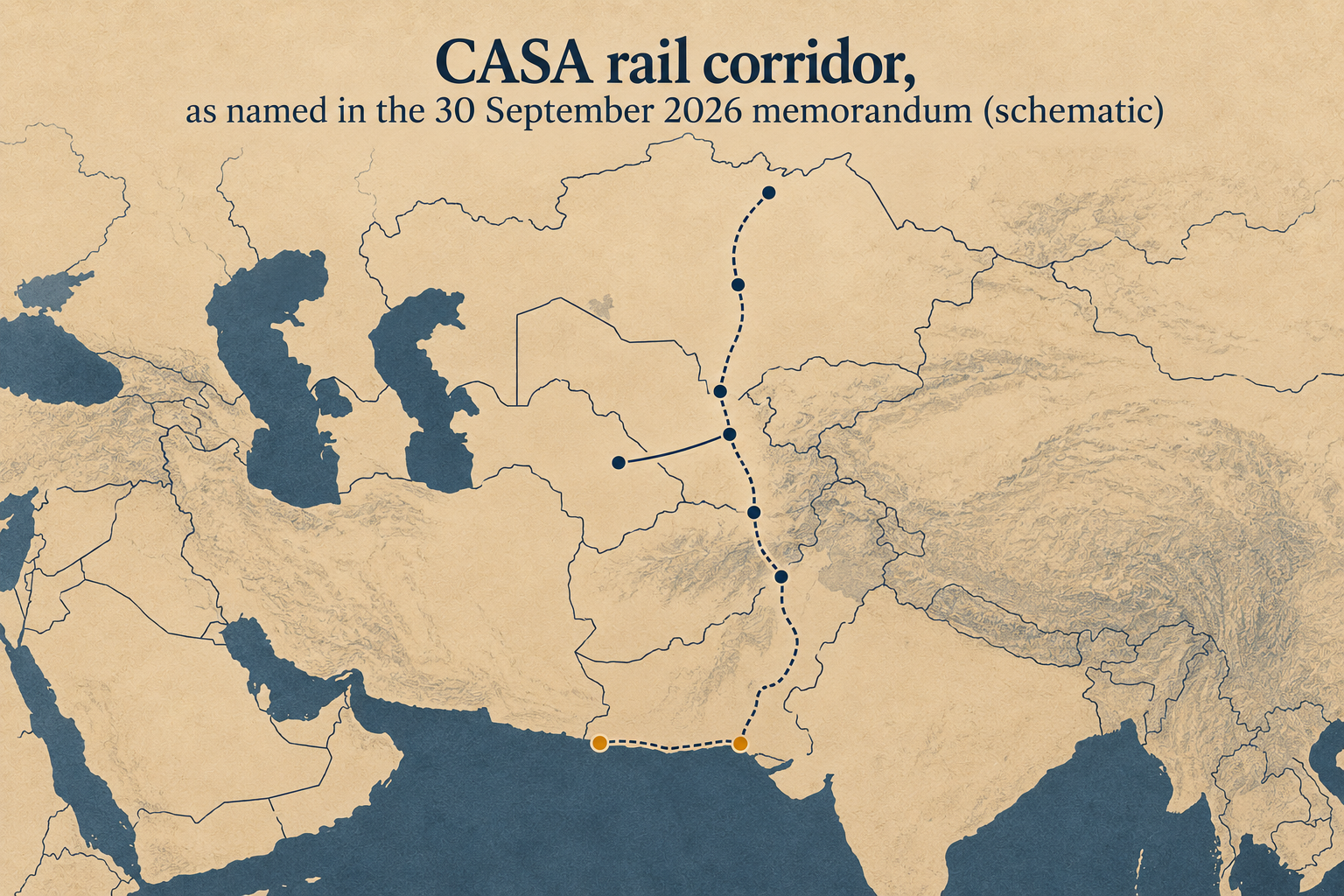
Kazakhstan, Uzbekistan and the Emirates intend to work up jointly a project for a new rail route to Pakistan's seaports along the Kazakhstan-Uzbekistan-Afghanistan-Pakistan line, the Kazakh prime minister's office said late on 30 September. Under the memorandum the parties will carry out technical and economic studies and assess the case for building the railway infrastructure and the facilities that go with it. Kazakhstan and Uzbekistan bring developed rail networks and transit capacity, the statement said, and the Emirates bring international experience in transport infrastructure, logistics and large investment projects.
A working group to handle the technical, economic and financial questions is under consideration. The statement names no signatories, no venue and no sum.
Kazakhstan and Uzbekistan bring developed rail networks and transit capacity, the statement said, and the Emirates bring international experience in transport infrastructure, logistics and large investment projects.
CASA is the third name on the same map. Uzbekistan, Afghanistan and Pakistan signed a framework agreement in Kabul in July 2025 for a railway from Termez through Mazar-i-Sharif and Logar to Kharlachi on the Pakistani border, and Kazakhstan has its own line in Afghanistan, the Turgundi-Herat railway it agreed to build and finance. The memorandum stitches Kazakhstan onto the Uzbek corridor and adds a Gulf investor.
The physical obstacles are unchanged. Afghanistan has almost no track, Pakistan runs on a broad gauge different from the Soviet 1,520 mm standard, and any through route needs a break-of-gauge terminal and a security arrangement that no party has published.
The Emirati signature is the novelty. Abu Dhabi has bought into Central Asian logistics through port and terminal stakes and now puts a ministry's name on a corridor whose southern end would be Karachi or Gwadar. For Astana the route is a second exit to the Indian Ocean after the Iranian line through Bandar Abbas, which the 2026 war has made unreliable, and for Tashkent it keeps Kazakhstan, the largest neighbour, inside a project that has so far been Uzbek-led.
A memorandum to study is the lowest rung of the ladder. The signals that it has climbed one are a published route and gauge solution, a cost estimate with a financing split, and a working group with named chairs and a deadline. The Kazakh statement gives none of the three yet.