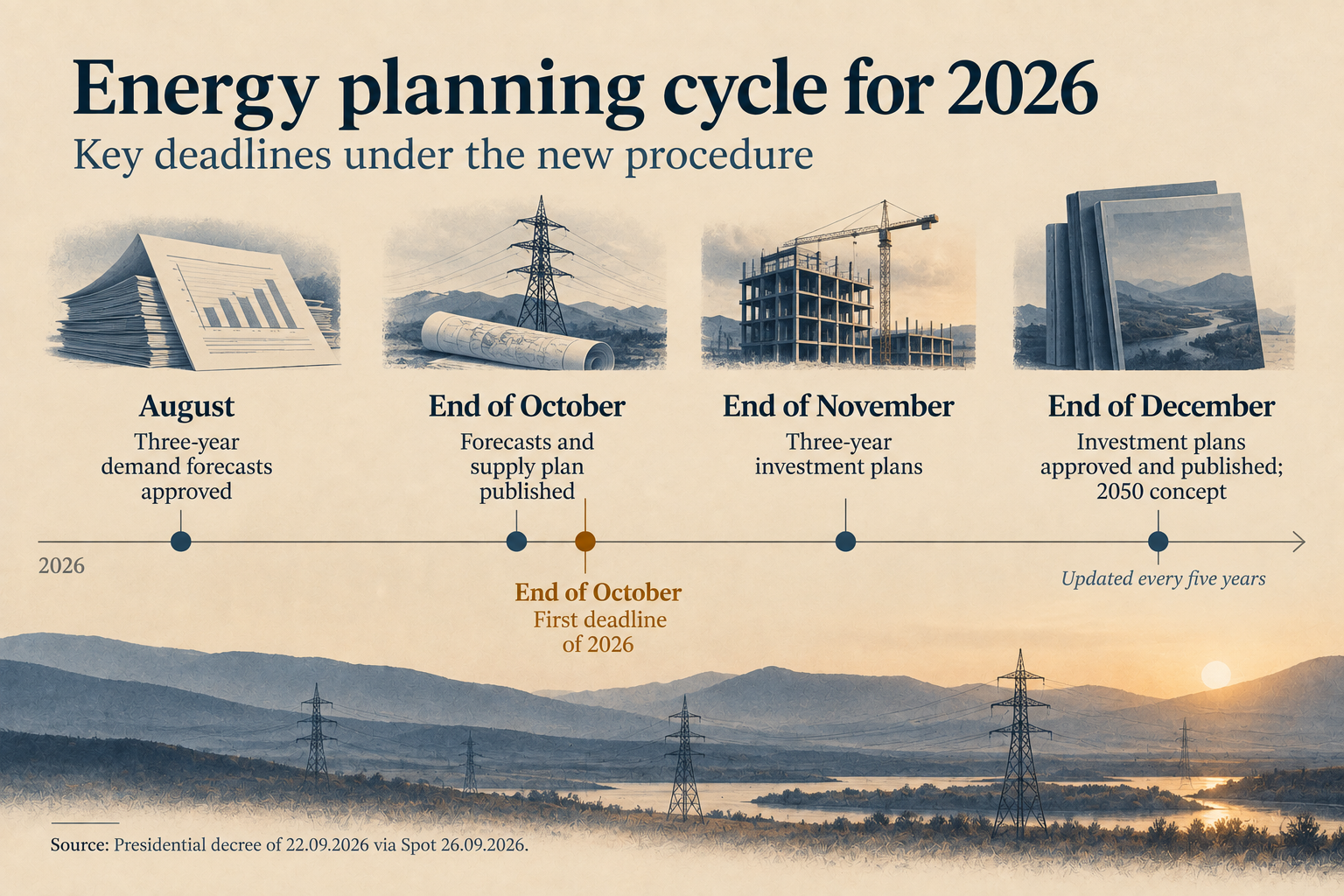
Every year by August the three bodies approve forecasts of demand for energy resources over three years, by region and by sector; on those forecasts they draw up a three-year strategic plan for supplying consumers. The forecasts and the plan must be published by the end of October. By the end of November come three-year investment plans naming the projects, their technical and economic indicators, their sources of financing and the land and money they need, to be approved and published by the end of the year.
Each project’s state partner is to prepare the design documentation with local and international specialists and then announce an open tender. Individual privileges and preferences inside projects are ruled out, as is the management of any project not in the investment plan; design work and the search for financing may no longer run in parallel with construction, except for projects built entirely on private money.
The forecasts and the plan must be published by the end of October.
The ministries also owe a concept of stable energy supply to 2050, to reach the cabinet and be published by December and to be updated every five years: the country’s fuel and energy potential, long-term demand with demography and the specialisation of regions, diversification into green and nuclear power and storage, efficiency and digital tools, and energy security and independence. Staff of the energy ministry, the regulator and the energy inspectorate will be sent on internships abroad, 50 students a year will go to foreign energy schools until 2030, and the state expects $50 million in grants for the training.
The first forecasts and plan under the decree fall due at the end of October, five weeks after the commissioning test at the 1,573 MW Syrdarya plant on 25 September took 1,600 MW off the grid and cut power across the borders in Kazakhstan, Bishkek and Tajikistan.