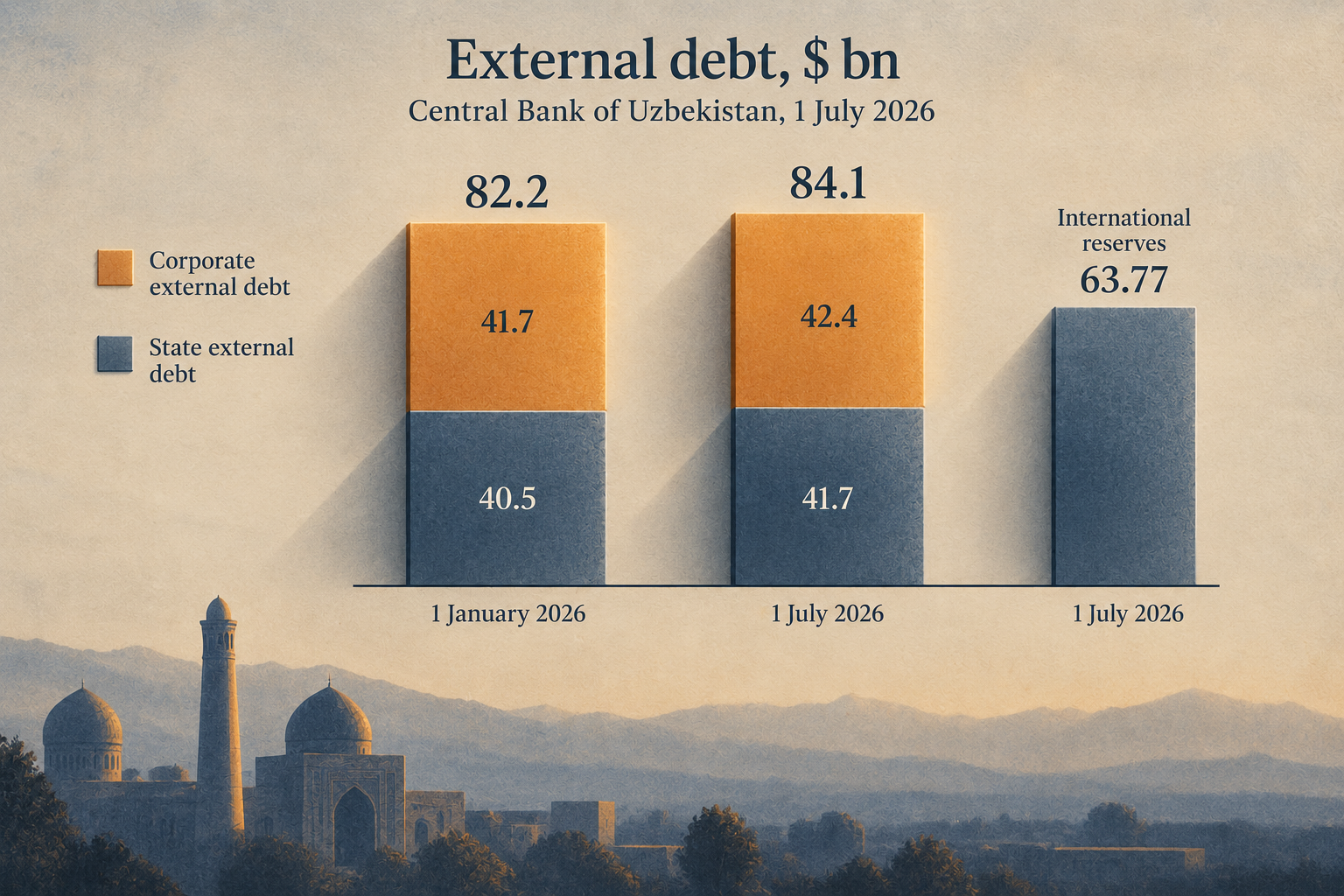
The review, published on Tuesday and carried by Spot on Wednesday at 10:06 Tashkent time, dates the debt to 1 July. Public external debt rose by $1.2 billion in the half, from $40.5 billion, and the private sector’s by $0.7 billion, from $41.7 billion, on Spot’s reading of the tables.
Its second number is the deficit. Over January to June the current account was about $6.2 billion in deficit, the net inflow of foreign direct investment $2.3 billion, and the Central Bank’s reserves $63.77 billion on 1 July.
The corporate half of the debt, $42.4 billion, now exceeds the state’s, as it has since at least the turn of the year, when Spot reported the corporate sector overtaking the state.
Exports of goods fell 8.6% against the first half of 2025 and imports rose 24%, the review says, and Spot gives the half-year totals as $15.4 billion and $28.8 billion.
Set against the debt, the reserves cover three quarters of it, $63.77 billion against $84.1 billion. The corporate half of the debt, $42.4 billion, now exceeds the state’s, as it has since at least the turn of the year, when Spot reported the corporate sector overtaking the state.
Unresolved: the ratio of the debt to output and its service cost for 2026, which the review does not state.