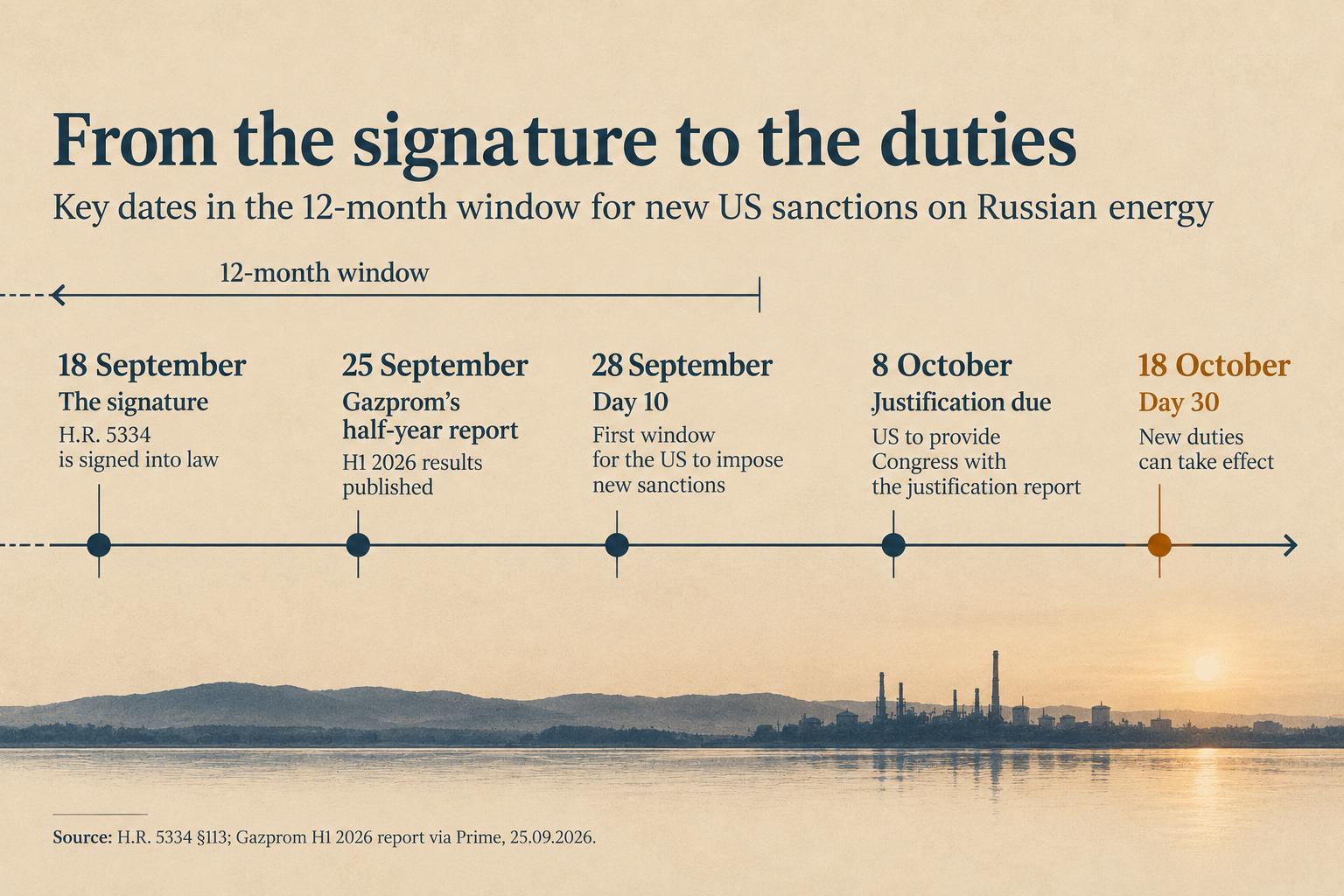
The sentence sits in Gazprom’s issuer’s report for the first half of 2026, which Prime quoted at 16:27 Moscow time on Friday. Aggregate supplies of Russian pipeline gas to the markets of the near abroad significantly, by 29%, exceeded the level of the same period a year earlier, it says, and the growth is mainly due to larger sales of gas to Kazakhstan. In Gazprom’s books the near abroad is the former Soviet market it still serves, and the report gives no cubic metres for any country in it.
The regional numbers on the record come from the buyers. Vice-minister of energy Kaiyrkhan Tutkyshbayev told the Tyumen forum on 16 September that Kazakhstan takes 11 billion cubic metres this year and is discussing about 9 billion for 2027, and that a supplement to the contract with Gazprom had been signed, with a long-term agreement to be discussed by the end of the year.
In Gazprom’s books the near abroad is the former Soviet market it still serves, and the report gives no cubic metres for any country in it.
Gazprom’s chief executive Alexei Miller said on 4 September that supplies to Kazakhstan, Kyrgyzstan and Uzbekistan had grown by almost 70% since the start of the year. The International Energy Agency expects Uzbekistan to take just over 10 billion cubic metres in 2026. The three figures cover three windows, a half-year, the year to 4 September and the calendar year, and none of them is the law’s 12 months to 18 September.
On those volumes CAW counted Kazakhstan and Uzbekistan in fourth and fifth place among the buyers of Russian gas on 18 September: China near 39 billion cubic metres and Turkey near 21 in 2025, Belarus near 18, Kazakhstan and Uzbekistan near 9 each over the law’s 12-month window, and France, Hungary and Japan between 8 and 9, all of it desk arithmetic on published figures. Gazprom’s sentence is the seller’s side of the same story: the growth in the half-year that sits inside the law’s window is, in its word, mainly Kazakh.
The Lindsey O. Graham Sanctioning Russia and Iran Act was signed on 18 September. Within 30 days, by 18 October, the president must raise duties to up to 100% on all goods from a country that makes new purchases of Russian crude oil or natural gas from day 30 and was among the five largest importers of Russian crude oil or natural gas by total volume over the 12 months before enactment. At least 10 days before that, by 8 October, the president or the trade representative must send the congressional committees a written justification with the methodology.
Gas is exempt for a country whose Russian gas was under 15% of Russia’s exports in the window and which has taken significant steps to cut it; the Congressional Research Service notes the act does not define significant steps.
The law firms that will advise the targets read the first wave three ways. Kelley Drye, on the day of the signing, describes two rankings, the five largest importers of Russian crude oil under tariff code 2709 and the five largest importers of natural gas under code 2711, and, citing a Reuters report, lists China, India, Slovakia, Hungary, Azerbaijan, France, Japan and Belgium.
Baker McKenzie, on 21 September, writes of the five largest importers of Russian crude oil and natural gas during the prior 12 months, a phrase that reads as one ranking. Akin Gump, on 23 September, repeats the statute’s oil or natural gas without choosing, calls China and India the two countries most likely in scope, and adds the names the bill’s proponents suggested: Azerbaijan, Hungary, Kazakhstan, Kyrgyzstan, Singapore, Slovakia, Turkiye and the United Arab Emirates.
The difference is the whole story for Astana and Tashkent. One combined ranking of oil and gas by volume fills the first list with crude buyers, China and India first, and leaves the pipeline-gas buyers of Central Asia outside it.
Two lists put Kazakhstan and Uzbekistan on the gas one, a billion cubic metres from the European and Japanese buyers of Russian LNG, and the exemption’s second prong, significant steps to cut the imports, is hard to claim while they rise. The statute writes the two lists into the first 180-day review and leaves the first wave to the justification of 8 October.
The region has said nothing. No statement on the list had appeared on Akorda’s pages or the Kazakh government’s index by Monday morning, and Kun.uz’s Monday listing carried none from Tashkent. The Treasury’s sanctions office lists its newest action on 24 September, regulatory amendments and a licensing report, and no step against a bank under the act’s section 103.
The trade representative’s press page runs to 27 September with a trade board with China, a labour probe and sugar tariffs, and nothing on Russia.
Unresolved on the record: the unit the trade representative will use for code 2711, which counts liquefied petroleum gases with pipeline gas, in tonnes or in cubic metres; the banks through which QazaqGaz and Uzbekneftegaz pay for the gas; and the re-export line Tutkyshbayev raised on 16 September, when he said the pricing policy is transparent and the work with Gazprom has been done, without naming a buyer for gas that leaves Kazakhstan again.