Search
China's refiners halt fuel exports for October, and Mongolia has 18,000 tonnes on order
Chinese refiners have halted exports of petrol, diesel and jet fuel for October to every destination but Hong Kong and Macau, Reuters reported on Thursday, citing 4 sources. Mongolia has ordered 8,000 tonnes of petrol and more than 10,000 of diesel from China for the month, Kyrgyzstan thanked Beijing last week for stable supplies, and Russia's producers' diesel export ban runs to 31 October.
Drivers circle Sukhbaatar Square as Mongolia's opposition moves on the cabinet
Cars circled Ulaanbaatar's central square on 1 October in protest at a petrol shortage that began in July. In parliament, a Democratic Party MP read out the loan ledger behind a ₮500 billion fuel-storage programme and said the whole cabinet must answer, while his party collects signatures to bring down the government. The fuel headquarters and the Khural plenary sit at 14:00 Ulaanbaatar time.
Pashinyan tells Rosatom the new reactor will be chosen on price, safety, dates and guarantees
Nikol Pashinyan received Rosatom’s director general Alexei Likhachev on Tuesday and discussed the extension of the second unit of the Armenian nuclear plant and Russia’s proposals for a new unit, his office said. The government is still weighing offers from international partners and will decide soon, and the final decision “will be of an exclusively economic nature, taking account of price, quality, safety, timing and guarantees”.

Georgia switches off its intraday power market for 9 months from Thursday
The Georgian Energy Exchange suspends its intraday electricity market from 1 October to 1 July 2027, under a government resolution of 8 September and a regulator’s rule change of 18 September, the exchange said in a notice dated Tuesday. Trading on the day-ahead market continues as usual. Participants lose access to the intraday trading system for the 9 months and keep their registered portfolios.
Mongolia’s newest petrol train is 5 to 6 days of use, and Russia keeps its diesel ban to 31 October
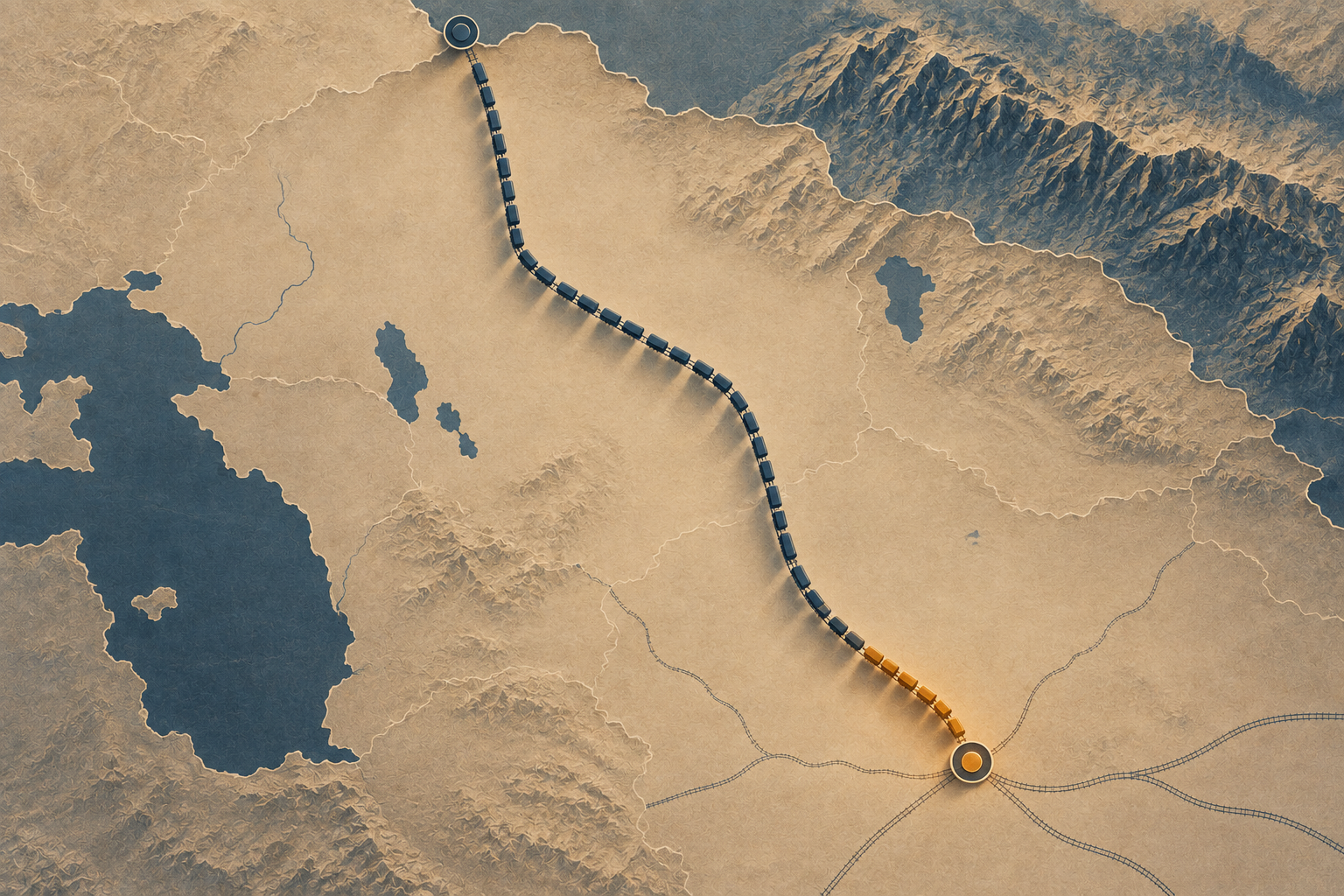
The 13,000 tonnes of AI-92 petrol that reached Ulaanbaatar by rail in 217 wagons cover 5 to 6 days of normal use, the head of the oil department at the Mineral Resources and Petroleum Authority, D. Davaabayar, said at a briefing on Wednesday. Sixty-eight of the wagons had reached the unloading station. The same morning Russia’s government extended its producers’ ban on diesel exports to 31 October.
Baku ratifies Gran Tierra’s onshore PSA for 5 northern districts, 7 months after its signing
The Milli Majlis ratified on Wednesday, in a single reading, the exploration, development and production sharing agreement between SOCAR, Gran Tierra Energy (Azerbaijan) GmbH and SOCAR Quba-Khazaryani for parts of the Quba, Qusar, Shabran, Siyazan and Khizi districts, APA reported at 15:14 Baku time. The agreement was signed in Baku on 18 February. Gran Tierra holds 65% and operates.
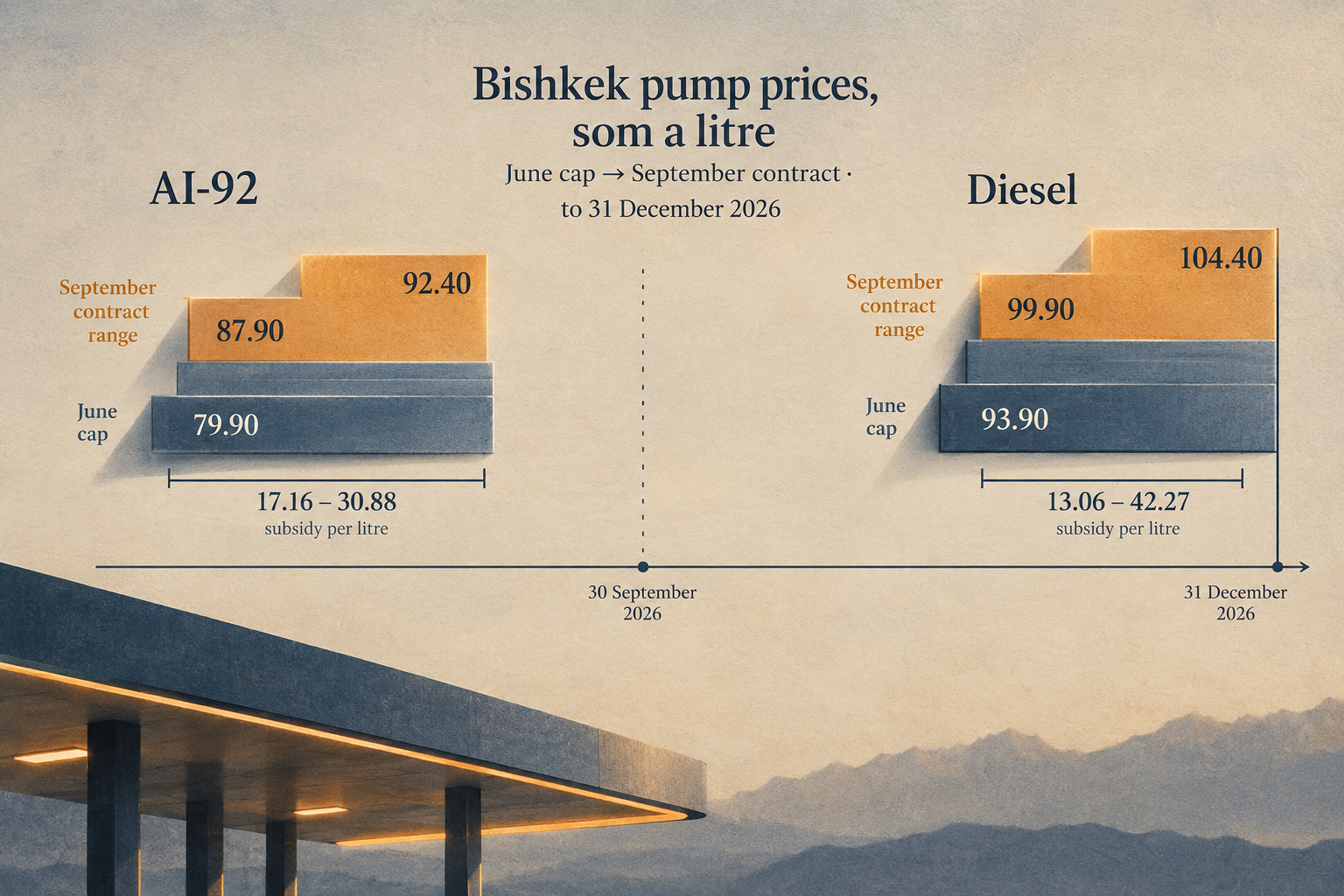
Kyrgyzstan’s fuel cap expires tonight while its subsidised price agreements run to 31 December
The cap on fuel prices that the cabinet set in May runs out tonight, and nothing changes at the pump on Thursday. A second resolution of 7 July moved price-setting to agreements between the antimonopoly service and the sellers, the service printed the agreed ranges on 11 September, and the subsidy that holds them runs to 31 December, the economy ministry says. The cap stopped setting prices 12 weeks ago.
Astana says the Graham act’s tariffs do not reach Kazakhstan, whose gas imports put it near the cut
Kazakhstan is not covered by the tariff measures the law provides for, the foreign ministry told the Kazakh outlet Ulysmedia.kz in a written answer published on Tuesday at 17:08. Its 3 sentences name no volume and no exemption, and they are the first official word from Astana on the Lindsey O. Graham Sanctioning Russia and Iran Act since Donald Trump signed it on 18 September.
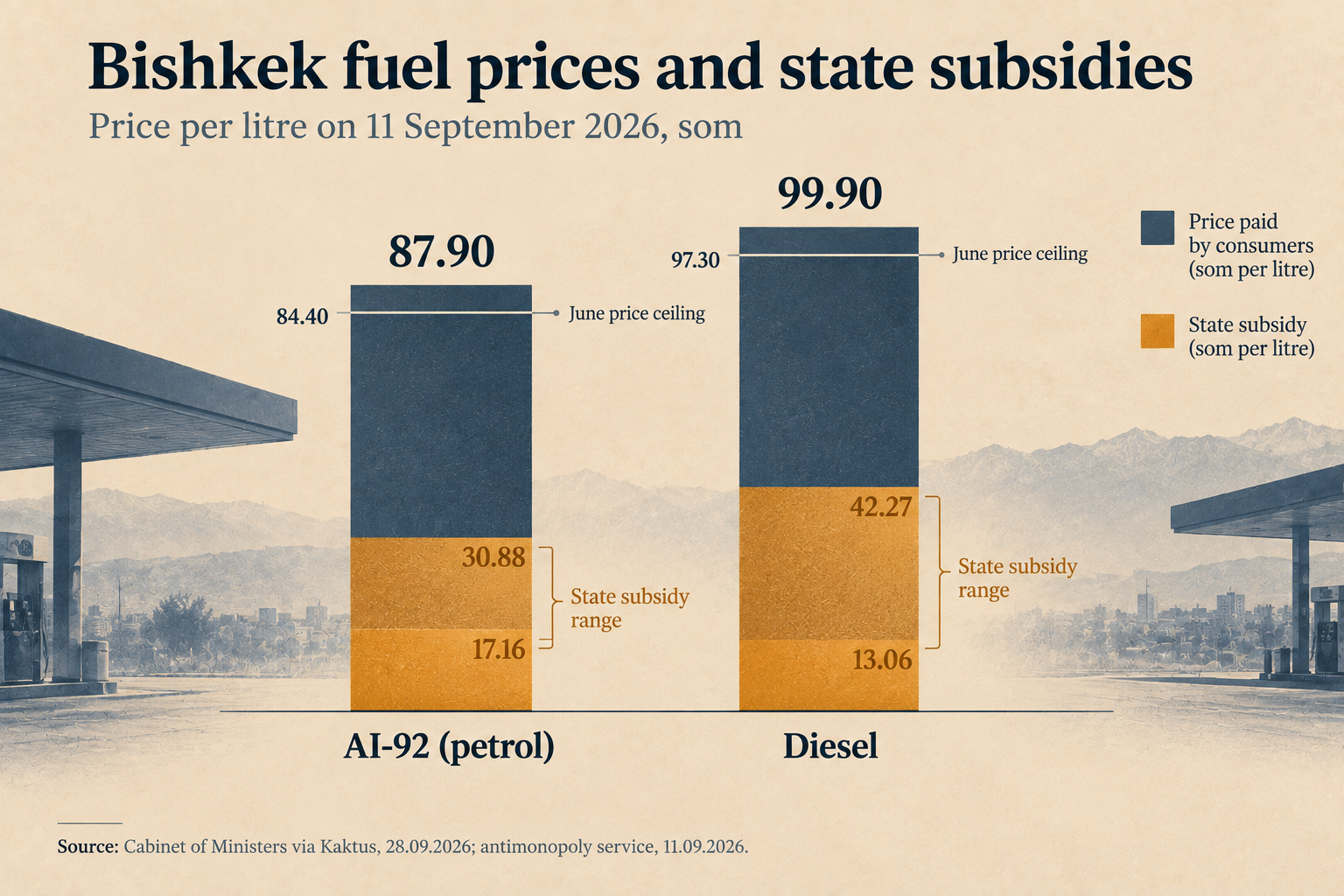
Bishkek's diesel subsidy reaches 42 som a litre with 2 days left on its fuel price ceilings
The Kyrgyz cabinet's readout of Monday's fuel meeting gives the subsidy paid to importers per litre in ranges set by contract: 17.16 to 30.88 som on AI-92 petrol, 13.06 to 42.27 som on diesel, 0.46 to 1.40 som on autogas. The antimonopoly service's price ceilings, in force since 25 May, run to 30 September. It does not mention them.
Russia locks away its fuel export data, and the region loses the numbers behind its diesel
Decree 686, published on Monday, bars anyone in Russia from publishing what its fuel exporters ship, to whom, at what price and through which port, plus refinery output and exchange sales of petrol and diesel. Companies may disclose their own figures; the government has 10 days to list the goods covered. Kazakhstan, Kyrgyzstan, Tajikistan and Mongolia, whose Russian diesel intake doubled in August, lose the exporter's side of the count.
Uzbekistan puts its energy sector on three-year plans and bars projects outside them
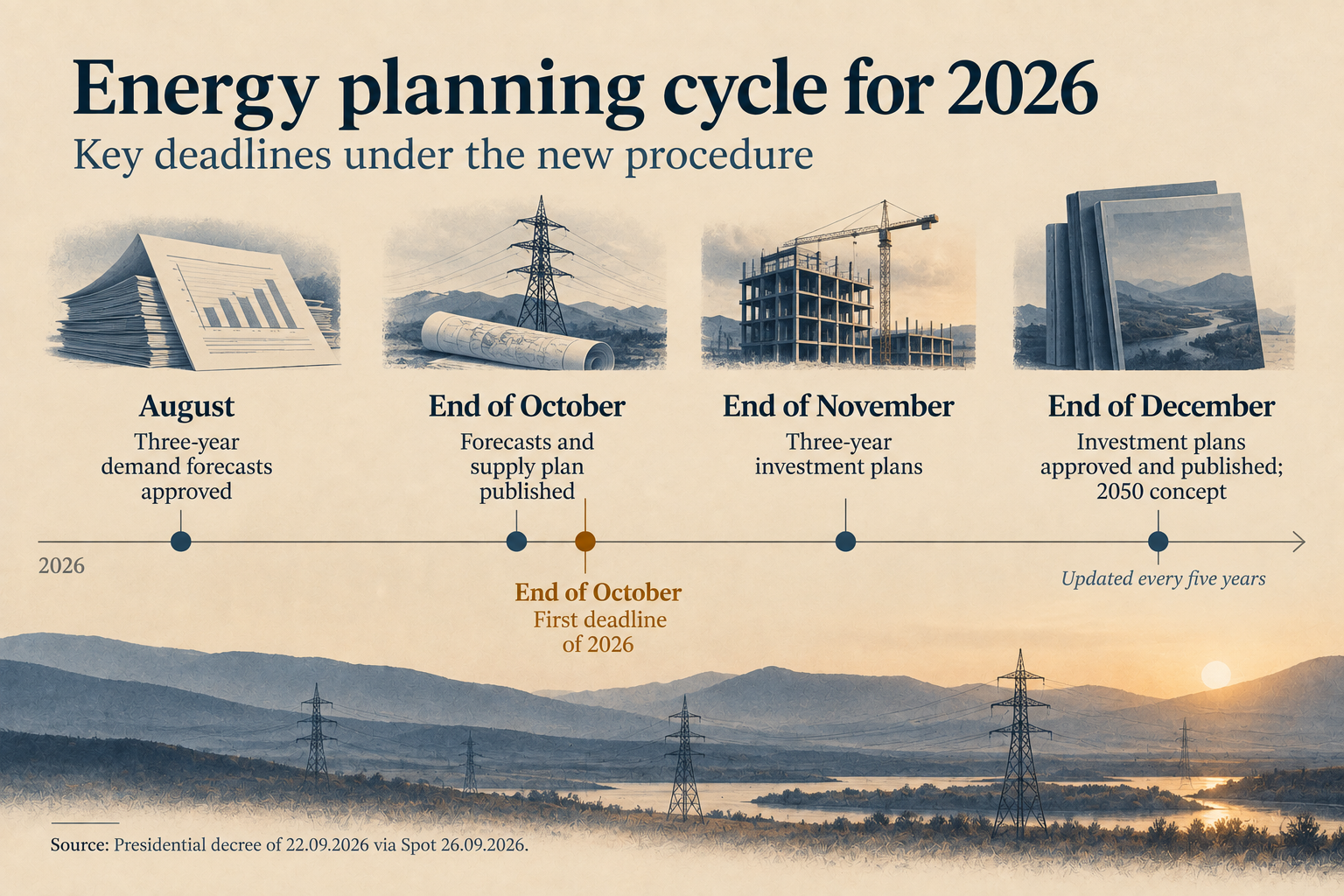
A presidential decree of 22 September, reported by Spot on Saturday, makes the energy ministry, the economy and finance ministry and the energy market regulator publish three-year demand forecasts and a three-year supply plan by the end of every October, with investment plans to follow by the end of November. No individual privileges may be granted inside the projects, and no project outside the plan may be run.
Gazprom says its growth is Kazakhstan, and the USTR has 10 days to show its count
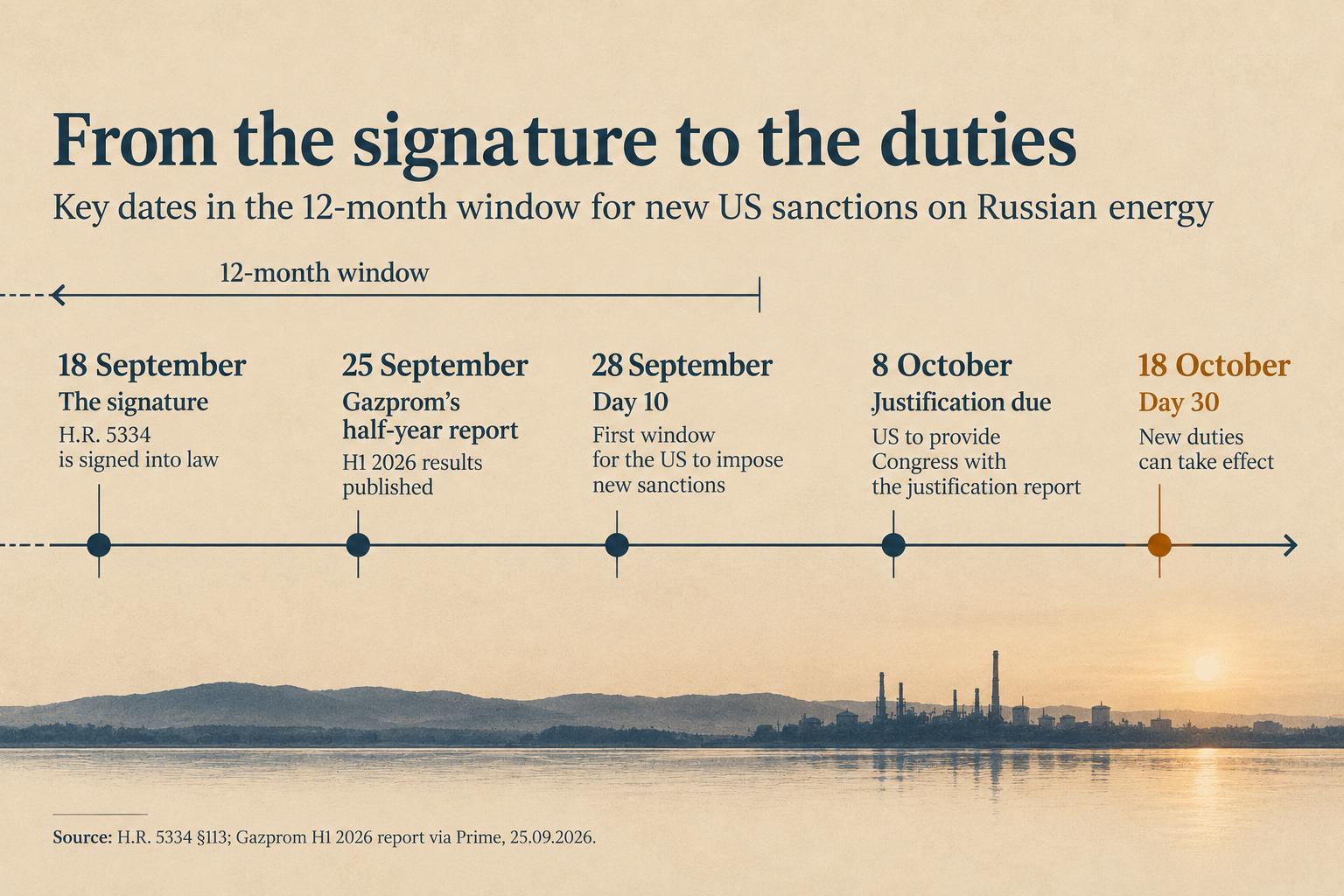
Gazprom’s half-year report, as Prime quoted it on Friday afternoon, says its pipeline sales to the near abroad rose 29% in the first half of 2026 mainly because of Kazakhstan, and prints no volume. Monday is day 10 of the law that ranks Russia’s gas buyers; the US Trade Representative’s written justification is due by 8 October, and its press page through 27 September carries nothing on it.

Russian gas flows to Armenia again after 10 days of pipeline work: 2.7 billion cubic metres a year through one line across Georgia while Simonyan names four suppliers for the future
Gazprom Armenia said gas deliveries through the North Caucasus-Transcaucasia trunk pipeline resumed on 25 September after a suspension “from 15 September” for planned maintenance and repair on the Russian section, Interfax reported at 12:20 Moscow time. The line carried about 2.7 billion cubic metres to Armenia in 2025, beside the roughly 476 million a year that arrive from Iran in the gas-for-electricity swap, and Interfax put the contract price at $177.5 per 1,000 cubic metres to the end of 2026 or the start of 2027; Security Council secretary Alen Simonyan had given $165 at the border on 16 September, frozen since 2019.
Friday’s Syrdarya trip reached Bishkek and Tajikistan as well: two districts of the Kyrgyz capital were dark until 09:24 while Tajikistan’s grid steadied in minutes
The dawn trip at Uzbekistan’s new Syrdarya plant, which took 1,600 MW off the Uzbek grid at 05:05 Tashkent time and split Kazakhstan’s north-south transit, also cut power in the Pervomaisky and Sverdlovsky districts of Bishkek for two to three and a half hours and set off the emergency automation in Tajikistan, the Kyrgyz operator and the Tajik ministry said on Friday. Kyrgyzstan’s National Electric Networks restored the city centre at about 08:15 and the microdistricts from about 09:24 Bishkek time; Tajikistan’s energy ministry said its system steadied “within minutes” and works normally, and that the cause is being established with the dispatch centre Energia and the neighbouring systems.

A dawn test at the new Syrdarya plant knocks 1,600 MW off Uzbekistan’s grid, splits Kazakhstan’s north-south transit and sheds 962 MW in the south for 41 minutes
At 05:05 on Friday, during commissioning tests at the new 1,573 MW thermal plant in Bayavut district of Syrdarya region, built by the consortium of France’s EDF, Qatar’s Nebras Power and Japan’s Sojitz and Kyuden, 1,600 MW of capacity dropped out of Uzbekistan’s grid and households and farm water pumps in several regions lost power, the energy ministry said through its Telegram channel; reserves at other plants and the storage systems were brought in, every consumer was back by 07:27, and the ministry apologised, Spot reported at 07:54. Kazakhstan’s grid operator KEGOC put the loss at 1,516 MW at 05:02, said the surge of power flow split its north-south transit, restricted 962 MW of consumption, and restored the southern zone’s parallel operation with the Central Asian systems at 05:43, Forbes.kz reported.

Three governments spend 3 days in Almaty on the Kambar-Ata-1 agreement: the World Bank watches and the only sum on the table is Kazakhstan’s plan to borrow $500 million for its third of the dam
Kyrgyzstan, Kazakhstan and Uzbekistan held the third round of talks on the intergovernmental agreement on Kambar-Ata-1 in Almaty from 21 to 23 September, the Kyrgyz energy ministry said on Thursday through Economist.kg: deputy energy minister Salaat Sadyrakunov for Bishkek, first vice-minister of water resources and irrigation Nurlan Aldamzharov for Astana, first deputy energy minister Umid Mamadaminov for Tashkent, with the World Bank’s representatives in the room as observers. That document is to define the joint construction and management of the plant, the approach to financing it and the coordination between the 3 states, and the sum in the room is Kazakhstan’s plan, first reported by Economist.kg in March, to borrow about $500 million from the bank’s structures for the construction.
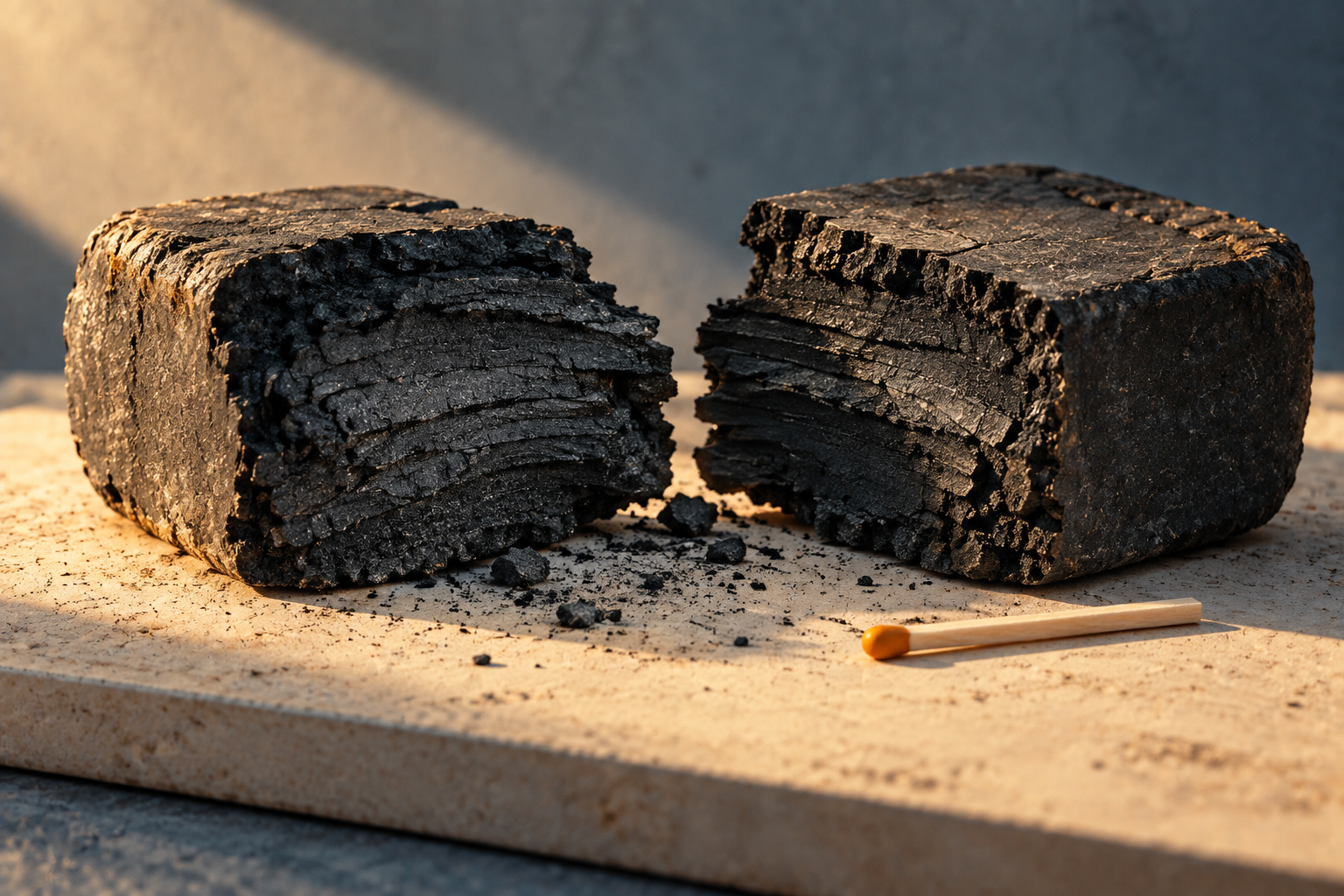
Mongolia’s cabinet orders a coal pyrolysis plant at Baganuur for 600,000 tonnes of semi-coke a year, 67% owned by the sovereign fund, to be running by early 2028
The government decided at its regular meeting on Wednesday to build a coal pyrolysis plant on the Baganuur mine through a public-private partnership: 600,000 tonnes of semi-coke a year, a 40 MW power unit and 400 jobs, with construction starting in the fourth quarter of 2026 and commissioning in the first quarter of 2028, Montsame reported. Chinggis Khaan Sovereign Wealth Fund Holding is to hold 67% of the operating company, Baganuur Coal-Chemical Plant LLC, and the capital city 33%; the stated purpose is to cut Ulaanbaatar’s air pollution with a smokeless fuel.

Pashinyan says Armenia is talking to 5 countries about a new nuclear plant, with Rosatom’s 1,200 MW study already in Yerevan and Metsamor’s life running to 2026
Armenia is negotiating with the United States, Russia, China, France and South Korea over a new nuclear power plant and “is looking for the best offer to start construction”, Prime Minister Nikol Pashinyan said at a panel of the Concordia summit in New York, Arka reported on Wednesday at 14:27. Metsamor supplies up to 40% of the country’s electricity, its operating life has been extended to 2026 and work is under way on a further extension of 10 years; a preliminary feasibility study by Rosatom for a new 1,200 MW unit is already before the Armenian side, and the plan is to build the new plant within 8 to 10 years.
Tashkent plans 57.2 GW by 2035 with 26 storage projects and nearly 5,000 km of new lines behind a grid it says will now be built from demand
President Shavkat Mirziyoyev reviewed a plan on Tuesday that takes Uzbekistan’s generating capacity to 46.1 GW by 2030, for about 129 billion kWh a year, and to 57.2 GW by 2035, for 154.7 billion, the presidential press service reported. The plan counts 6.3 GW of solar and wind already built, more than 100 hydro plants at close to 2.5 GW, 26 storage projects of 4.2 GW with 17 under way, and, by 2030, 9 new 220 kV substations, 7 at 500 kV and almost 5,000 km of new transmission lines. Its stated method is new: demand is set first, then the plants and the wires.
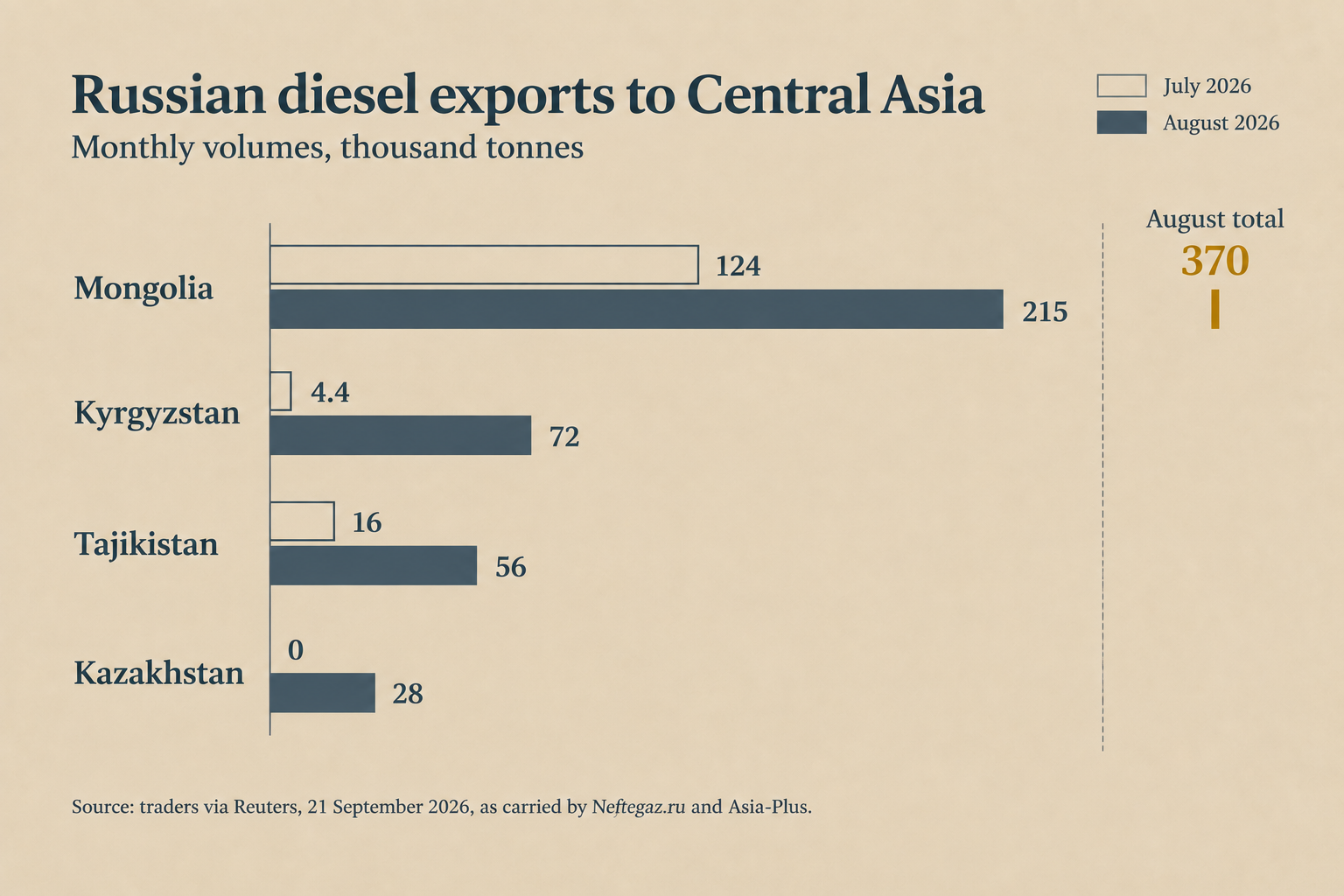
Russia’s diesel to 4 buyers in Central Asia and Mongolia doubled in August to 370,000 tonnes, with Mongolia taking 215,000 and Kyrgyzstan’s intake rising from 4,400 to 72,000
Russian diesel exports to Kazakhstan, Kyrgyzstan, Tajikistan and Mongolia exceeded 370,000 tonnes in August, more than double July’s, traders told Reuters on Monday in figures Neftegaz.ru carried the same evening and Asia-Plus on Tuesday. Mongolia took about 215,000 tonnes against 124,000 in July, Kyrgyzstan more than 72,000 against 4,400, Tajikistan more than 56,000 against 16,000, and Kazakhstan, which imported none in July, about 28,000. Over January to August Russia sent 2.5 million tonnes of diesel to Central Asia and Afghanistan, against 2.6 million a year earlier.