Cabinet chairman Adylbek Kasymaliev chaired Monday's meeting on domestic fuel supply, and Kaktus carried the cabinet's readout at 21:48 Bishkek time. The cabinet keeps paying the importers, and it prints the price per litre of doing so. Stocks, deliveries, prices and the stability of supply were discussed, and state bodies were told to tighten control over supplies and stocks.
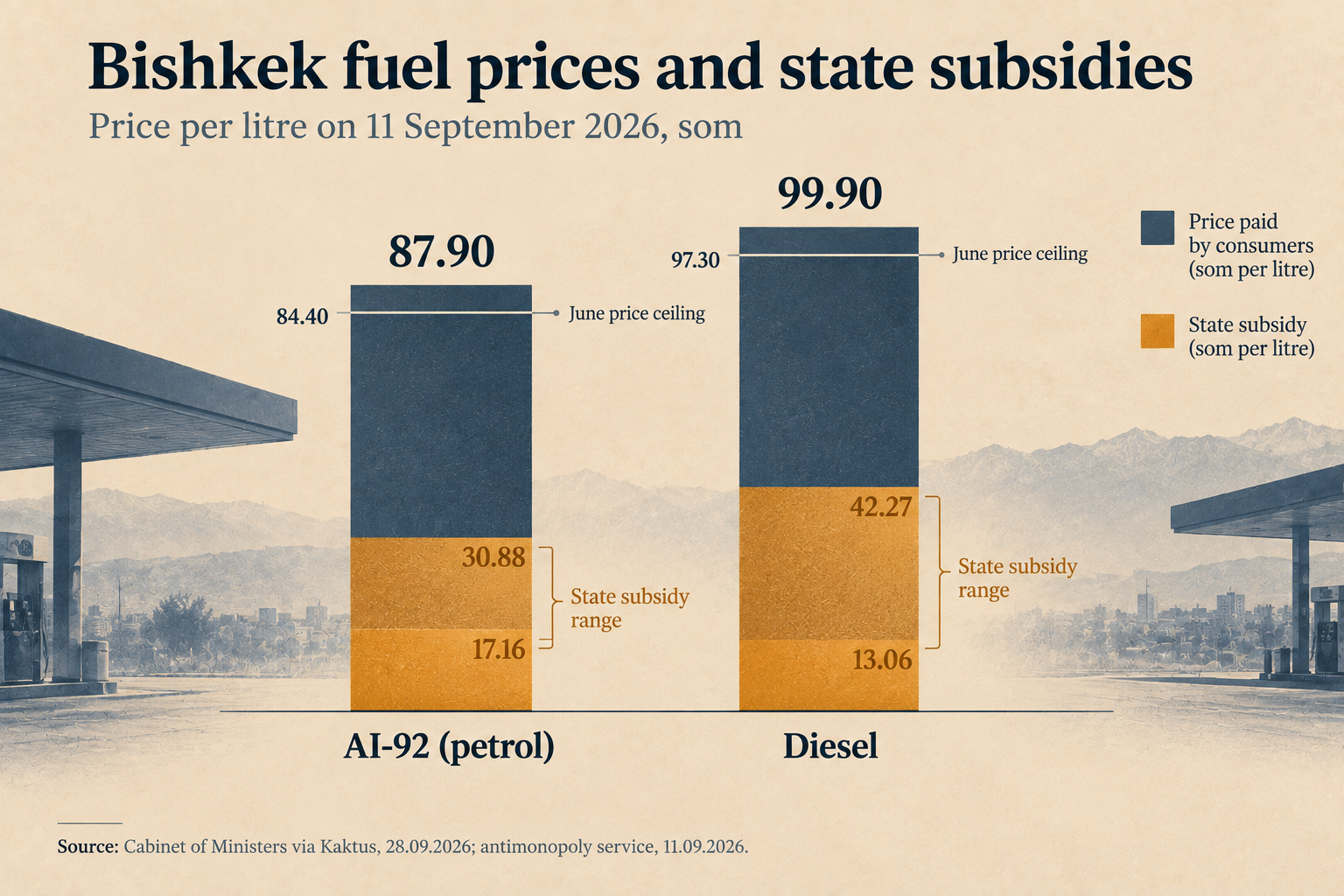
Under resolution 579 the cabinet compensates importers against dollar reference prices; the readout gives what that comes to per litre. On AI-92 petrol the subsidy runs from 17.16 to 30.88 som depending on the contract; on diesel from 13.06 to 42.27 som; on liquefied gas from 46 tyiyn to 1.40 som. No total for the year and no end date for the payments are given.
The cabinet keeps paying the importers, and it prints the price per litre of doing so.
On 11 September the antimonopoly service printed Bishkek's prices: 87.90 som a litre for AI-92, 99.90 for diesel, 48.80 for autogas. At the top of its range the diesel subsidy is 42% of that pump price, the petrol subsidy 35%. Daniyar Amangeldiev, the first deputy chairman of the cabinet, told parliament last week that the state covers "practically 40%" of the price, and the 2027 draft budget pledges 39 billion som against inflation.
By 25 August the cabinet had allocated 956 million som to importers under the scheme, on the figures it published then. Monday's readout adds the rate and withholds the volumes.
The ceilings are the antimonopoly service's order of June: ranges, 79.80 to 84.40 som for AI-92, 88.90 to 89.90 for AI-95, 93.80 to 97.30 for diesel, 45.80 to 48.80 for autogas, from 25 May to 30 September. The service's price table of 11 September already sat above the tops of the petrol and diesel ranges, which it described as prices set "within agreements with the companies that import oil products and sell them through filling stations".
Since at least 11 September, then, the ceilings have not held the pump; what runs out on Wednesday is the instrument, and Monday's readout does not say what replaces it. No new order had surfaced on Kaktus or Economist.kg by Tuesday morning.
The same evening the antimonopoly service proposed a different answer: making diesel from coal. Kyrgyzstan has about 70 deposits with forecast reserves above 6.4 billion tonnes, its note says; a tonne of coal yields 200 to 300 kilograms, or 240 to 360 litres, of liquid fuel; a notional plant of 100,000 tonnes a year would need 330,000 to 500,000 tonnes of coal and $100 million to $200 million, or 9 to 18 billion som.
Two Kazakh projects of the same size are costed at $63 million and $65 million, the service says. Its proposal went to the presidential administration and the economy ministry.
In August Kyrgyzstan took more than 72,000 tonnes of Russian diesel, on Reuters's count of traders' data. The plant the service sketches would produce in a year what arrived in about 6 weeks at August's pace; the country's total diesel demand is not in its note.
What changes next: 1 October is the first pump day without ceilings unless an order appears before it; the cabinet has given ranges but no total for 2026 and no end date for the subsidy; and the coal-to-liquid proposal now sits with the president's office and the economy ministry.