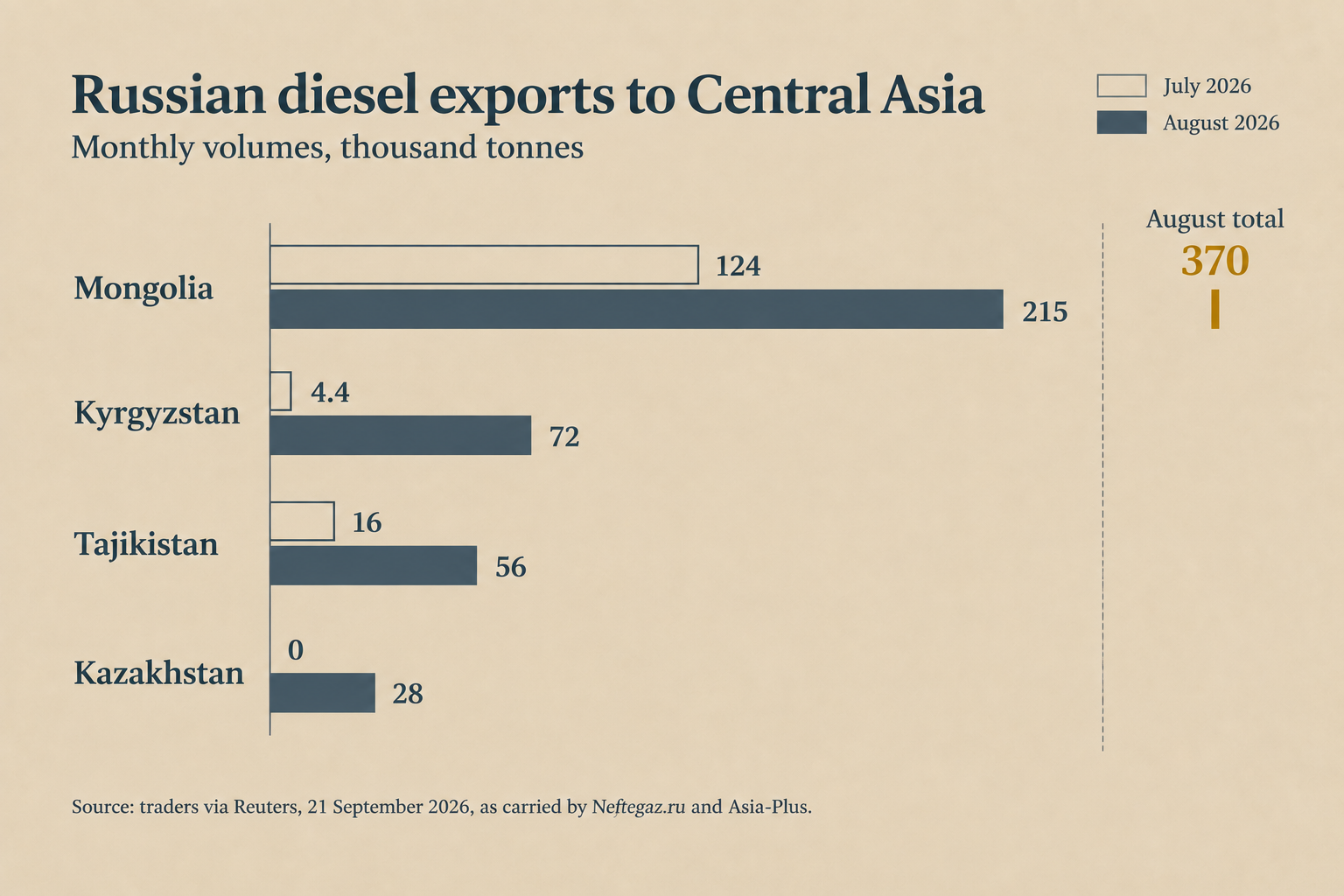
The traders’ explanation is supply: Russian diesel production recovered to about 170,000 tonnes a day in August. The export ban for producers, resolution 854 of 8 July as extended by 1097 of 28 August, kept “the possibility of supplies to countries including the former Soviet republics and Mongolia under intergovernmental agreements”, and the August tonnes went out through that door, as Neftegaz.ru frames it.
Tajikistan is where the July gap was priced at the pump. Diesel disappeared from some Dushanbe filling stations in early July; where it remained the price reached 17 to 18 somoni a litre by the end of the month; on 31 August the Dushanbe average was about 16.5 somoni, below the July peak and 50% above early June’s 11, Asia-Plus writes. In the first half of the year the republic imported 599,500 tonnes of oil products, 91.1% of them from Russia, on the antimonopoly service’s count.
August’s surge has not restored the year.
Mongolia’s 215,000 tonnes are the largest line in the region’s August book and the one counted most recently on the ground: the industry ministry’s fuel headquarters held 730 tank wagons of diesel on the Ulaanbaatar railway on Monday morning, about 8 days of sales on CAW’s arithmetic. Kyrgyzstan’s jump from 4,400 to 72,000 tonnes in one month sits inside the intergovernmental supply of 100,000 tonnes of fuel a month that Bishkek has to the end of the year; Kazakhstan, a refiner itself, took 28,000 after a July with none.
The 8-month total says what one month cannot: 2.5 million tonnes against 2.6 million. August’s surge has not restored the year. The figures end before 20 September, when Gazprom Neft’s Moscow refinery stopped processing crude, and before Deputy Prime Minister Novak’s order of Monday for risk scenarios on the domestic market. September’s diesel to the 4 will show whether the intergovernmental door stays as wide as it was in August.