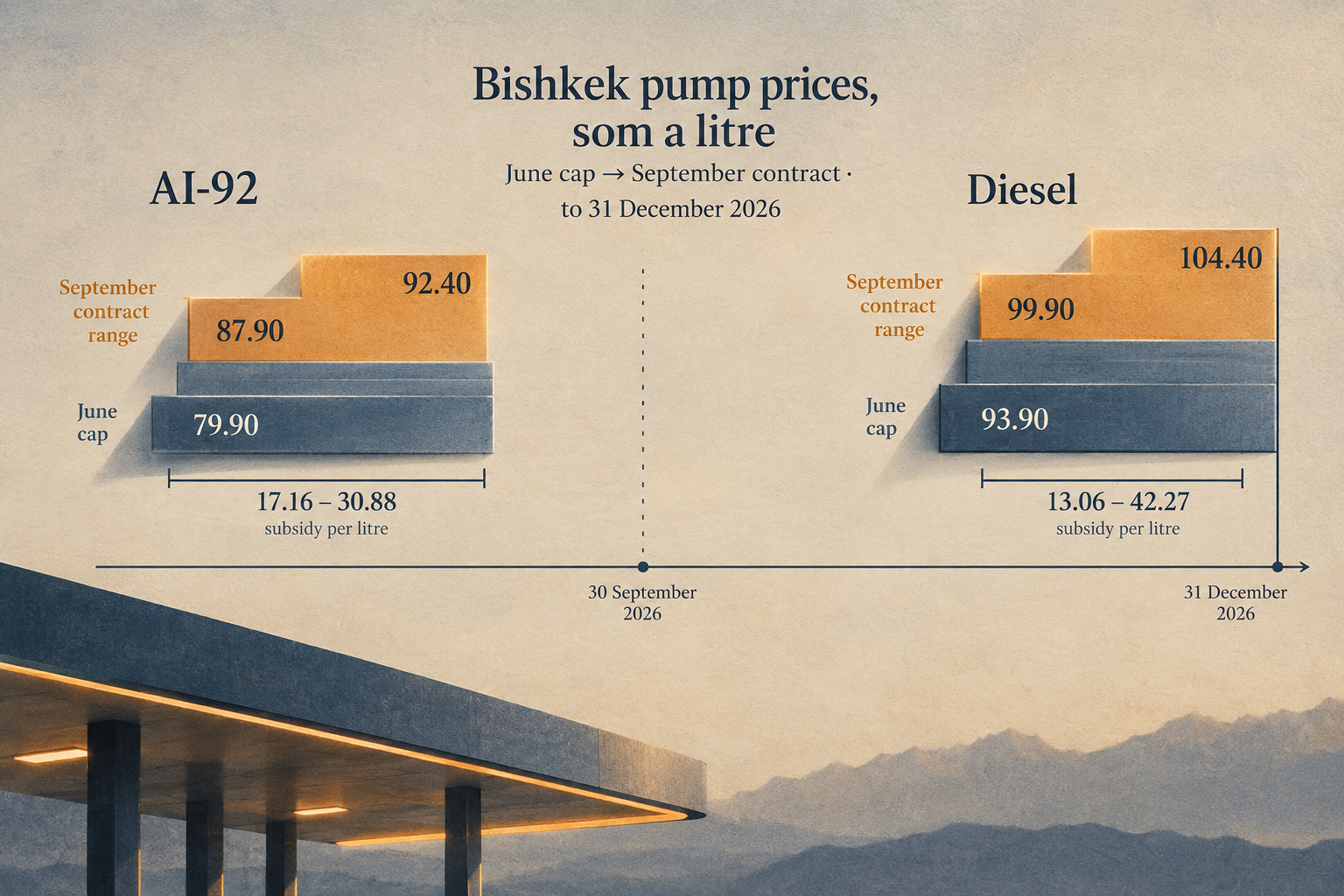
Cabinet resolution 369 of 25 May introduced temporary state regulation of fuel prices for the period to 30 September, with maximum retail prices and a subsidy to importers for the gap between the cost of imported fuel and the price at the pump. In June the caps in Bishkek were 79.90 som a litre for AI-92 petrol, 93.90 for diesel and 45.80 for autogas, with regional ranges up to 84.40, 97.30 and 48.80, Economist.kg and Vecherny Bishkek recorded.
On 7 July resolution 464 changed the mechanism. Regulation now works through price agreements with market participants, and AI-95 left the regulated list. On 28 July the antimonopoly service signed the agreements with the companies that sell fuel through filling stations, under which they sell at prices set by an approved schedule of changes, keep fuel available and report their wholesale purchase prices, K-News reported that day.
The order of 25 May expires on 30 September, the agreements of 28 July and the ranges of 11 September run to 31 December, and the first pump day of October opens on the September prices.
On 11 September the agreed prices appeared: 87.90 to 92.40 som for AI-92 by region, 99.90 to 104.40 for diesel, 48.80 to 51.80 for autogas, with branded fuel up to 1.50 som above the standard price, and the service said its control measures run to the end of 2026, Time.kg reported that day. Both new ranges for petrol and diesel start above the tops of the June caps, 87.90 against 84.40 and 99.90 against 97.30, and autogas starts where June’s range ended, at 48.80.
By 24 to 25 August the state had paid importers 956,139,000 som to cover the gap, the economy ministry said, and the subsidy is extended to 31 December, K-News reported on 21 September, without naming the instrument of the extension. The cabinet’s readout of Monday’s fuel meeting put the payment at 17.16 to 30.88 som a litre on petrol and 13.06 to 42.27 som on diesel, depending on the contract.
At the top of its range the diesel subsidy is 42% of the 99.90 som Bishkek price of 11 September, and the state covers “practically 40%” of the price, first deputy cabinet chairman Daniyar Amangeldiev told parliament last week, an average whose base he did not give. No total for this year is printed in the cabinet’s readout or in K-News’s account of the extension.
The order of 25 May expires on 30 September, the agreements of 28 July and the ranges of 11 September run to 31 December, and the first pump day of October opens on the September prices. Whether the ranges move again before the year’s end is the service’s to announce. Most of the fuel they price is Russian: Kyrgyzstan took more than 72,000 tonnes of Russian diesel in August, on Reuters’s count of traders’ data, against 4,400 tonnes a year earlier.