Kyrgyzstan

At the EAEU council, Lukashenko asks Armenia where its brandy will go if it chooses the EU
The Eurasian Intergovernmental Council met in Minsk on Friday under Kazakhstan’s chairmanship, with Pashinyan on a video link. Bektenov put the union’s first-half growth at 1.1% and its investment at $244.5 billion, Mishustin said mutual trade rose 10% from January to July, and Lukashenko told the heads of delegations that Armenia should work out where its brandy and fruit will go before it hurries to the EU.

Kyrgyzstan’s first satellite rides a Falcon 9 from Vandenberg and will be run from Bishkek
The president’s administration said the spacecraft went up on 1 October from Vandenberg in California on a SpaceX rideshare, the product of joint work with the United Arab Emirates. Sadyr Japarov, who watched the launch, said it is an earth-observation satellite for farmland, glaciers and disasters, built over about two and a half years, and that a communications satellite could follow in 5 to 10 years.
Bishkek screens every cash exchange and every crypto firm’s owner as sanctions clocks run
The cabinet approved an anti-laundering strategy to 2030 and rewrote its 2025 rules for virtual-asset firms: beneficial owners vetted by the financial intelligence service, mining licences reported monthly, identification for every cash exchange whatever the sum. The documents name no deadline. Russia’s cash-rouble cap took effect on Tuesday, US sanctions on banks dealing with Russian state banks are due from 18 October, and EU and US lists carry Kyrgyz names.

China's refiners halt fuel exports for October, and Mongolia has 18,000 tonnes on order
Chinese refiners have halted exports of petrol, diesel and jet fuel for October to every destination but Hong Kong and Macau, Reuters reported on Thursday, citing 4 sources. Mongolia has ordered 8,000 tonnes of petrol and more than 10,000 of diesel from China for the month, Kyrgyzstan thanked Beijing last week for stable supplies, and Russia's producers' diesel export ban runs to 31 October.
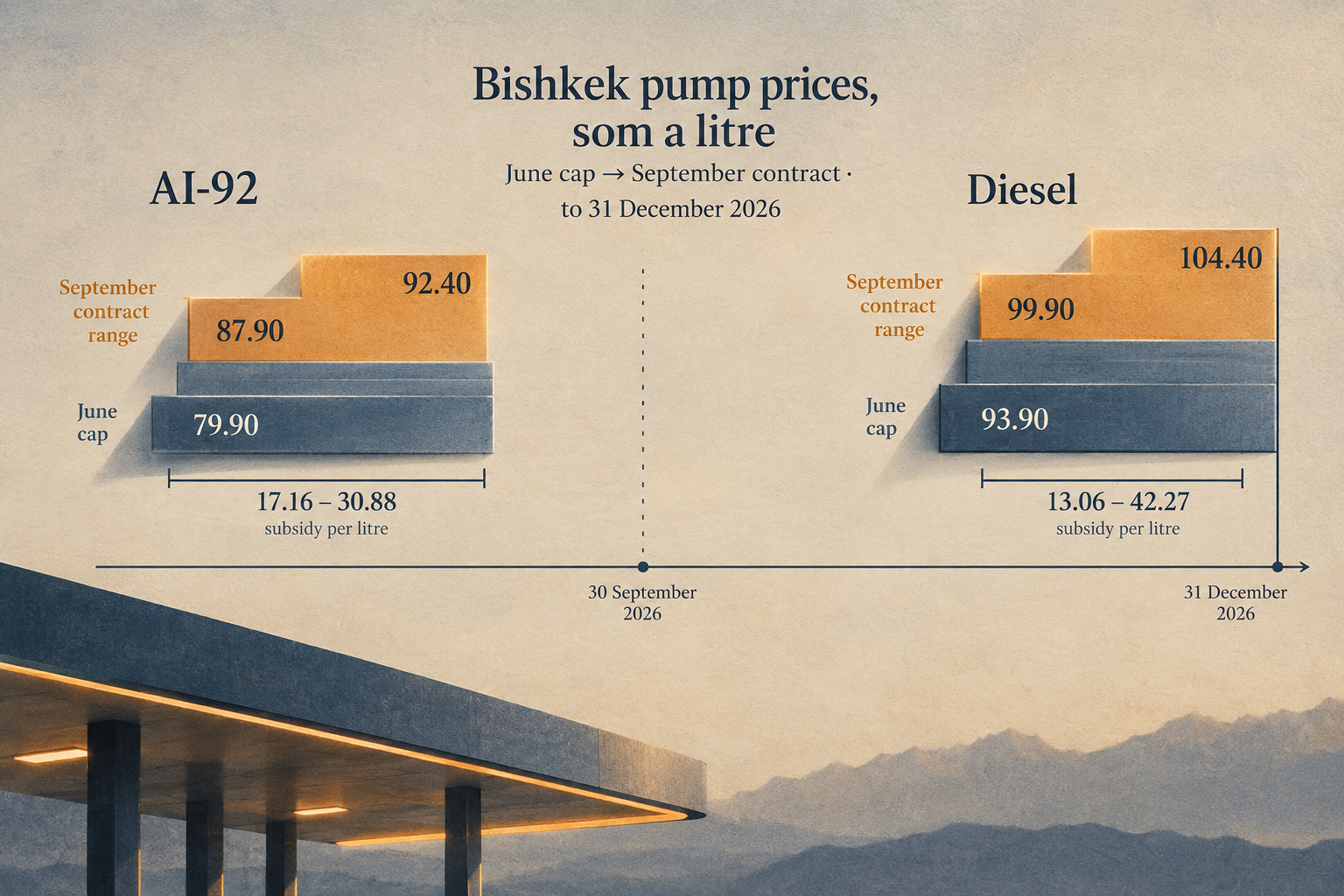
Kyrgyzstan’s fuel cap expires tonight while its subsidised price agreements run to 31 December
The cap on fuel prices that the cabinet set in May runs out tonight, and nothing changes at the pump on Thursday. A second resolution of 7 July moved price-setting to agreements between the antimonopoly service and the sellers, the service printed the agreed ranges on 11 September, and the subsidy that holds them runs to 31 December, the economy ministry says. The cap stopped setting prices 12 weeks ago.

Russia caps cash roubles for 7 neighbours at 1 million a head and bans firms from carrying any
A decree Vladimir Putin signed on Tuesday bans anyone from carrying more than 1 million roubles in cash out of Russia into the other 4 members of the Eurasian Economic Union, Azerbaijan, Tajikistan or Uzbekistan. Companies and sole traders may carry none, with 3 exceptions. The $100,000 ceiling that had applied since April is gone, and cash above the limit is confiscated at the border.
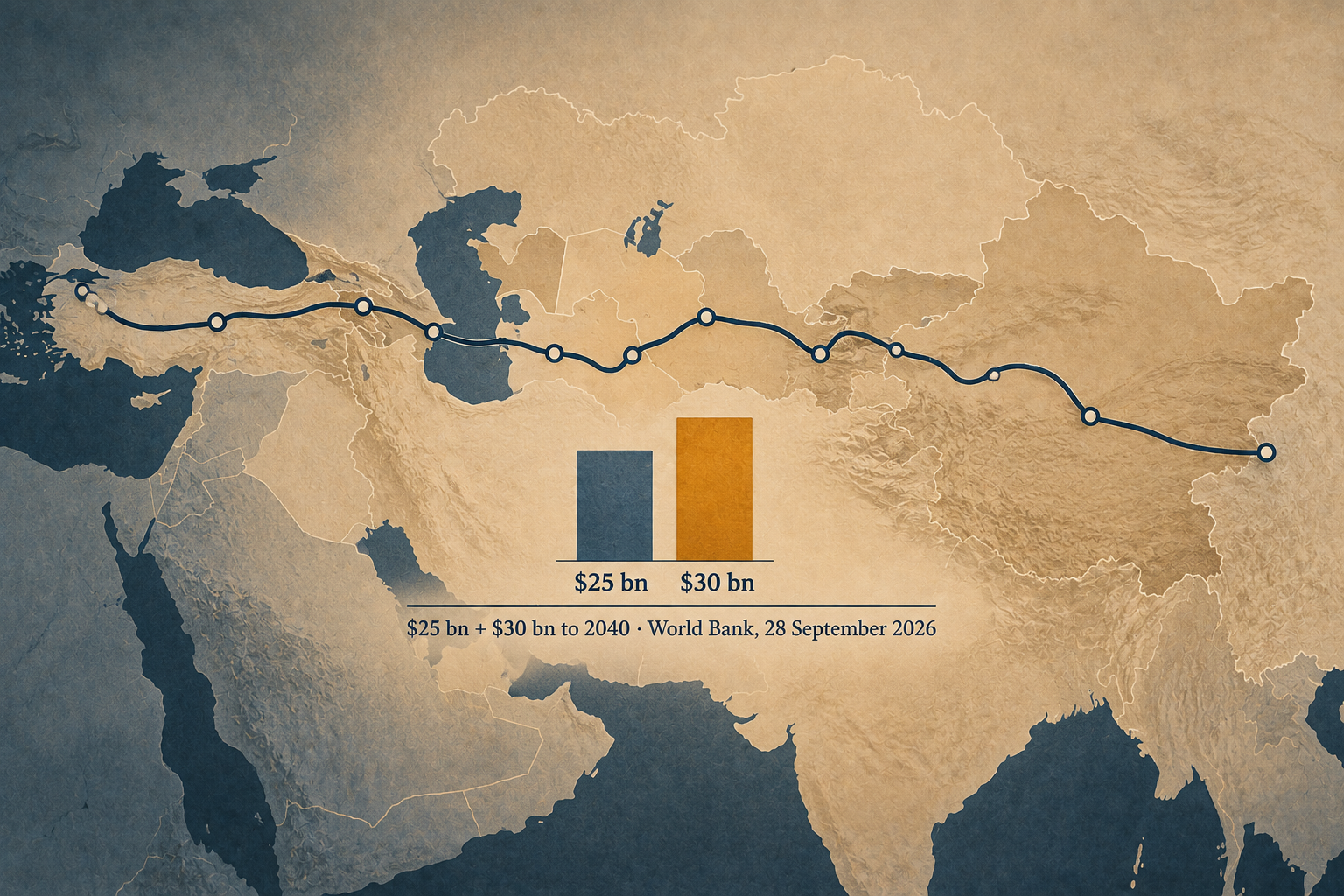
The World Bank prices the corridor at $55 billion to 2040, with $30 billion of it beyond the track
A World Bank report published on Monday says the Trans-Caspian corridor’s development could triple its volumes, halve its travel times, add 3.3% to the 9 countries’ GDP and create 2 million jobs by 2040. The bill it attaches is at least $25 billion of physical infrastructure and an estimated $30 billion of enabling investment. With reforms, the Bank says, the volumes would quadruple.
Five Years Ahead: the dawn that will come every dawn
Uzbekistan has approved 57.2 gigawatts of generating capacity for 2035. On Friday the region's grid showed what one new plant does to 4 countries before breakfast.
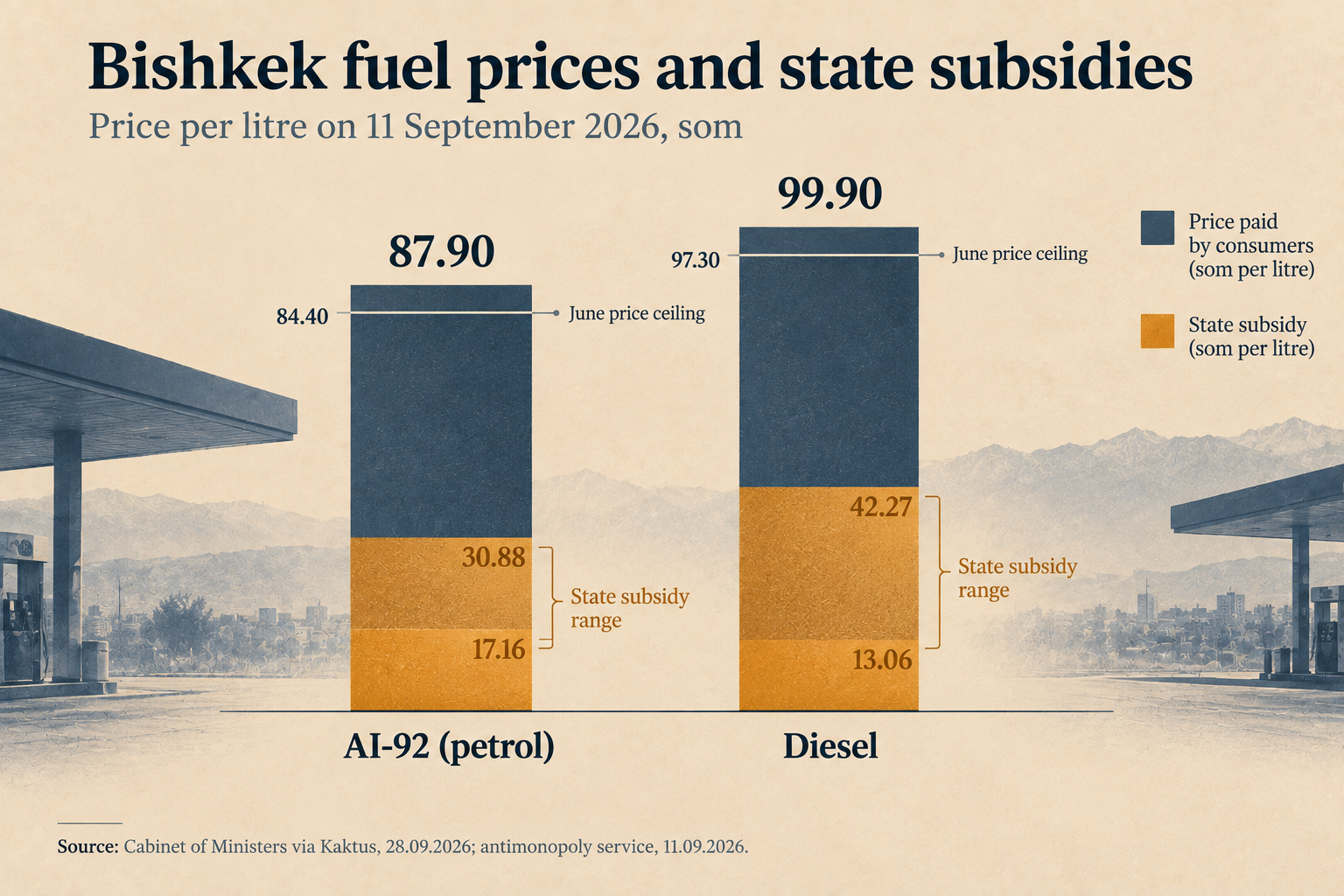
Bishkek's diesel subsidy reaches 42 som a litre with 2 days left on its fuel price ceilings
The Kyrgyz cabinet's readout of Monday's fuel meeting gives the subsidy paid to importers per litre in ranges set by contract: 17.16 to 30.88 som on AI-92 petrol, 13.06 to 42.27 som on diesel, 0.46 to 1.40 som on autogas. The antimonopoly service's price ceilings, in force since 25 May, run to 30 September. It does not mention them.

Russia locks away its fuel export data, and the region loses the numbers behind its diesel
Decree 686, published on Monday, bars anyone in Russia from publishing what its fuel exporters ship, to whom, at what price and through which port, plus refinery output and exchange sales of petrol and diesel. Companies may disclose their own figures; the government has 10 days to list the goods covered. Kazakhstan, Kyrgyzstan, Tajikistan and Mongolia, whose Russian diesel intake doubled in August, lose the exporter's side of the count.

Japarov asks TİKA for hospitals, farm laboratories and small hydro in the high mountains
Sadyr Japarov received the head of Turkey’s cooperation agency TİKA, Abdullah Eren, on Monday and proposed that its next projects in Kyrgyzstan go to health care, the modernisation of agricultural laboratories, vocational education and the training of green-energy specialists, with a separate line for remote and high-mountain districts, the presidential administration said in a readout Bulak carried at 13:45.

Friday’s Syrdarya trip reached Bishkek and Tajikistan as well: two districts of the Kyrgyz capital were dark until 09:24 while Tajikistan’s grid steadied in minutes
The dawn trip at Uzbekistan’s new Syrdarya plant, which took 1,600 MW off the Uzbek grid at 05:05 Tashkent time and split Kazakhstan’s north-south transit, also cut power in the Pervomaisky and Sverdlovsky districts of Bishkek for two to three and a half hours and set off the emergency automation in Tajikistan, the Kyrgyz operator and the Tajik ministry said on Friday. Kyrgyzstan’s National Electric Networks restored the city centre at about 08:15 and the microdistricts from about 09:24 Bishkek time; Tajikistan’s energy ministry said its system steadied “within minutes” and works normally, and that the cause is being established with the dispatch centre Energia and the neighbouring systems.

Three governments spend 3 days in Almaty on the Kambar-Ata-1 agreement: the World Bank watches and the only sum on the table is Kazakhstan’s plan to borrow $500 million for its third of the dam
Kyrgyzstan, Kazakhstan and Uzbekistan held the third round of talks on the intergovernmental agreement on Kambar-Ata-1 in Almaty from 21 to 23 September, the Kyrgyz energy ministry said on Thursday through Economist.kg: deputy energy minister Salaat Sadyrakunov for Bishkek, first vice-minister of water resources and irrigation Nurlan Aldamzharov for Astana, first deputy energy minister Umid Mamadaminov for Tashkent, with the World Bank’s representatives in the room as observers. That document is to define the joint construction and management of the plant, the approach to financing it and the coordination between the 3 states, and the sum in the room is Kazakhstan’s plan, first reported by Economist.kg in March, to borrow about $500 million from the bank’s structures for the construction.

Mirziyoyev’s Andijan day: 500,000 sum a tonne for cotton sold through the exchange and a crossing to Kyrgyzstan twice the size of Dustlik
President Mirziyoyev, at a meeting in Andijan on Thursday, ordered a subsidy of 500,000 sum for every tonne of cotton that farmers sell through the commodity exchange, paid also to the clusters that buy it there, and 1.5 million sum a hectare for clusters growing cotton on their own land, Gazeta.uz reported at 14:55; the interest on textile exporters’ loans is proposed to be compensated above 5% in foreign currency and above 14% in sum for 3 years, and the government is to draft a refund of 3% of the value of goods sold through marketplaces. Out of the same day in Andijan came a border post: Keskanyor, agreed with the Kyrgyz side, twice the size of Dustlik, to be designed and started within 3 months.

One abstention, 15 chairs and a date in the law: 3 parliaments count in one week
Astana’s new council produced a single dissenter and no dissent. Ulaanbaatar’s committees voted a budget at half a room. Bishkek’s deputies confirmed, 86 to none, an election day the calendar had fixed for them. The old Commonwealth between the empires knew all 3 arithmetics. The last one ended it.
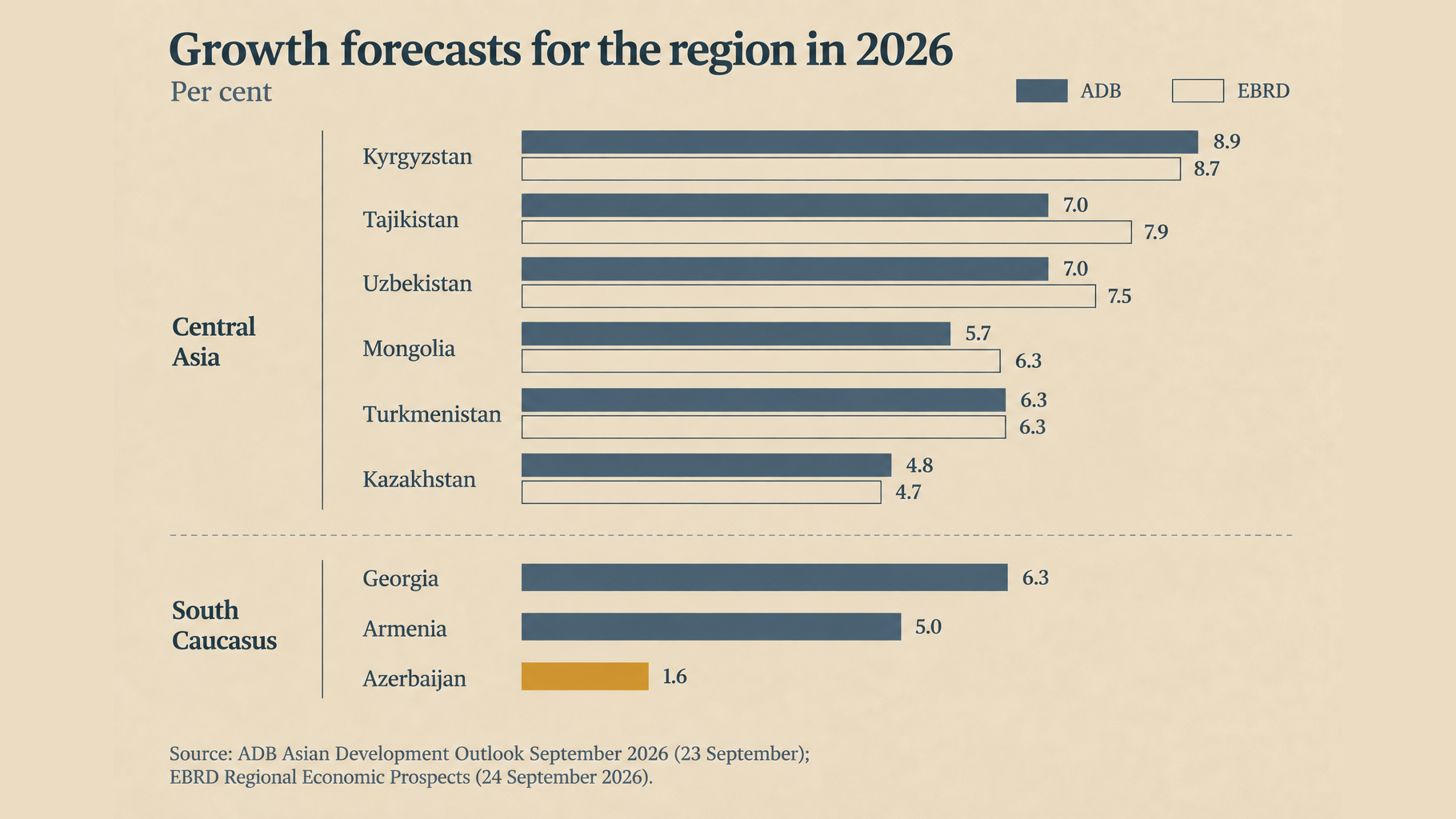
The ADB and the EBRD publish their autumn forecasts a day apart: Central Asia and Mongolia grow 5.8% on one count while the Caucasus slips on the other
The European Bank for Reconstruction and Development put Central Asia and Mongolia at 5.8% growth in 2026 and 5.3% in 2027 in its Regional Economic Prospects published on Thursday: Kyrgyzstan 8.7% this year, Tajikistan 7.9%, Uzbekistan 7.5%, Mongolia and Turkmenistan 6.3%, Kazakhstan 4.7%. The Asian Development Bank’s September Outlook, published on Wednesday, raised Uzbekistan to 7.0% from 6.7% after an 8.5% first half and Georgia to 6.3% from 5.5%, cut Tajikistan to 7.0% from 7.3% and Azerbaijan to 1.6% from 2.0%, and left Kazakhstan at 4.8%, Kyrgyzstan at 8.9%, Turkmenistan at 6.3%, Armenia at 5.0% and Mongolia at 5.7%. Its subregion, the Caucasus and Central and West Asia, slips to 3.7% for 2026 and 4.1% for 2027, a tenth of a point down on July on both years.

Kyrgyzstan’s parliament sets the presidential election for 27 January 2027 by 86 votes to none, and its prime minister spends the week in Hangzhou with Li Qiang and a trade expo
The Jogorku Kenesh confirmed on Thursday morning that the presidential election will be held on 27 January 2027, by a resolution that 86 deputies voted for and none against, Kabar reported; the law fixes the regular election on the fourth Wednesday of January of the year in which the president’s term expires, and leaves the parliament the confirmation. Speaker Marlen Mamataliyev told the chamber a Wednesday vote is meant to lift turnout and cut vote-buying. On Wednesday the cabinet’s chairman, Adylbek Kasymaliev, was in Hangzhou, where Premier Li Qiang received him on the eve of the Global Digital Trade Expo and named the China-Kyrgyzstan-Uzbekistan railway and “the modernization of ports” as the projects to advance, Xinhua reported.
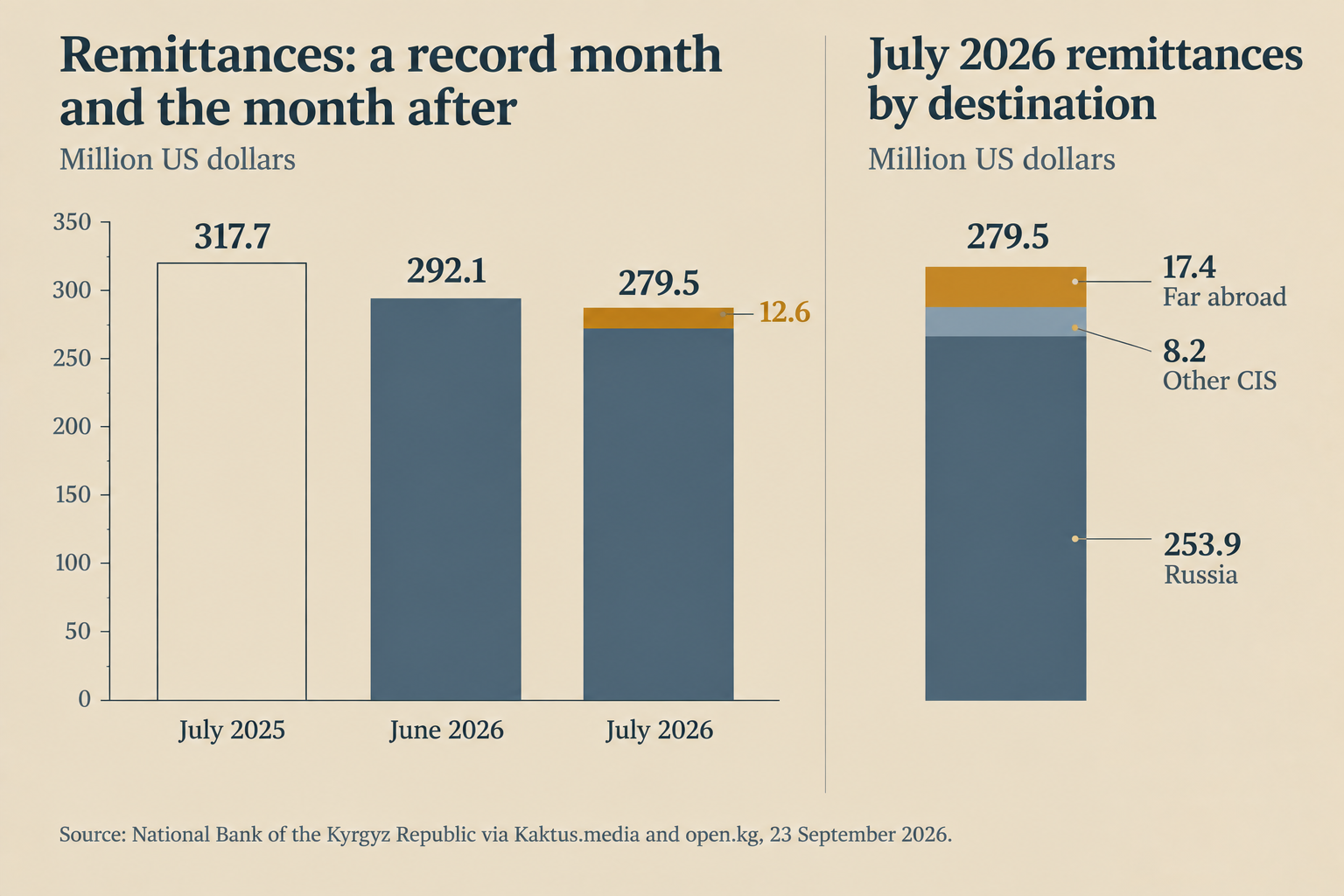
Remittances to Kyrgyzstan fall to $279.5 million in July, 12% below a year earlier, with Russia sending 9 dollars in 10
Individuals sent $279.5 million to Kyrgyzstan in July, the National Bank’s figures show: $262.1 million from CIS countries, $253.9 million of it from Russia, and $17.4 million from further abroad. The month is $12.6 million below June’s record of $292.1 million and $38.2 million below the $317.7 million of July 2025, a fall of 12% on the year; money sent out of the country fell to $24.4 million from $35.5 million in June, $21.8 million of it to the CIS.
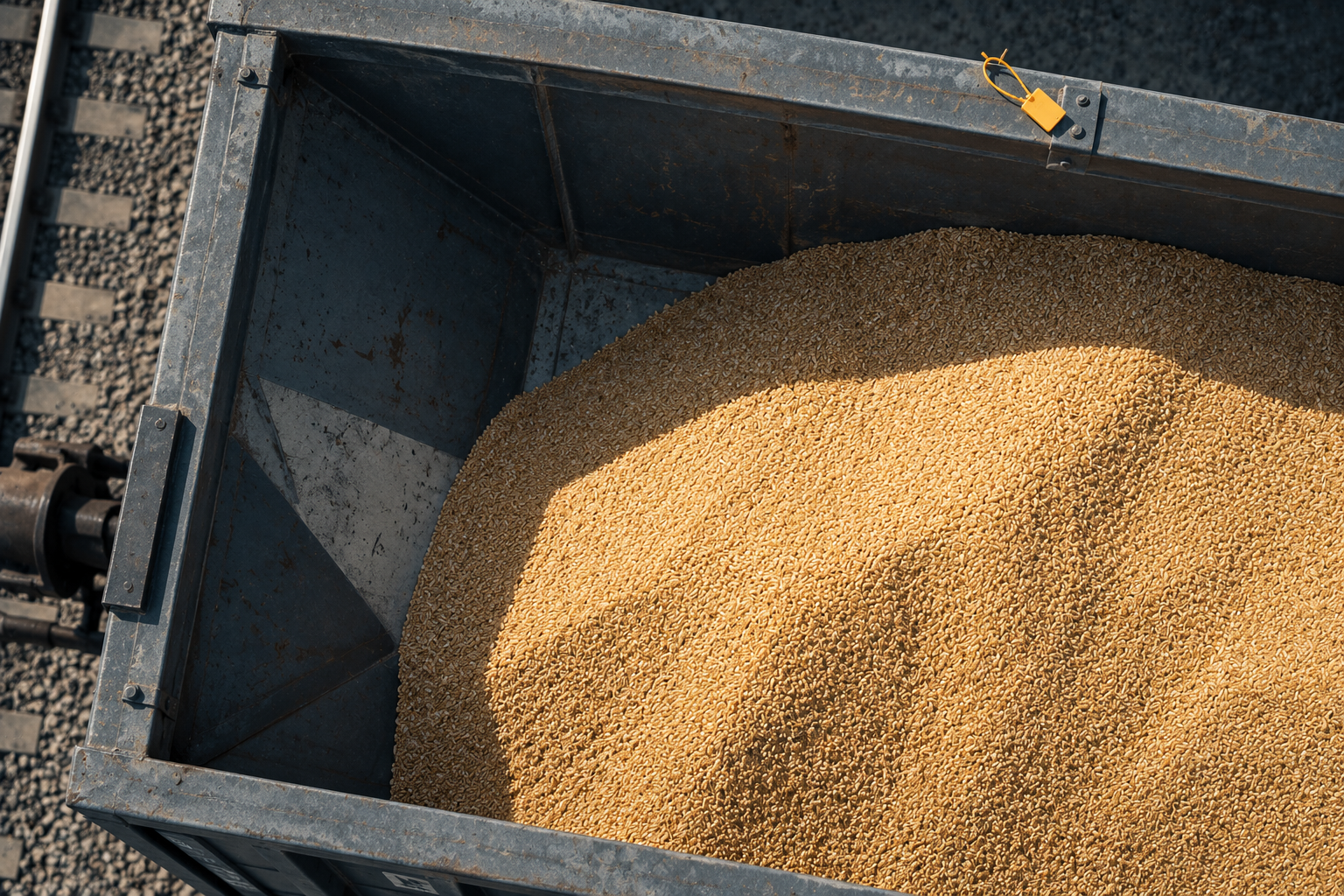
Kyrgyzstan signs 3 export protocols with China’s customs chief and gets Torugart opened to its grain as it thanks Beijing for fuel
Deputy cabinet chairman Erlist Akunbekov and the head of China’s General Administration of Customs, Sun Meijun, signed 3 protocols on quarantine, sanitary and phytosanitary requirements for Kyrgyz exports at a working meeting during Akunbekov’s visit to China, and agreed that Kyrgyz grain will go to China through the Torugart crossing, open.kg reported on Tuesday night in the account 24.kg carried on Wednesday morning. Akunbekov also thanked the Chinese side for its support in keeping fuel supplies from China to Kyrgyzstan stable, and raised longer working hours at Torugart.
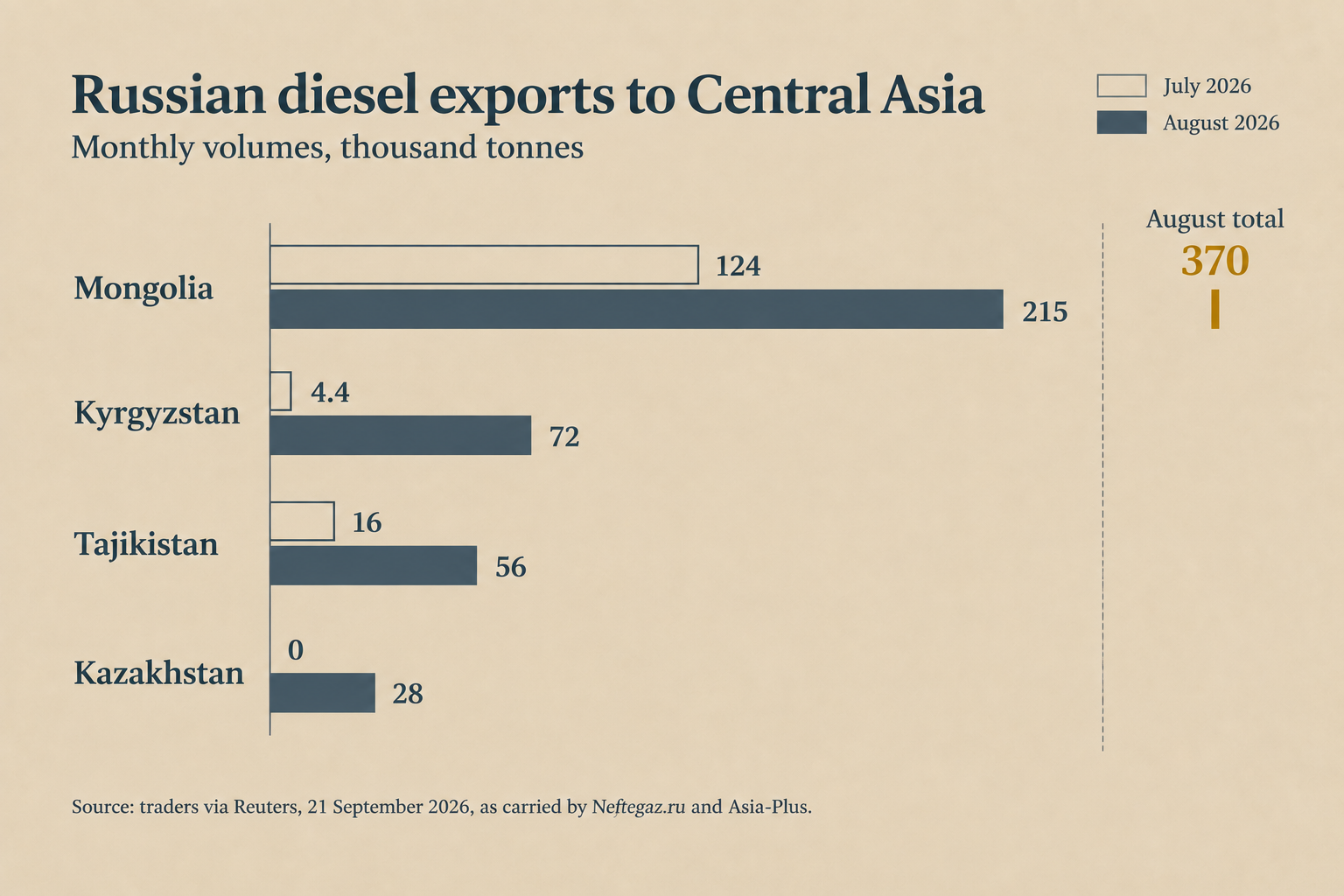
Russia’s diesel to 4 buyers in Central Asia and Mongolia doubled in August to 370,000 tonnes, with Mongolia taking 215,000 and Kyrgyzstan’s intake rising from 4,400 to 72,000
Russian diesel exports to Kazakhstan, Kyrgyzstan, Tajikistan and Mongolia exceeded 370,000 tonnes in August, more than double July’s, traders told Reuters on Monday in figures Neftegaz.ru carried the same evening and Asia-Plus on Tuesday. Mongolia took about 215,000 tonnes against 124,000 in July, Kyrgyzstan more than 72,000 against 4,400, Tajikistan more than 56,000 against 16,000, and Kazakhstan, which imported none in July, about 28,000. Over January to August Russia sent 2.5 million tonnes of diesel to Central Asia and Afghanistan, against 2.6 million a year earlier.