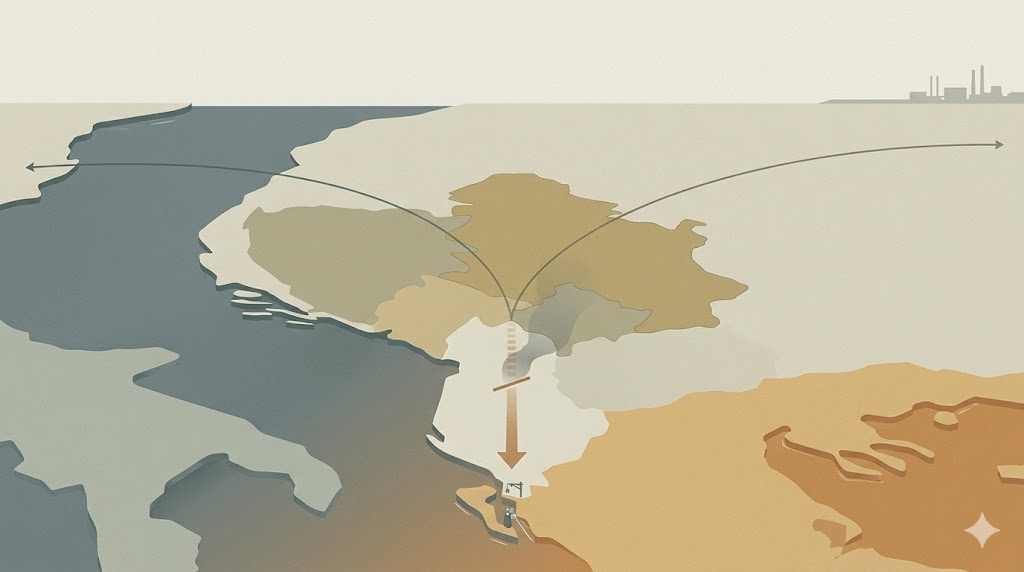
For landlocked Central Asia, the Iran war is first of all a logistics and price shock. The International North-South Transport Corridor, the rail-and-sea route south through Iran to Bandar Abbas and the Indian Ocean, was the region’s shortest path to warm water. With Hormuz shut and Iran at war, that path is effectively closed, which forces freight onto the Middle Corridor west across the Caspian and the Caucasus, and onto the routes east into China. Both are longer, and the Caucasus leg is contested in its own right.
The price side cuts two ways for Kazakhstan. Higher oil lifts budget revenue and sovereign-fund inflows and makes Kazakh crude a more attractive alternative for China. But the country exports most of its oil through the Caspian Pipeline Consortium line across Russia, a route already disrupted this year, so it cannot freely bank the upside. The same price spike feeds fuel and food inflation at home, sharpened by Iran’s export ban.
Central Asia is trading one set of chokepoints, Hormuz and Iran, for another, the Caucasus and Chinese terms.
There is an investment cost as well. Gulf sovereign funds had committed more than 16 billion dollars to Central Asian energy, logistics and banking before the war. As Gulf capital tightens, China is positioned to fill the gap, deepening the dependence the region keeps saying it wants to lighten. Turkmenistan, whose gas swaps and short rail route run through Iran, feels the same squeeze from the other side.
So the war accelerates a shift the region was already making, away from Russian and Iranian routes toward the Middle Corridor and China. The honest way to read it is as a reshuffle, not a rescue: Central Asia is swapping one set of chokepoints for another. What matters now is how much freight actually moves west, and who finances those corridors when the Gulf money pulls back.