Analysis
In-depth analytical pieces, newest first.
Tokayev removes defence minister after the Caspian deaths and wants a reform plan in 10 days
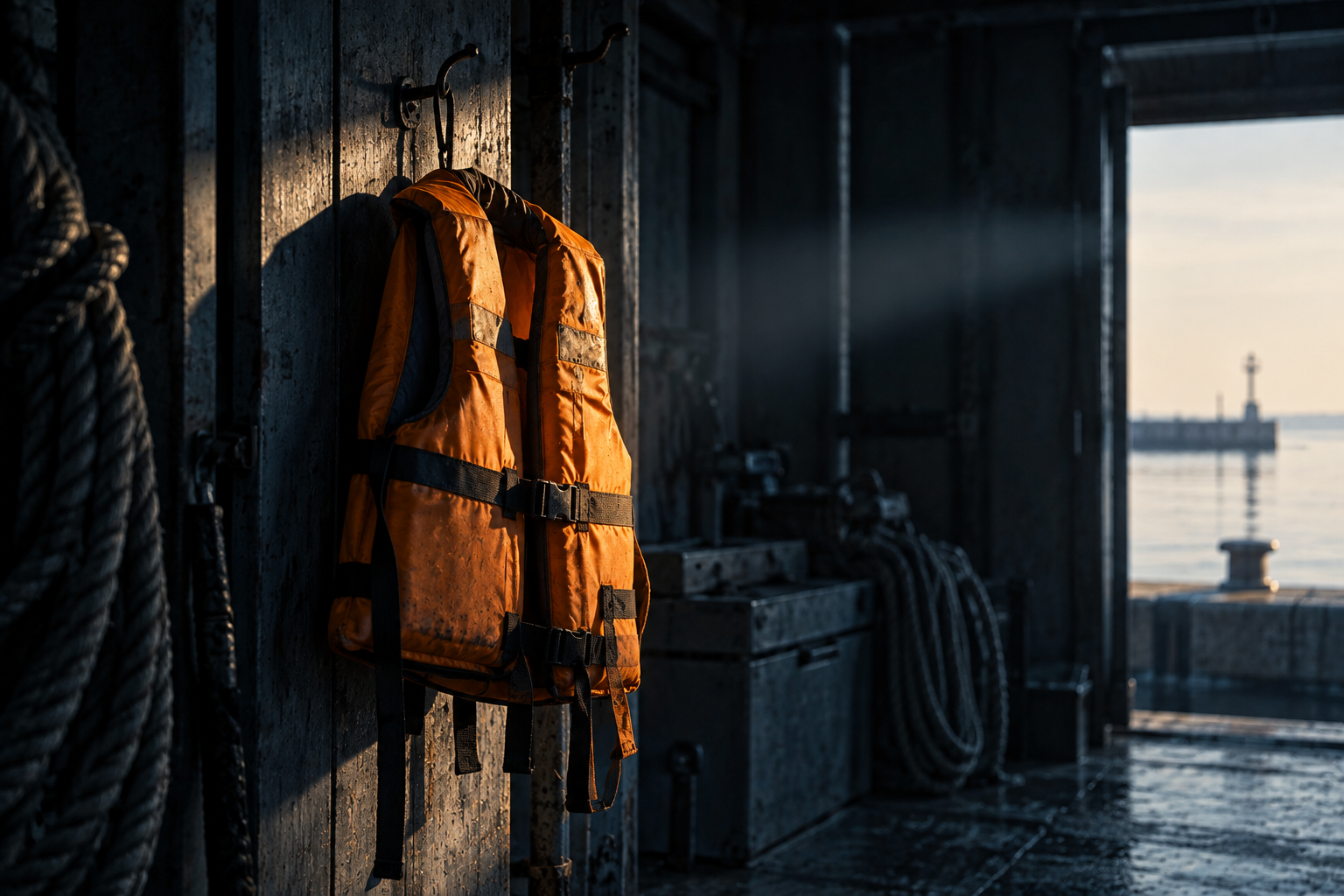
Tokayev dismissed Dauren Kosanov on Sunday morning and gave the defence ministry to Major General Aidos Myrzakhmetov, until then the commander of the special operations forces. The president told the ministry’s leadership that the 14 men who died on 24 September had not been given life jackets, and gave it 10 days to draft a military reform plan.
Washington books Samarkand for October while BlackRock draws Tashkent’s financial centre: Rubio’s 100 companies, a C5+1 back where it began in 2015, a launch date of 2027
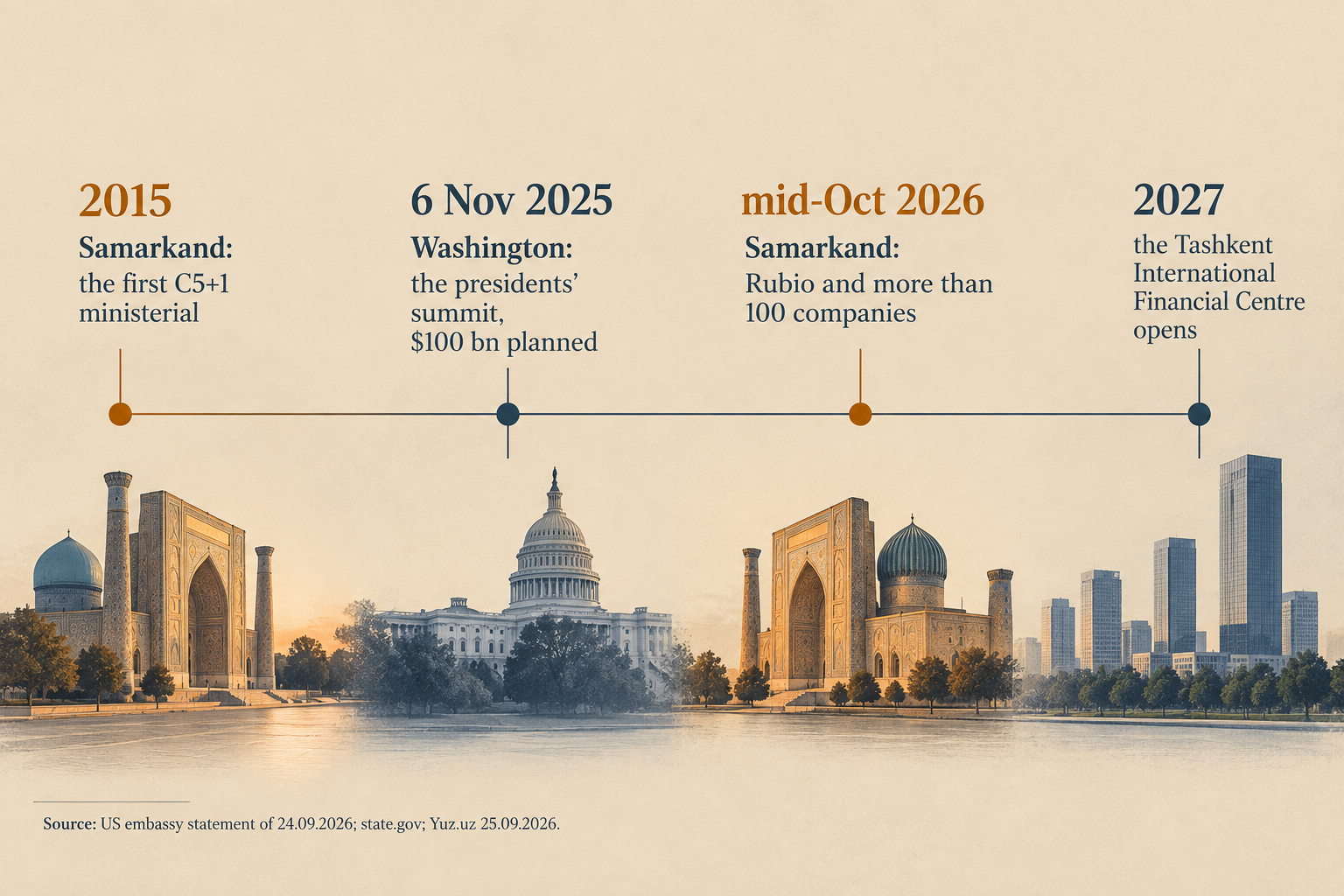
Secretary of State Marco Rubio will bring “a historic business delegation of more than 100 American companies” to Samarkand in mid-October for the C5+1 ministerial with the five Central Asian foreign ministers, the US special envoy for South and Central Asia Sergio Gor announced on Thursday in a statement the Tashkent press relayed on Friday. The same morning Saida Mirziyoyeva, head of the presidential administration and since 10 September secretary general of the Tashkent International Financial Centre’s council, met BlackRock’s president Robert Kapito and vice chairman Thomas Donilon in New York on the centre’s launch in 2027, with BlackRock “assisting in forming the concept and structure of the Centre”.

Kazakhstan and China sign 10 agreements in Almaty on a day of mourning: Tokayev’s $50 billion of trade, a target of $100 billion, and a morning that had promised 40 documents
The Kazakhstan-China Investment Forum opened in Almaty on Friday with a minute of silence for the servicemen lost in the Caspian and had 10 agreements on its list by mid-afternoon, one of them carrying a number: wind stations of 450 MW in Akmola region with SUNGROW. President Tokayev put last year’s trade at a record of almost $50 billion, the target at $100 billion, China’s investment in Kazakhstan at more than $29 billion and the enterprises with Chinese capital at more than 9,000, and proposed to hold the meeting every September as the Almaty Investment Dialogue. In the morning the organiser, Kazakh Invest, had expected more than 40 commercial documents worth several billion dollars.

A dawn test at the new Syrdarya plant knocks 1,600 MW off Uzbekistan’s grid, splits Kazakhstan’s north-south transit and sheds 962 MW in the south for 41 minutes
At 05:05 on Friday, during commissioning tests at the new 1,573 MW thermal plant in Bayavut district of Syrdarya region, built by the consortium of France’s EDF, Qatar’s Nebras Power and Japan’s Sojitz and Kyuden, 1,600 MW of capacity dropped out of Uzbekistan’s grid and households and farm water pumps in several regions lost power, the energy ministry said through its Telegram channel; reserves at other plants and the storage systems were brought in, every consumer was back by 07:27, and the ministry apologised, Spot reported at 07:54. Kazakhstan’s grid operator KEGOC put the loss at 1,516 MW at 05:02, said the surge of power flow split its north-south transit, restricted 962 MW of consumption, and restored the southern zone’s parallel operation with the Central Asian systems at 05:43, Forbes.kz reported.

Three Caucasus capitals sell one corridor at the UN in a day: Kobakhidze’s $7 billion to 2032, Pashinyan’s 26% rising to 49%, and Bayramov’s direct dialogue with Mirzoyan
Irakli Kobakhidze told the UN General Assembly on Thursday that Georgia will put $7 billion into its transit infrastructure by 2032, the railway’s modernisation, new highways, the Anaklia deep-water port, a new international airport for Tbilisi and a fibre-optic cable under the Black Sea, and that Georgia “reaffirms its readiness to maintain dialogue with all international partners willing to work with us on the basis of mutual respect and sovereign equality”; the words European Union did not occur in the speech, Novosti Gruzii noted on Friday morning, and 20% of the country “remains under the occupation of the Russian Federation”. The same day Nikol Pashinyan told the hall that Armenia “will initially have a 26 percent stake in the TRIPP Development Company” and that “in the 50th year, the Republic of Armenia’s share will become 49 percent”, Armenpress reported at 05:24 on Friday, and on the margins Jeyhun Bayramov and Ararat Mirzoyan reviewed the progress since the Washington summit and “agreed to continue direct dialogue”, the Azerbaijani foreign ministry said through Report.az at 08:16.
Azerbaijan drafts its 2027 to 2030 strategy on a 1.2% year, with $91 billion in reserve, 5.6% of GDP in debt and 8.8 billion manat for defence
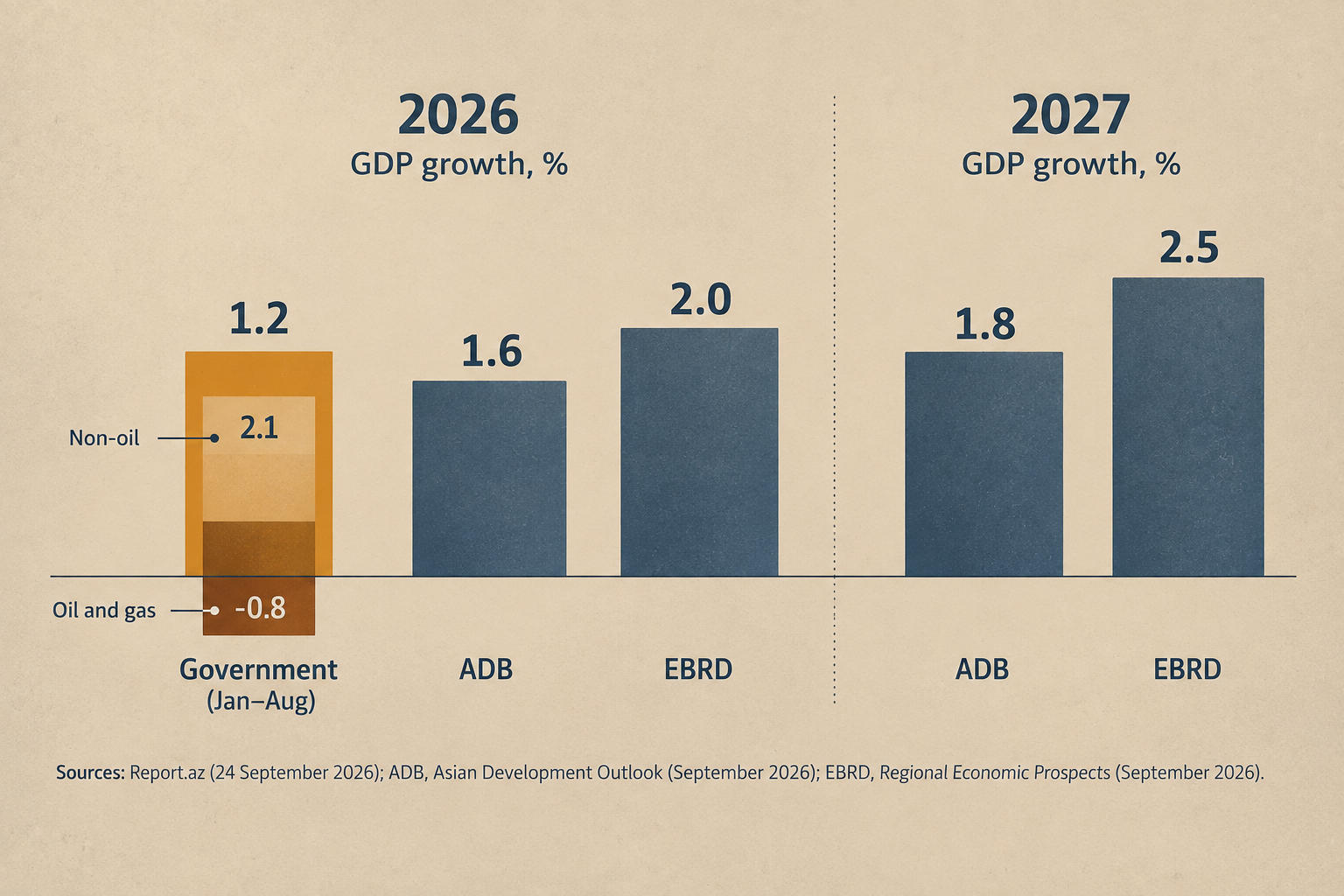
The drafts of a new development strategy for 2027 to 2030 and of the second State Programme of the Great Return have been discussed at the Economic Council and presented to President Aliyev, Report.az wrote on Thursday at 15:44, quoting prime minister Ali Asadov, and the numbers around them describe the year the strategy is written in: growth of 1.2% in January to August, 2.1% outside oil and gas and a fall of 0.8% inside it, strategic currency reserves of about $91 billion, external state debt of $4.5 billion or 5.6% of projected GDP, a trade surplus above $10 billion in 8 months and inflation of 5.7%, with 5.3% forecast for 2027. Approval is expected in the coming months, Report.az wrote.

Tokayev will dissolve every maslikhat in Kazakhstan, and the councils that Amanat filled in 2023 go back to the polls on a date the election commission has yet to name
President Tokayev told the second day of the People’s Council’s first session on Thursday that the closing stage of the reforms will be elections to the maslikhats at every level: he will consult the prime minister and the Kurultai’s chairman shortly on ending the councils’ powers early, sign a decree, and leave the date to the Central Election Commission, Zakon.kz reported at 12:31. His reason is the party map. The great majority of maslikhat deputies were elected from Amanat, he said, and that party no longer acts on its own, having joined Adilet, so the question of the legitimacy of the greater part of the maslikhats’ deputy corps would arise.
The ADB and the EBRD publish their autumn forecasts a day apart: Central Asia and Mongolia grow 5.8% on one count while the Caucasus slips on the other
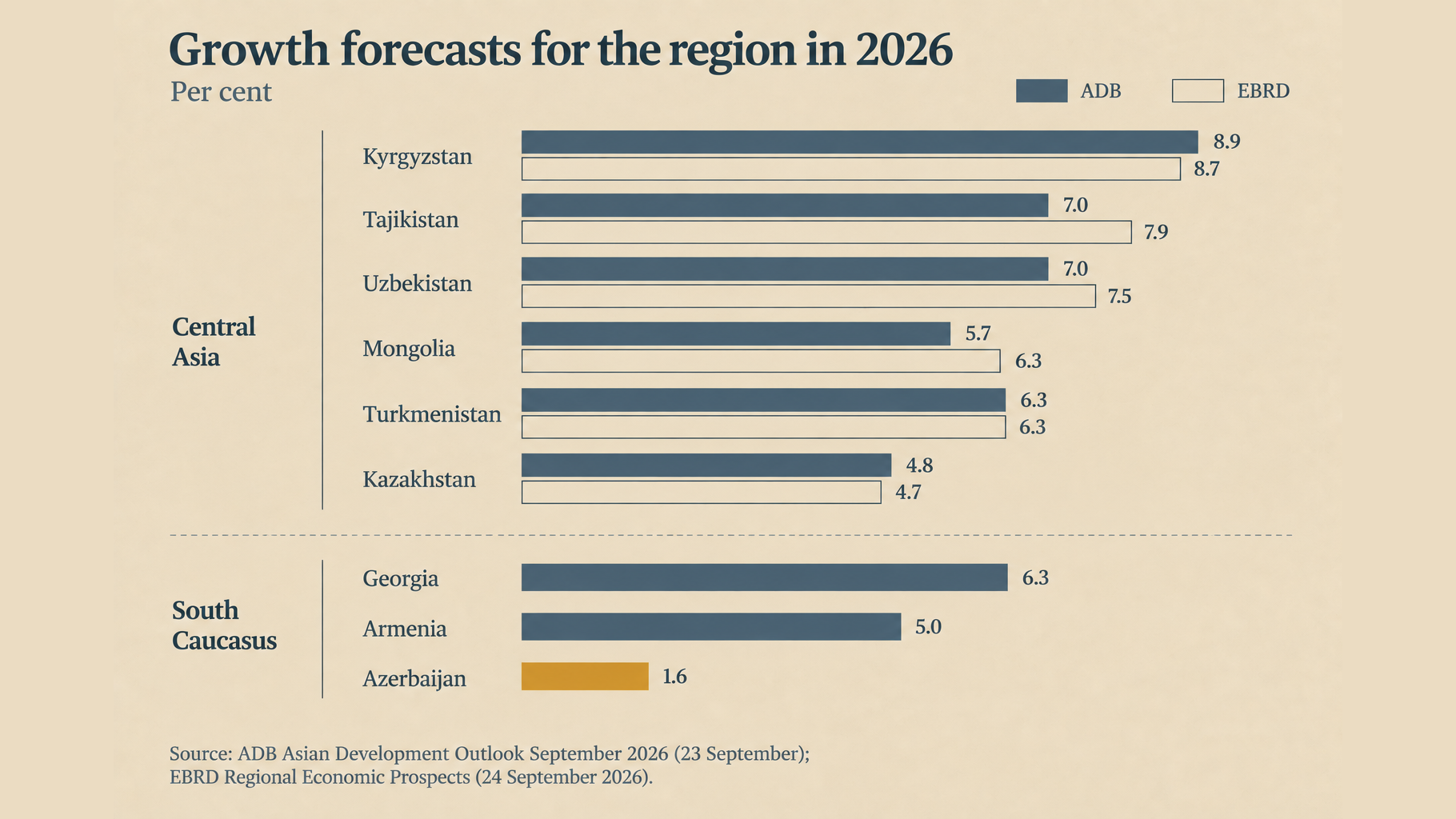
The European Bank for Reconstruction and Development put Central Asia and Mongolia at 5.8% growth in 2026 and 5.3% in 2027 in its Regional Economic Prospects published on Thursday: Kyrgyzstan 8.7% this year, Tajikistan 7.9%, Uzbekistan 7.5%, Mongolia and Turkmenistan 6.3%, Kazakhstan 4.7%. The Asian Development Bank’s September Outlook, published on Wednesday, raised Uzbekistan to 7.0% from 6.7% after an 8.5% first half and Georgia to 6.3% from 5.5%, cut Tajikistan to 7.0% from 7.3% and Azerbaijan to 1.6% from 2.0%, and left Kazakhstan at 4.8%, Kyrgyzstan at 8.9%, Turkmenistan at 6.3%, Armenia at 5.0% and Mongolia at 5.7%. Its subregion, the Caucasus and Central and West Asia, slips to 3.7% for 2026 and 4.1% for 2027, a tenth of a point down on July on both years.

Kyrgyzstan’s parliament sets the presidential election for 27 January 2027 by 86 votes to none, and its prime minister spends the week in Hangzhou with Li Qiang and a trade expo
The Jogorku Kenesh confirmed on Thursday morning that the presidential election will be held on 27 January 2027, by a resolution that 86 deputies voted for and none against, Kabar reported; the law fixes the regular election on the fourth Wednesday of January of the year in which the president’s term expires, and leaves the parliament the confirmation. Speaker Marlen Mamataliyev told the chamber a Wednesday vote is meant to lift turnout and cut vote-buying. On Wednesday the cabinet’s chairman, Adylbek Kasymaliev, was in Hangzhou, where Premier Li Qiang received him on the eve of the Global Digital Trade Expo and named the China-Kyrgyzstan-Uzbekistan railway and “the modernization of ports” as the projects to advance, Xinhua reported.
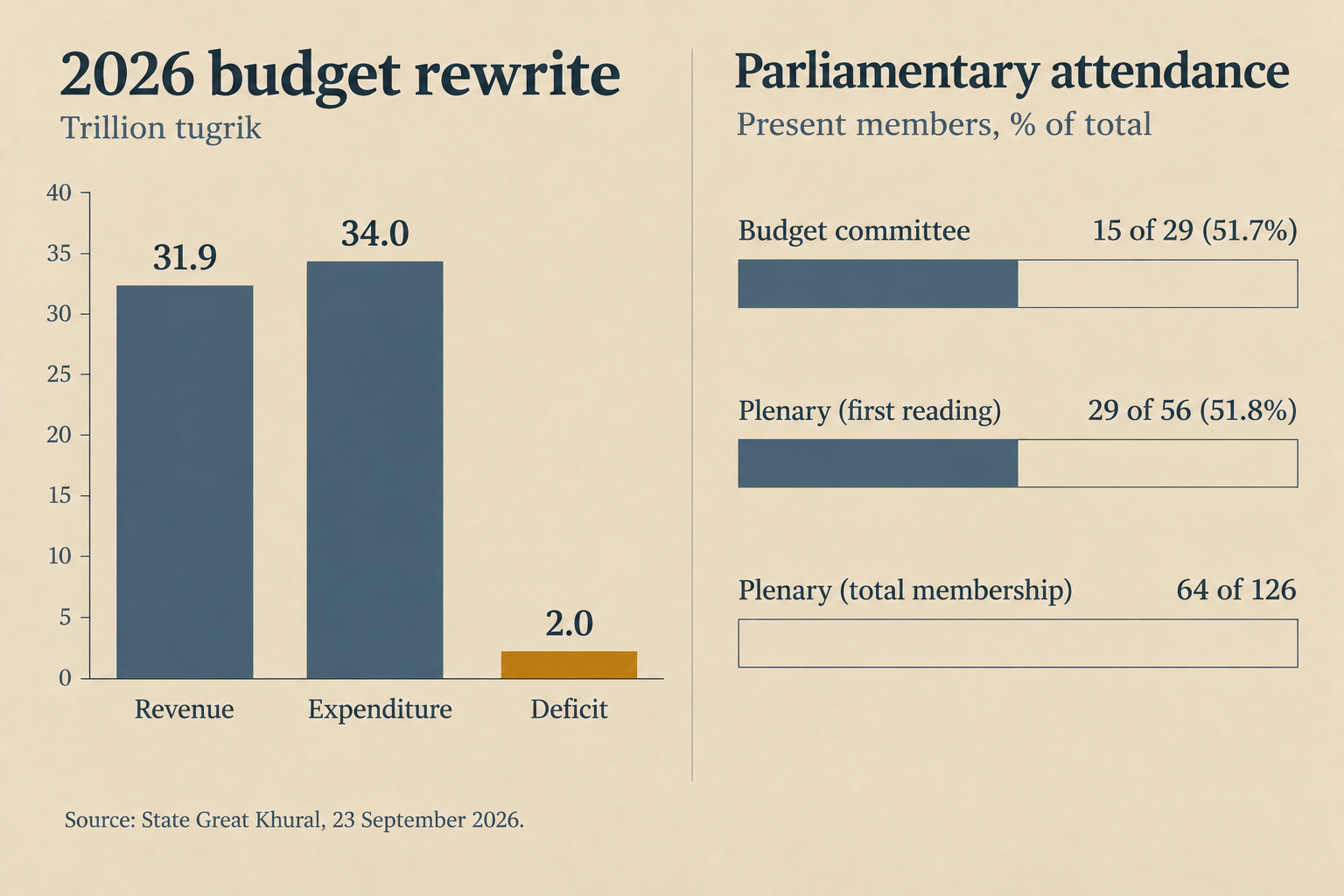
Mongolia’s committees clear the 2026 budget rewrite’s third reading with a 2 trillion tugrik deficit and back $450 million from the ADB and the ¥158.3 billion airport loan on one day
The State Great Khural’s security and foreign policy committee took the third reading of the 2026 budget amendment on Wednesday with 15 of its 29 members present and sent its conclusions to the budget committee, the parliament’s site reported: balanced revenue of 31.9 trillion tugrik, expenditure of 34.0 trillion and a deficit of 2.0 trillion, with 107.3 billion for tariff-loss subsidies, 92.7 billion for power stations, 150.0 billion for food reserves, 170.1 billion for wage rises and 1,440.9 billion in savings. On the same day a joint sitting of the budget and security committees, 29 of 56 members present, backed the government’s 2 loan drafts, the Asian Development Bank’s $450 million “financing general programme” by 56.3% of those present and Japan’s ¥158.3 billion loan for the Chinggis Khaan airport by 66.7%, and sent its minutes and conclusions to the government.

Kazakhstan’s People’s Council elects Yerlan Koshanov its chairman by 120 votes to 1, and the week’s seating of the second republic is complete
The Qazaqstan Halyq Kenesi elected Yerlan Koshanov, the last chairman of the abolished Mazhilis, as its chairman at its first session in Astana on Wednesday: 121 ballots came out of the urn, none of them spoiled, 120 for him and 1 abstention, Kazinform reported at 15:02. President Tokayev had proposed him at the session’s opening as “a responsible, qualified and experienced statesman” for a post that “should be held by a person known in the country, able to become the link between the people and the power”, and told the members that “a special responsibility rests on each member of the Halyq Kenesi”. In 5 days the second republic has re-seated the heads of its court, election commission and audit chamber, named a full constitutional bench with the Kurultai’s consent, and given its consultative chamber a chairman who ran the presidential administration from September 2019 to February 2022.
Tashkent plans 57.2 GW by 2035 with 26 storage projects and nearly 5,000 km of new lines behind a grid it says will now be built from demand
President Shavkat Mirziyoyev reviewed a plan on Tuesday that takes Uzbekistan’s generating capacity to 46.1 GW by 2030, for about 129 billion kWh a year, and to 57.2 GW by 2035, for 154.7 billion, the presidential press service reported. The plan counts 6.3 GW of solar and wind already built, more than 100 hydro plants at close to 2.5 GW, 26 storage projects of 4.2 GW with 17 under way, and, by 2030, 9 new 220 kV substations, 7 at 500 kV and almost 5,000 km of new transmission lines. Its stated method is new: demand is set first, then the plants and the wires.
Tokayev names all 10 judges of the Constitutional Court in one morning, and the People’s Council he appointed on Tuesday sits for the first time
President Tokayev appointed 10 judges of the Constitutional Court by decrees published on Wednesday morning, 5 days after he reappointed Elvira Azimova as its chairwoman, Akorda’s list shows: Saken Abdolla, Leila Zhakayeva, Kairat Zhakipbayev, Aizhan Zhatkanbayeva, Aigul Kydyrbayeva, Kanat Musin, Bakyt Nurmukhanov, Sergey Skryabin, Aslan Tukiyev and Sergey Udartsev. The Kurultai gave its consent to the 10 at its sitting the same morning, on the presentation of Roman Sklyar, the head of the presidential administration, and in the same sitting cleared 8 members of the audit chamber, whom the president then appointed, and 6 of the election commission, Kazinform reported between 10:24 and 10:33. The same day the Qazaqstan Halyq Kenesi, the 126-member People’s Council whose composition he approved on Tuesday, opens its first session in Astana. In 5 days the second republic has re-seated the heads of the court, the election commission and the audit chamber, named a full bench and convened a consultative chamber, every one of them by the president’s signature, and the bench with a consent the Kurultai gave in a morning.
Aliyev weighs a 5.3 billion manat mining programme to 2030 that must first re-count reserves last measured 40 years ago
President Ilham Aliyev chaired a meeting on Tuesday on the draft State Programme for the development of the mining and metallurgical industry for 2027 to 2030, AZERTAC reported at 14:35. Economy minister Mikayil Jabbarov put the investment at 5.3 billion manats over the 4 years, 1.1 billion from the state budget, 2.2 billion from state companies and 2 billion from private funds, with the sector’s contribution to GDP to rise from 700 million to 1.8 billion manats and its exports from 1.3 billion to 3.4 billion by 2030. The president’s own condition came before the targets: the reserve figures date from Soviet times, about 40 years ago, and are out of date.
Mongolia’s parliament opens with 75 members on its third attempt as the prime minister dares the Democrats to file for his dismissal
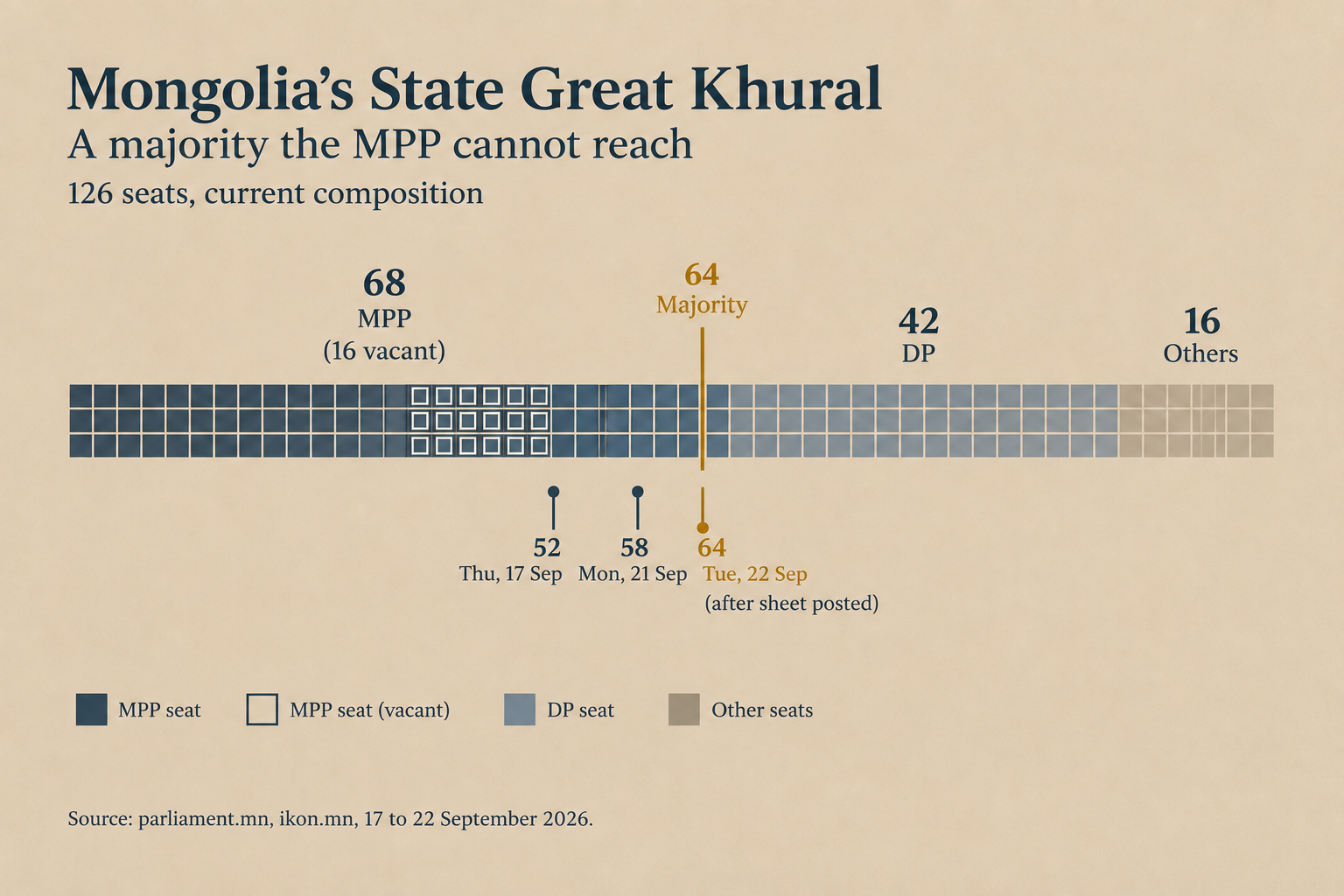
The State Great Khural’s plenary opened at 14:01 on Tuesday with 75 of its 126 members registered, 59.5%, after 2 attempts that stopped at 52 and 58, the parliament’s own account of the sitting says. Prime Minister N. Uchral presented the release of S. Amarsaikhan as justice and home affairs minister and the appointment of G. Temuulen in his place, 24 members put questions, Temuulen took the oath, and under the session rules the house voted on nothing. In the chamber Uchral told the Democratic Party to collect signatures and submit a letter for his dismissal if they disliked his work, ikon.mn reported at 18:30, and D. Amarbayasgalan, the former Speaker who stayed away on Monday and speaks for what he calls “our 30”, said he would meet the prime minister the same day.
Dushanbe’s tax bill triples the VAT threshold and taxes online shops at 3%, and 12 trades lose the simplified regime
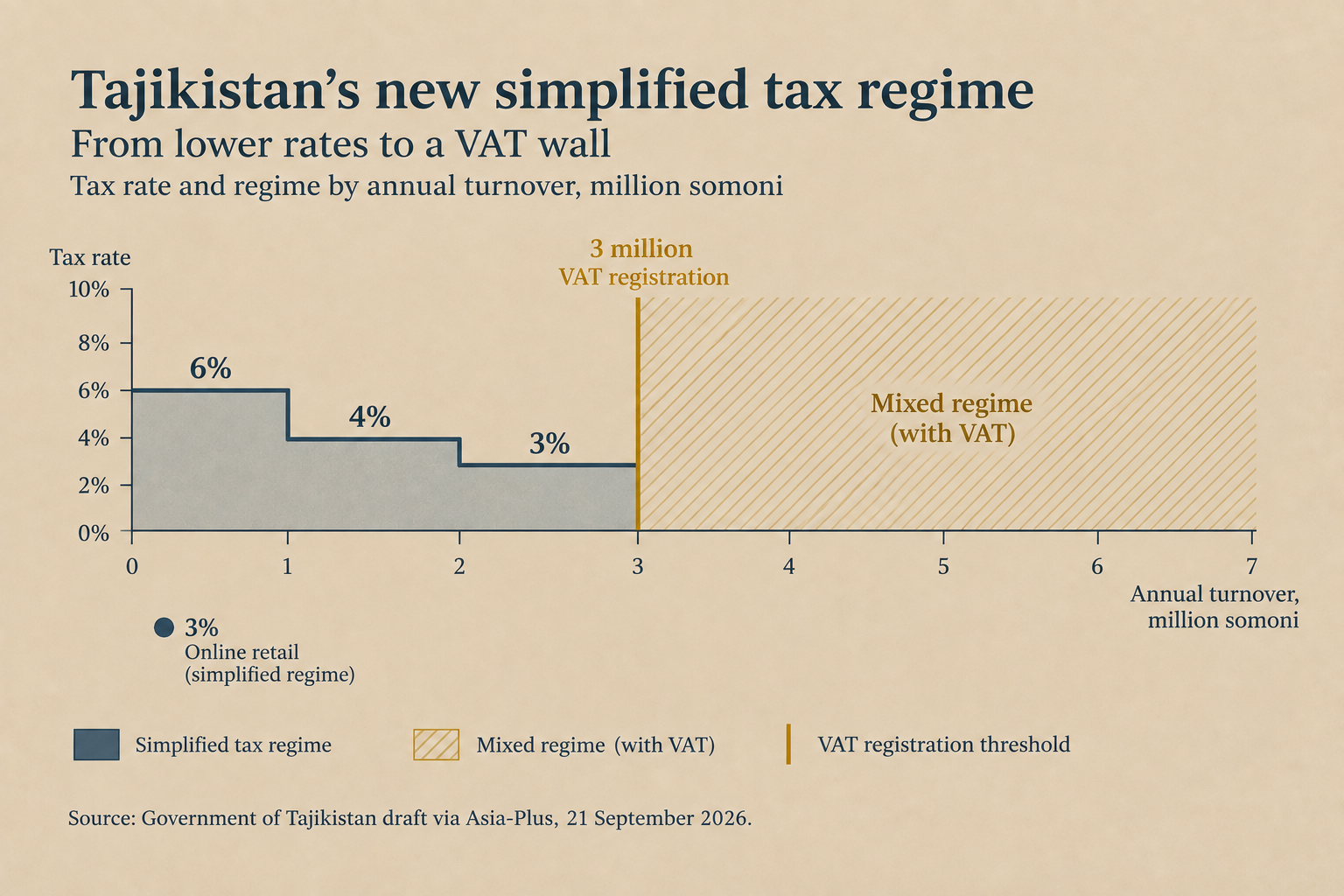
Tajikistan’s government has sent parliament a package of Tax Code amendments that raises the turnover at which a business must register for VAT from 1 million to 3 million somoni, sets 3% as the simplified rate for firms between 2 and 3 million, puts a 3% turnover tax on online retail and removes construction, consulting, audit, medicines, markets and 7 other lines of business from the simplified regime altogether, Asia-Plus reported on Monday. The package arrives 10 days after the World Bank published a framework under which its grants to Dushanbe are expected to become credits from the fiscal year that began in July.
Mongolia’s parliament opens on its third attempt after 2 quorum failures as the prime minister presents G. Temuulen for justice minister
The plenary called for 14:00 on Tuesday in Ulaanbaatar opened in the State Palace, ikon.mn reported at 14:11, after failing for want of a quorum on Thursday and on Monday; Prime Minister N. Uchral was presenting the appointment of G. Temuulen as justice and home affairs minister as its first item. The house needs 64 of its 126 members to register; it reached 52 on Thursday and 58 on Monday, when 16 members of the governing Mongolian People’s Party, a former prime minister and a former Speaker among them, were on ikon.mn’s list of those who had not registered. In March the same absences idled the chamber for 2 weeks, and the prime minister resigned before it sat again.
Bishkek tells parliament it cannot hold pump prices next year, with 39 billion som pledged against inflation and an election on 27 January
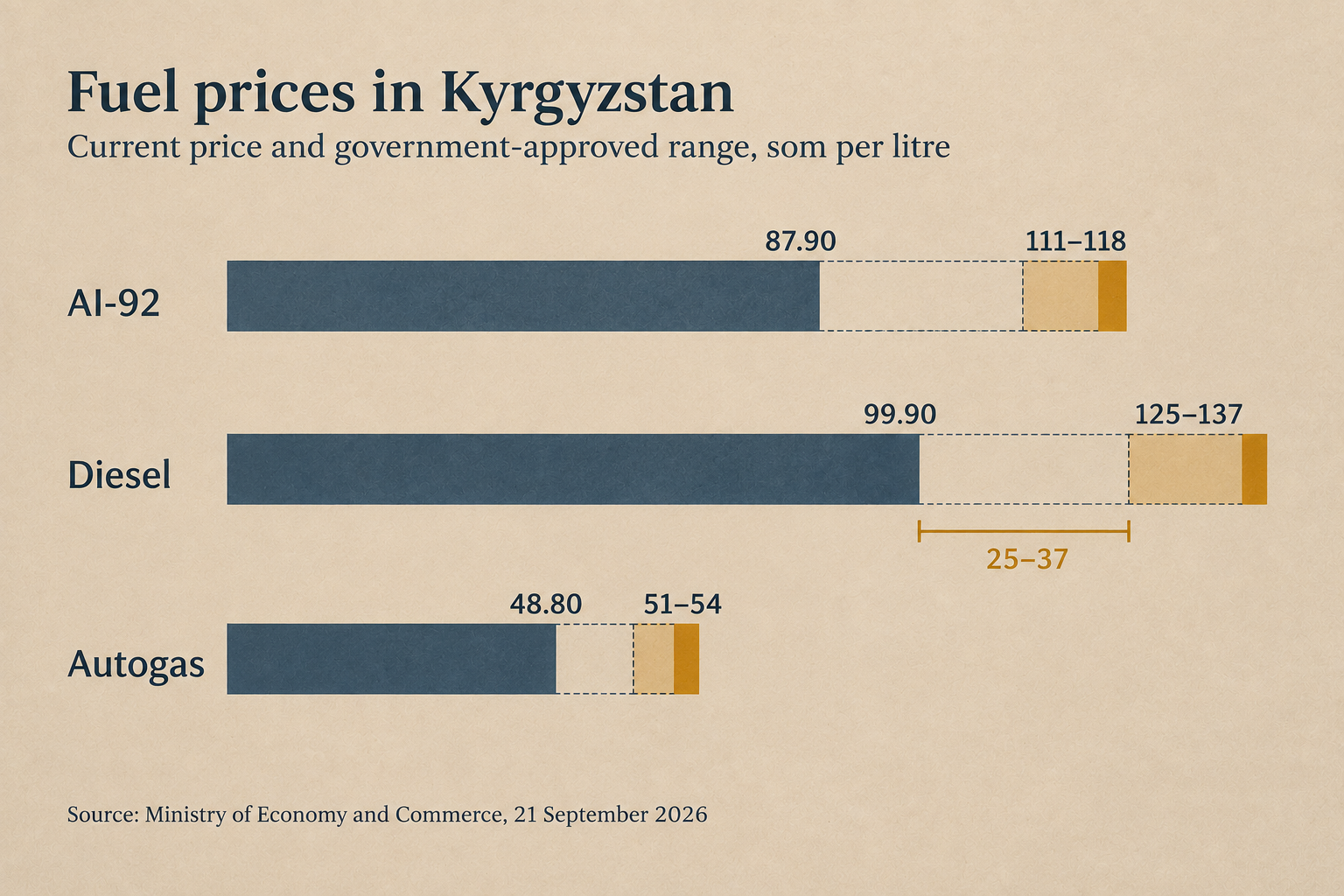
Kyrgyzstan’s first deputy cabinet chairman, Daniyar Amangeldiev, told a parliamentary committee on Monday that the state pays “practically 40%” of the fuel price and that “next year we will not be able to hold it and will reduce it”. At the same sitting he put 39 billion som, about $446 million at Monday’s official rate, against inflation in 2027, naming fuel first. The compensation scheme that keeps AI-92 petrol at 87.90 som a litre runs to 31 December, 27 days before the presidential election.

Mongolia’s parliament fails to open again as 16 ruling-party members, a former prime minister and a former Speaker among them, stay away
Fifty-eight of 126 members had registered by 16:42 on Monday in Ulaanbaatar, 6 short of the 64 a sitting needs, and the plenary called for 14:00 had not begun, ikon.mn reported. Sixteen of the missing belong to the governing Mongolian People’s Party: the former prime minister L. Oyun-Erdene, the former Speaker D. Amarbayasgalan and S. Amarsaikhan, the dismissed justice minister whose removal the sitting was called to hear, are on the outlet’s list. In March, with the same 3 absent, the plenary stood idle for 2 weeks until the prime minister resigned.
London’s war-risk list now covers the whole Black Sea, and the open water off Georgia’s ports is inside it
The Joint War Committee’s circular of 16 September lists the Black Sea “excluding territorial waters of adjoining countries other than Russia and Ukraine”; until then, in the Black Sea, the London market listed the coastal waters of Russia and Ukraine. Dunya, the Turkish business daily, puts war-risk premiums at 1% to 1.5% of a ship’s insured value, against 0.1% to 0.2% in normal conditions, which can add $150,000 to $300,000 to a 7-day voyage. The new line crosses routes that call at neither belligerent’s ports: KazTransOil, which owns the Batumi oil terminal, sent 293,000 tonnes of cargo toward that port in August.