Search

Kyrgyzstan moves its fuel wall to New Year's Eve and prices it in dollars
Decree No. 579, signed by Prime Minister Adylbek Kasymaliev on Wednesday, extends the state's compensation of fuel importers from 30 September to 31 December and fixes the reference purchase prices at $960 a tonne for AI-92 petrol, $1,050 for diesel and $650 for autogas. The wall the market had been watching for the end of September now stands at the end of the year, and the treasury's exposure is written in dollars.

Mongolia opens an artificial-shortage case against a fuel retailer
The Anti-Monopoly Office is investigating Sod Mongol Group over petrol held in storage while 7 of its stations stood closed. Its citation has a statutory name: an artificial shortage created by misleading consumers.

The region's fuel backstops harden into the supply plan
Ukraine's drones stopped Lukoil's NORSI refinery on Wednesday, and Reuters counted the wider score: every big Lukoil plant in Russia now stands idle. For Central Asia's importers, the hedges assembled this summer, Chinese contracts, an Iranian request, third-country cargoes inside a Russian commitment, now read as the base case.

Uzbekneftegaz loses 3.5 billion cubic meters in six months
Uzbekistan's state gas company produced 18.3 billion cubic meters in the first half of the year, 16% below last year's pace. June's daily output was the weakest since at least early 2022.

A Kazakh refinery turns north, and the minister calls the terms normal
Kazakhstan's energy ministry says an arrangement is in place under which the Kondensat refinery in Aksay keeps up to 30% of its petrol and diesel at home and sends the rest to Russia. The tonnage is small. The direction, with Russia's own petrol exports banned into 2027, is the news.

Kazakhstan cuts its oil plan by exactly what the strikes took
On 25 August Kazakhstan's energy ministry took the 2026 oil and condensate plan down to 96 million tonnes and put the losses from strikes on Caspian Pipeline Consortium facilities at about 3.5 million tonnes. The year opened on a plan of 99.55 million. Subtract the loss from the opening plan and you land within 50,000 tonnes of the new figure. On that arithmetic the ministry is assuming nothing back.

Russia's fuel export bans now reach into 2027
Alexander Novak put dates on the whole architecture on Saturday: petrol exports banned for all sellers through 31 January 2027, diesel for non-producers extended to the same day, jet fuel to 30 November, with producers regaining their diesel exemption on 1 September. For the region's importers, Russia's export calendar is now a winter planning document.

Rogun spends three-quarters of its annual budget by August
Emomali Rahmon inspected Rogun and heard the year's arithmetic, in a visit Avesta reported on Friday: 8.4 billion of the 11.4 billion somoni allocated for 2026 is already spent, 7 months in. His instruction, delivered on the dam, was to finish "within the established timelines" and to have the reservoir at 1,140 m by early September.

Azerbaijan builds 97% of a power line, and the missing 44 kilometres are Armenian
AzerEnergy says the 330 kV line from Jabrayil to Aghband is 97% complete: 74 km of double circuit, 1,000 MW of capacity, pointed at the border of Syunik. The full chain is meant to run from Jabrayil to Turkey, and every link is built, building or planned on Azerbaijani and Turkish ground except the 44 km that cross Armenia. Baku is building the corridor's hardware first and negotiating its legal existence second.
Bishkek pays 87.90 for petrol, and the treasury adds up to 30 on top
Two weeks ago this column counted the gap between the petrol cap and the pumps at 7 som. What holding the broken line costs is now in print: about 1 billion som so far.
Georgia's new refinery runs its first Kazakh crude
Kulevi took 5,500 tonnes of Kazakh crude in July, the first Kazakhstan has ever sold into Georgia, at $3.2 million. The operator says August cargoes and Libyan barrels will finish replacing Russian supply. For Astana the volume is a rounding error. For Tbilisi, direction.
Uzbekistan auctions 2,500 river sites for small hydropower
Tashkent has identified about 3,000 potential sites for small and micro hydropower stations and put more than 2,500 of them up for auction, the first deputy energy minister said, a day after the president ordered the segment scaled up.

Dushanbe puts a number on the Iranian option: 2.55 million tons
Tajikistan has asked Iran for 2.55 million tons of crude and petroleum products, figures the Transport Ministry published from last week's Tehran talks, a request close to three times all freight now moving between the two countries.

Mirziyoyev says a second nuclear station is in preparation
Uzbekistan is running big preparations for a second nuclear power station, President Shavkat Mirziyoyev told an investment ceremony in Khorezm region. He said it on Monday; gazeta.uz surfaced the remark overnight into Thursday.
Mongolia puts soldiers and tax holidays on an unfinished refinery
The cabinet in Ulaanbaatar has assigned Internal Troops to guard the refinery under construction at Altanshiree and freed the project from land fees for 10 years and property tax for 5. Until the plant runs, Mongolia's fuel security is a daily wagon count from Russia. Wednesday's count was 76.

A 72 million tonne forecast meets a 33 million tonne half
The CPC moved 33.35 million tonnes of crude in the first half of 2026, down 7.4% on a year earlier, by figures Interfax carried on Tuesday from KazMunayGas’s operational report. A 72 million tonne plan for the year is still on the books, and the books now require a bigger half than either half of 2025.

Novorossiysk resumes its loadings, and the ships burn again
Novorossiysk reopened for crude on Sunday. Within 2 days a drone found a tanker whose tracking pointed to the CPC terminal, a grain ship burned out on approach, and the second Kazakh cargo the restart promised remains unconfirmed.
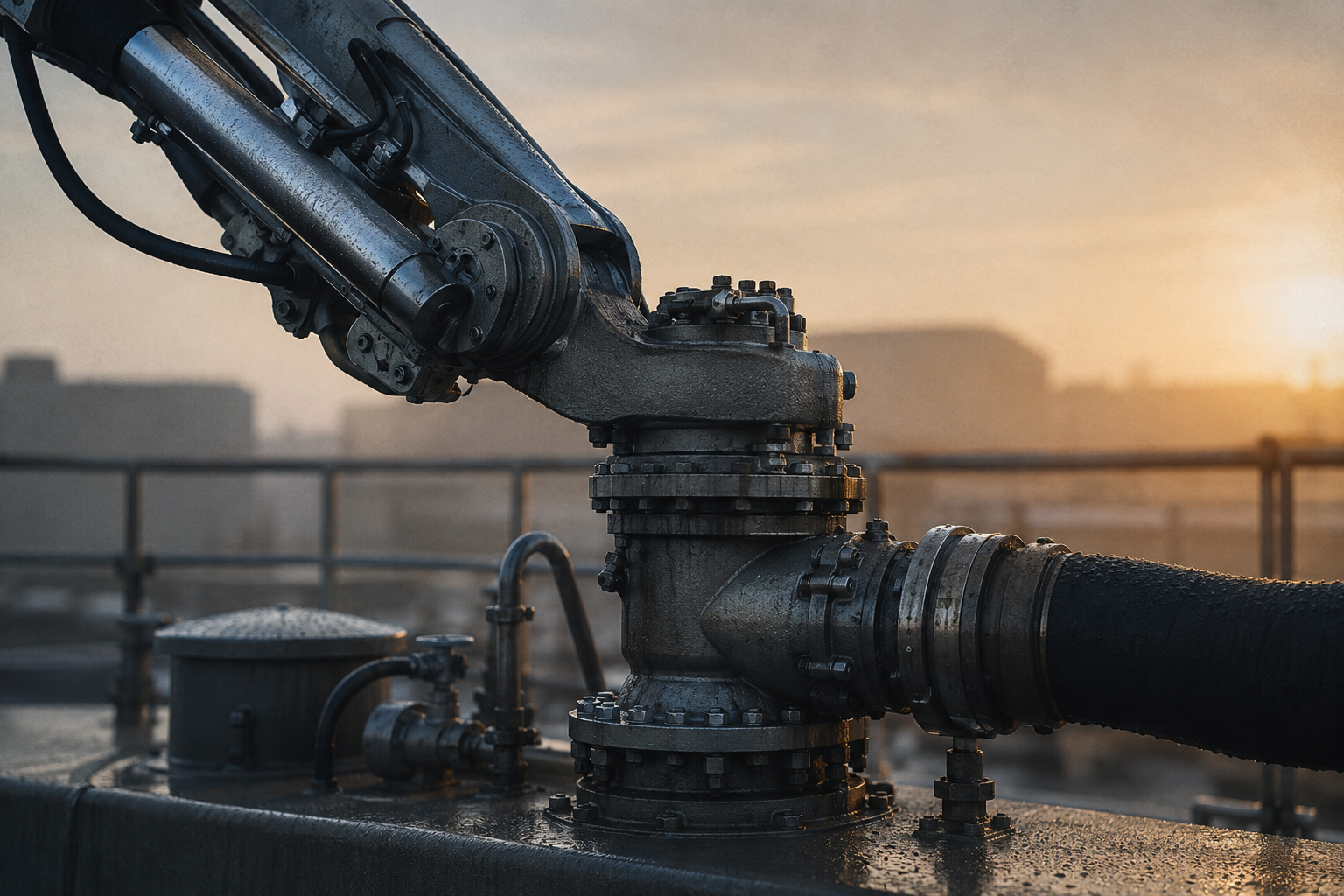
The blackout inquiry stops at the border
Four days after two Toktogul generators tripped and Kazakhstan's south went dark, the inquiries multiply on each side of the border and the joint one exists only in Bishkek's appeals. Kazakhstan's Tuesday cabinet session went to school readiness.
7 months of Central Asian oil via BTC equal 14 days of the CPC
Azerbaijan's statistics committee published the seven-month ledger of the Baku-Tbilisi-Ceyhan pipeline on Monday: 14.8 million tonnes, down 8.6% on last year, of which Central Asian oil made 2.6 million. Measured against the CPC system's own half-year rate, the transit leg every redistribution plan cites amounts to about 14 days of flow.

Kazakh crude is loading again at Novorossiysk
Novorossiysk resumed crude loadings on Sunday, Reuters reported on Monday, citing two industry sources, and the first two cargoes the sources describe are Kazakhstan's KEBCO grade. A Suezmax began loading Sunday and was due to sail Monday; a second tanker was expected to start on 80,000 tonnes of KEBCO on Tuesday.