
The European Bank for Reconstruction and Development holds its 35th Annual Meeting in Riga on 5 to 7 June. Around 2,000 participants: finance ministers, institutional investors, development bank heads, private sector clients. The official theme, 'Volatile to versatile: economies innovating in a changing world', is deliberately broad. What is specific, and what matters for Central Asia, is narrower.
The EBRD is the single largest multilateral lender in the region. In 2025 alone, it deployed nearly $2 billion across 120 projects in Central Asia and Mongolia. That number has been rising for six consecutive years. Riga is not just a procedural event: it is where the Bank's governors formally set strategic priorities and where bilateral meetings between country delegations and EBRD management produce next-year investment signals.
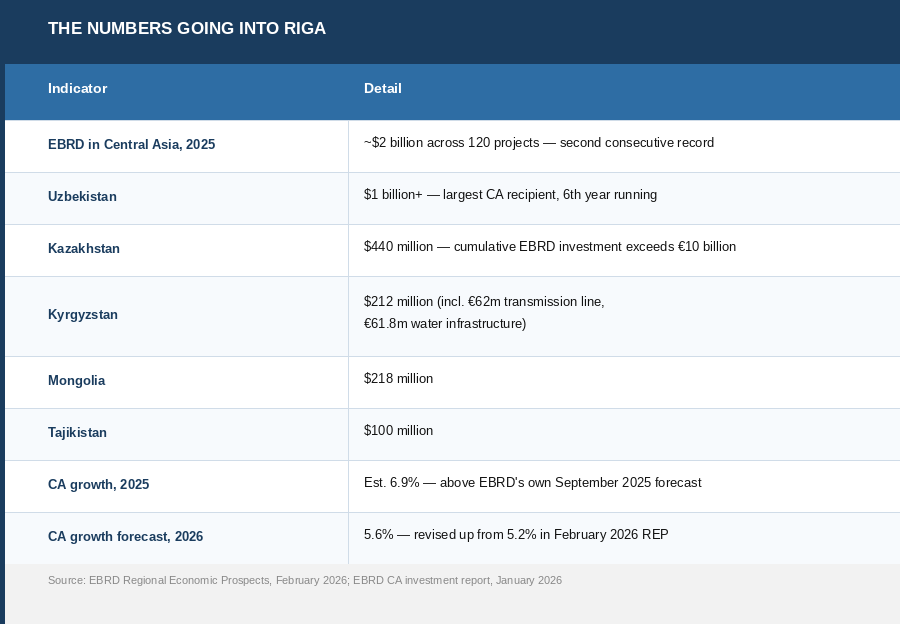
These figures frame what Riga is about for Central Asia. The region outperformed EBRD's own projections in 2025. The Bank's February 2026 Regional Economic Prospects revised the 2026 forecast upward to 5.6%, citing large-scale investment projects, particularly in Kyrgyzstan and Tajikistan. The updated Prospects, to be officially presented in Riga on 7 June, will be the first public read on how the EBRD now reads 2026-2027 risks for the region.
Aktau: the infrastructure deal to watch
The most concrete EBRD commitment tied to the Riga agenda is the Aktau port package: a €35 million EBRD loan plus up to €10 million in EU grant funding under the Asia Pacific Investment Facility, totalling €45 million. The money goes to two berth extensions and weather-resistant ship-to-shore cranes at Kazakhstan's primary Caspian gateway.
Container traffic at Aktau rose 121% year-on-year in the first nine months of 2025. The port was handling cargo it was not built to handle at that speed.
The target: develop the largest container terminal in the Caspian region by end-2026, with annual capacity of 240,000 TEUs. Container handling time should fall from 4 minutes per unit to 2.5 minutes. The port's capacity would double.
Aktau is owned by Samruk-Kazyna and operated by Kazakhstan Railways, the same institutional chain that manages the country's wider logistics strategy. The investment is explicitly framed by both the EBRD and the EU as a Trans-Caspian Corridor project. The EU's Global Gateway programme identified Aktau in a joint EBRD-EU transport study as a structural bottleneck in the Caspian segment of the Middle Corridor.
Aktau is the point where Central Asian cargo, from Kazakhstan, Uzbekistan, Turkmenistan, crosses the Caspian toward Azerbaijan, Georgia, and Turkey. The BTK railway, which entered full operation on 2 June, now has 5 million tonnes of annual capacity on the western side. Aktau's upgrade synchronises the eastern entry point. A corridor is only as fast as its slowest node. The EBRD-EU package addresses that node directly. For Uzbek and Kazakh exporters and for the logistics operators managing Middle Corridor freight, the Riga meeting is where the next phase of this investment will be signalled.
The Trans-Caspian Pipeline: the question Riga won't answer directly
The Trans-Caspian Pipeline, the subsea gas link from Turkmenistan across the Caspian to Azerbaijan, is not on the official Riga agenda. But it sits in the background of every energy session. The EU's self-imposed deadline for first TCP gas is November 2027. The window for a final investment decision is closing.
The EBRD has been involved in the TCP feasibility and financing discussions but has not committed capital. The legal framework, the 2018 Convention on the Legal Status of the Caspian Sea, cleared the principal bilateral obstacle, but Ashgabat has moved slowly. The Riga Business Forum sessions on capital mobilisation and the energy transition will be where investors and government officials test the water informally. No announcement is expected. The signals from those conversations will matter more than any press release.
For Turkmenistan specifically, which holds the world's fourth-largest proven natural gas reserves but exports almost entirely through a single Chinese pipeline: Riga is a chance to read Western institutional appetite. The EBRD does not operate in Turkmenistan directly. But its posture on TCP financing shapes whether commercial lenders and the EU's own instruments follow.
The governance dimension: what Riga decides institutionally
Beyond Central Asia, the Governors' plenary on 6 June has two formal items. First: reaffirm EBRD support for Ukraine, including a pathway toward post-war reconstruction. The Bank has deployed close to €10 billion in Ukraine since 2022. Second: endorse a new strategic focus on economic governance, a shift that affects how the Bank conditions lending across all regions.
For Central Asia, the governance agenda is not abstract. EBRD conditionality on rule of law, anti-corruption frameworks, and regulatory transparency has been a consistent lever in its negotiations with Kazakhstan and Uzbekistan. The updated governance doctrine will define the terms of the next investment cycle, including how the Bank handles its lending in Kyrgyzstan, which is simultaneously the EBRD's fastest-growing CA borrower and the first country hit by EU anti-circumvention sanctions.
Kyrgyzstan received $212 million from the EBRD in 2025, more than Tajikistan and Mongolia combined: while Bishkek was simultaneously under EU sanctions pressure for sanctions circumvention.
That tension has not prevented lending. But Riga's governance discussion will indicate whether the EBRD is prepared to make it a condition going forward.
Who should be watching Riga
Logistics operators and cargo companies moving freight on the Middle Corridor need to read the Aktau update and any announcements on port digitisation and rail interoperability. The BTK upgrade (2 June) and the Aktau investment are complementary: the corridor's throughput ceiling just rose significantly on both ends.
Energy investors with exposure to Turkmenistan or the Caspian energy trade should track the informal TCP conversations. No formal announcement is expected, but the institutional appetite signal from Riga will be meaningful.
Sovereign and corporate borrowers in Kazakhstan and Uzbekistan should watch the governance conditionality discussion. The EBRD's next strategic cycle will define loan terms for 2027 to 2030. Riga is where those terms get shaped.
Civil society organisations in the region will be present through the EBRD's dedicated civil society programme. The Bank publishes environmental and social impact frameworks for all major projects, including Aktau and the Kyrgyz transmission line, and Riga is where NGOs formally engage the Board.