A few aisles from where the American Under Secretary of State worked the room this week, a Chinese company had parked its excavators. Yellow, enormous, resting on the floor of the Astana mining congress like sleeping animals. XCMG. The Americans had come to talk Kazakhstan out of Chinese supply chains, and they did it in a hall rented, in part, to China.
Nobody found this strange. That is the first thing worth noticing.
· · ·
This was the week Kazakhstan did everything at once. Its officials opened the US-led critical minerals dialogue, the one Washington built to pull Central Asia’s copper and rare earths out of Beijing’s grip. The same days, a delegation in Shenzhen collected 24 agreements worth up to $6 billion for Alatau, the new city Kazakhstan is raising on a Chinese template with Chinese money. And the same days, the energy minister offered to push more Russian gas through Kazakh pipes to Uzbekistan.
Three directions. One week.
The obvious reading is virtuosity, and the reading is correct. Kazakhstan has run multi-vector foreign policy for thirty years, and Kassym-Jomart Tokayev runs it better than most. Sell access to all, belong to none. Keep the Americans hopeful, the Chinese invested, the Russians paid.
But look at what the virtuoso is standing on.
· · ·
Multi-vector was a cheap trick in a cheap decade. When the world was softly multipolar, when globalization still felt like the weather, a middle power could face four ways and call it a strategy. The patrons did not ask you to choose, because they were not yet at each other’s throats.
That decade has closed. The poles are hardening. Washington and Beijing are prying their supply chains apart on purpose. Russia is at war and keeping a list of who stands where. Iran has just shut the Strait of Hormuz again, and the conflict that was meant to stay in the Gulf is climbing into the routes Central Asia uses to breathe. The room in which Kazakhstan performs its balance is shrinking, and the guests have started to notice one another.
The three patrons are not three of a kind.
Russia holds the instruments of pain. The pipeline that carries more than 80 percent of Kazakhstan’s oil crosses its territory to the Black Sea. The remittances that feed millions of Central Asian households are earned in its cities. The gas, the grain routes, the long northern border. Moscow does not need Astana’s affection. It owns the plumbing.
China holds the instruments of weight. Record trade, the loans, the roads and the rails, and now a $6-billion template city. Beijing rarely coerces. It accumulates, until the accounts balance in only one direction.
And the United States offers the most attractive thing and the least binding one: a way out. A door marked elsewhere. It will buy tungsten, lend through its development bank, and call you a partner. It will not stand on your border when the weather turns. Washington sells a future. The neighbors hold the present.
So the famous balance runs on two dependencies Kazakhstan cannot escape and a third it cannot fully bank. The courtship with Washington is real, and its main use is to set Moscow and Beijing competing for a country that has nowhere else to stand.
· · ·
There is one more thing the choreography hides, and it may be the most telling. A good part of this performance is staged for an audience sitting in none of the three capitals. It plays to the people watching from Almaty, and to the trading floors. To a citizen, three patrons courted at once looks like a country too clever to be anyone’s client. To an investor, it looks like risk spread wide. Multi-vector is, among its other uses, a sovereignty pageant performed at home.
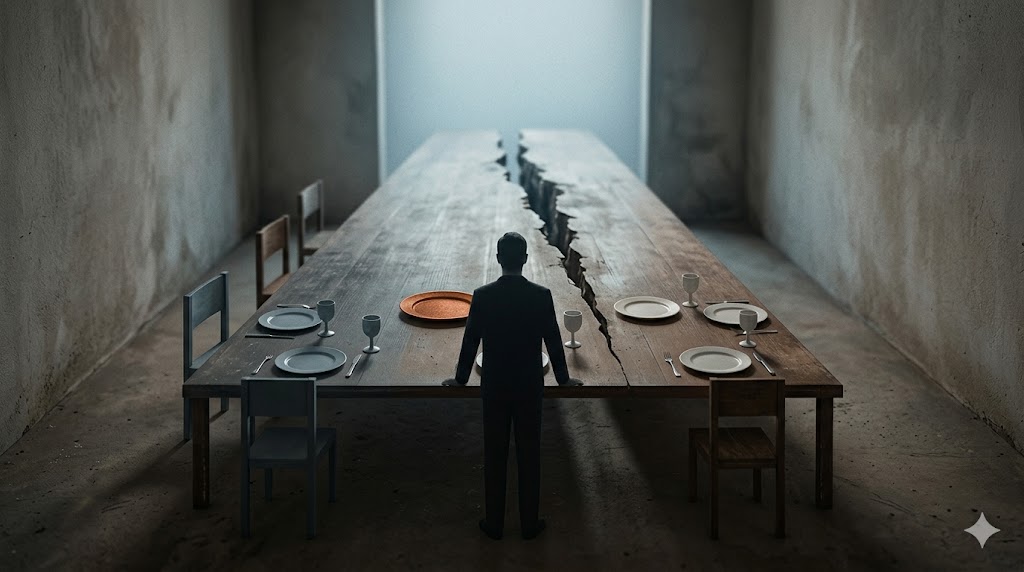
The trouble with pageants is that they assume an audience that stays seated. For thirty years the empires were content to be played, because being played cost them almost nothing. That contentment is the inheritance Tokayev is now spending. When the poles were soft, facing every direction was wisdom. As they harden, it starts to resemble the splits, performed on two of the tables drifting apart.
Kazakhstan will keep its footing a while longer. It is very good at this, and it has no better option than to be good at it. But the room is smaller now, the guests are watching each other, and somewhere a host is doing the arithmetic on how long he can seat three rivals at one table before one of them asks who else is coming to dinner.
That question went unasked this week. It will not stay unasked.
Peter Lidovsky writes on Eurasia and the politics of the spaces between empires. He contributes a weekly column to Central Asia Wire. The views expressed are his own.