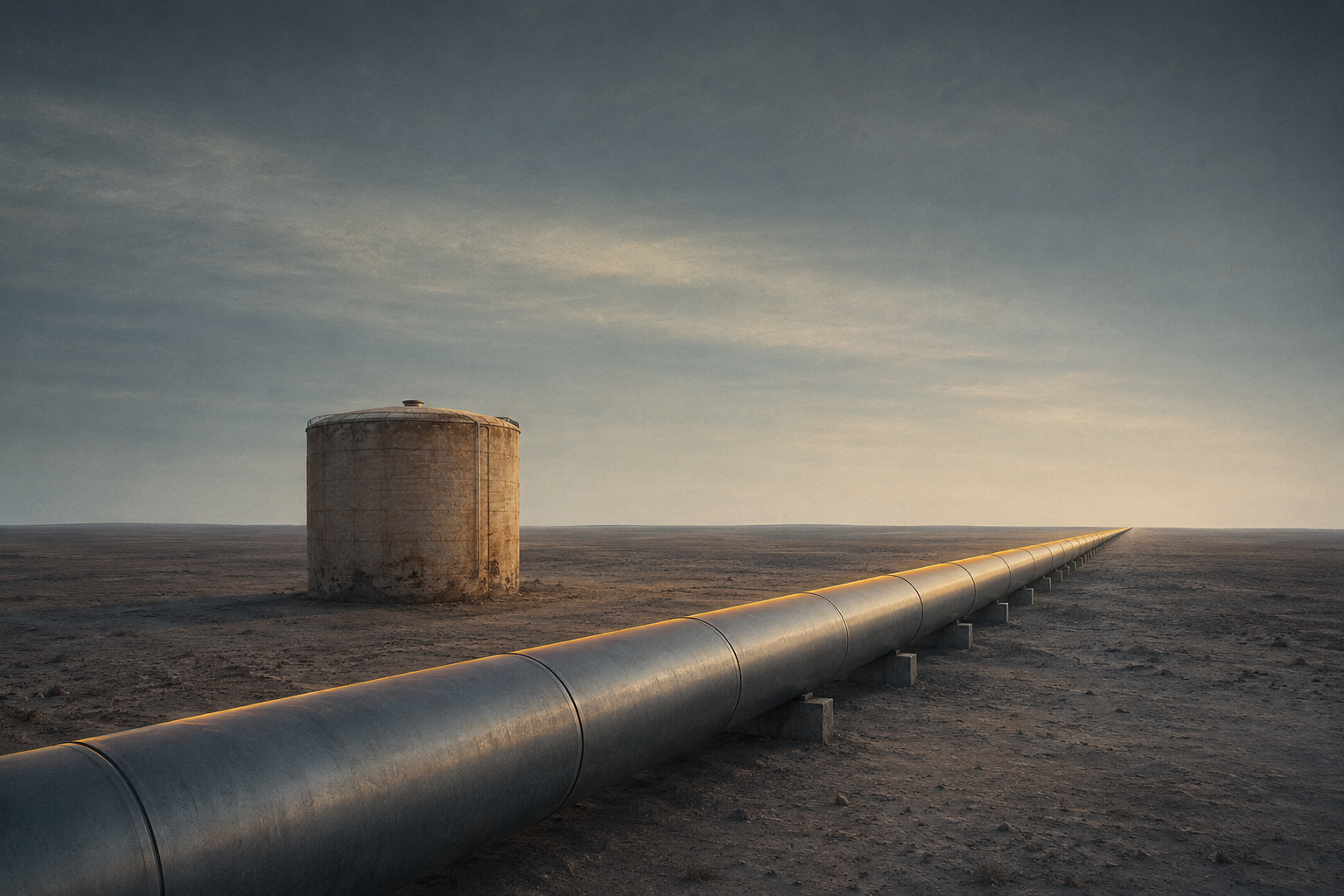
A pipeline stopped taking crude on the Black Sea coast on 20 July. Within about 48 hours, a field at the other end of a 1,511-kilometre pipe cut its output by more than half. Nothing at Tengiz broke. The wells were sound, the processing trains were sound, the shift turned up. The field slowed because there was nowhere to put what it makes.
National output fell 21% on 22 July, from a July average of 2.07 million barrels a day to 1.63 million. Tengiz went from an average 925,000 barrels a day to about 406,000. The binding constraint was storage.
A buffer is dull by design. Tankage between a wellhead and a tanker, a fuel reserve that covers a season, spare megawatts on the grid at six in the evening in July, a shed with transformers and turbine blades in it, water held behind a dam through a dry spring. All of it does one job, which is to turn a sudden failure into a slow one and buy the days in which somebody negotiates.
Central Asia has built a decade of infrastructure with very little of this in it.
Look first at the oil, since that is where the evidence is freshest. The alternatives to the closed route are real and they are small. Aktau across the Caspian to Baku and then Baku-Tbilisi-Ceyhan carried 1.3 million tonnes of Kazakh crude in the whole of 2025, against roughly 63 million tonnes through the Caspian Pipeline Consortium. Atasu to Alashankou into China took 1.1 million tonnes and Atyrau to Samara took 10 million, while the Kenkiyak to Atyrau reverse runs at about 6 million tonnes a year. On Monday Interfax-Kazakhstan reported that flows through Baku-Tbilisi-Ceyhan fell 9% in the first half of this year, with transit down 4%.
The redundancy on the map is genuine. Measured in tonnes it covers days, and the days are the number that matters when a terminal closes without notice.
Now the fuel. Kyrgyzstan imported 413,136.3 tonnes of petroleum products in the first five months of 2026, 19% less than a year earlier. Of the gasoline, 322.7 million litres of 327.1 million came from Russia, which is 98.6%. On 25 July Alexander Novak said Russia will hold its gasoline export ban to the end of 2026. The same day, Bishkek published a draft rewriting its import subsidy so that supported fuel can arrive at any crossing point, from any third country, naming China, Iran, Turkmenistan, Azerbaijan, Georgia and Turkey.
That is a sensible piece of drafting. It is also a price instrument: a subsidy changes who pays for a litre without putting a single litre inside the country, and this one expires on 30 September.
The grid tells the same story in a different currency. On 17 July two 220 kV lines in Kyrgyzstan tripped at the same moment, the load-shedding automatics fired, and Bishkek water intakes stopped. Ten days later no cause has surfaced in the Kyrgyz press. In Uzbekistan, consumption set records on five consecutive days this month, reaching 293.4 million kWh on 17 July, 7.6% above last summer’s maximum. A record is headroom, spent.
The region does know how to hold stock. It holds it against the interruption that arrives on a schedule.
Kazakhstan has allocated 384 billion tenge to power station repairs before the 2026 to 2027 heating season, 9% more than last year, and has stockpiled 3.5 million tonnes of coal and 143,000 tonnes of fuel oil. On Monday Mongolia’s prime minister told every tier of government to close out Naadam and turn to winter preparation, naming electricity, heating fuel and coal in that order. Winter has a date. Everyone can picture the failure, and the ministry that owns it is known in advance.
War, a drone, an arbitral order, a sanctions listing and a mudflow share one property: they arrive without a date, and the buffers that would absorb them are the ones that keep losing the argument for capital.
A buffer earns nothing, and it competes for capital against things that do.
A buffer earns nothing, and it competes for capital against things that do.
The Eurasian Development Bank counts 402 transport projects across Eurasia worth $345 billion, of which Central Asia holds $71.75 billion across 114 projects. Turkmenistan alone runs six international corridor projects worth $6.05 billion to 2035: $4.7 billion of highways, $1.2 billion of railways, and $150 million for border crossing points. Kazakhstan and Uzbekistan agreed last week to lift the capacity of their rail corridor from 35 million tonnes to 60 million. Kazakhstan has begun a $210 million first phase at the Baqty dry port on the Chinese border, designed for up to a million containers a year.
Every one of those is a throughput number. Throughput has a tariff, a revenue line, a ribbon and a minister standing next to it. A tank farm that sits full while nothing is wrong has none of these. When the money is borrowed, the appraisal model makes it worse: a development bank prices a corridor on tonnes moved, and storage enters the same spreadsheet as capital expenditure with no volume attached to it.
Water shows the cost of that arithmetic at full scale. Kyrgyzstan recorded more than 340 mudflows in the first half of 2026, the most in three to four decades, with glacier area down about 16% and preliminary damage of 399 million som. The buffer against that is a reservoir. The region’s largest, Rogun, is being financed by a 12-member international consortium led by the World Bank Group and took another $150 million from Italy’s climate fund on 23 July. Rogun has taken half a century and a consortium of twelve to fund. That is the going rate for one buffer, and it is why the smaller ones keep losing the argument.
Five years out, two versions of this are available.
In the first, interruption acquires a price. Charterers refusing to enter a terminal, war-risk premiums, force majeure notices and arbitration filings do the work that no ministry did: buyers begin writing continuity into contracts, insurers begin asking what happens on day 8, and storage enters the capital plan because it now reduces a cost that has a number on it. Aktau and Kuryk get tankage before they get the next container crane, and Kyrgyzstan legislates a fuel reserve with a published volume, the way a member of the International Energy Agency does. Uzbekistan builds reserve margin into its generation plan instead of announcing each new consumption record as an achievement.
In the second, price stays the only instrument. Subsidies widen, tariffs adjust, delegations fly, and each interruption is negotiated after it has begun. That version is cheaper every year until the year it is not, and its true reserve is diplomatic speed. July has been a live test of how fast that reserve actually is: Kazakhstan raised the tanker attacks at the SCO table on 24 July and asked publicly for a freeze in the war on 25 July, and had an answer from the Kremlin the next day.
The two versions are distinguishable well before 2031, and the tell is boring. It is a line item.
So the question worth carrying forward is a quantity. How many days of interruption can this region afford? The answer exists in principle as a set of numbers: days of fuel inside the borders, days of crude in tankage, hours of reserve on the grid at peak, months of water behind a dam. The moment to watch for is the first time one of those appears in a published plan with a target beside it. Until then, the reserve the region is actually running on is the speed of a phone call.
Adrian Cross writes the weekly column Five Years Ahead for Central Asia Wire. The views expressed are his own.