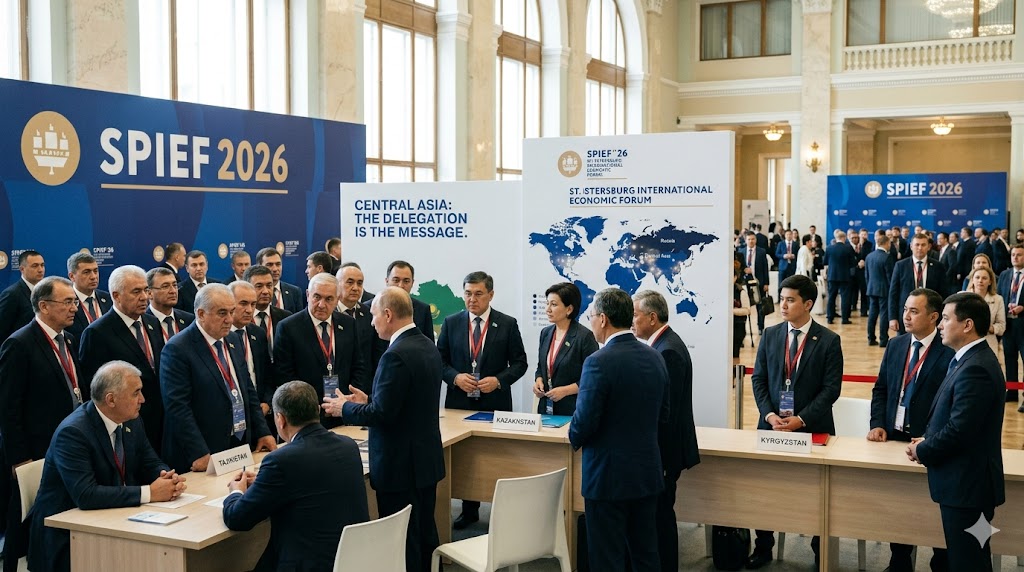
The St. Petersburg International Economic Forum opened today, and the five Central Asian states are in the room. But they are not in the room equally. The composition of each country’s delegation tells a story that no press release will: about who needs Russia right now, who is keeping its distance, and who is hedging carefully enough to send a minister but not a senior one.
Saudi Arabia holds the country-of-honour status at SPIEF 2026, with three cabinet ministers including the energy minister. That bilateral spotlight means Central Asian countries are not the story this year, which gives them more freedom to calibrate their presence without attracting attention. That calibration is visible in the delegation rosters.
Kyrgyzstan: the most committed
First Deputy Prime Minister Daniyar Amangeldiev leads the Kyrgyz delegation, the highest-ranking Central Asian official confirmed for SPIEF 2026. He has two appearances in the official programme: the Russia-Kyrgyzstan Business Dialogue on 3 June, where he delivers opening remarks, and the EAEU agricultural markets session on 5 June.
The level of engagement reflects the depth of Kyrgyzstan’s structural ties with Russia. Remittances from Kyrgyz migrants reached $3 billion in 2024, equivalent to 24% of national GDP, a figure that nearly matches the country’s total exports of $3.8 billion in the same year. The Russian-Kyrgyz Development Fund has financed more than 3,600 projects totalling over $900 million, helping create more than 33,000 jobs. Bilateral trade exceeded $3.8 billion in 2025.
Kyrgyzstan is also the current SCO chair, which gives Amangeldiev’s presence additional institutional weight: he represents not just Bishkek but the rotating presidency of a ten-member organisation.
The picture has complications. Kyrgyzstan emerged as a key hub for goods bypassing sanctions on Russia after 2022, with annual exports to Russia leaping from $393 million to $1.07 billion between 2021 and 2022. The country is now under Western pressure to close those channels, it recently liquidated 50 companies suspected of facilitating sanctions circumvention, the first such forced action in the country’s history. The SPIEF appearance by a senior official signals that, whatever the adjustments, Bishkek is not stepping back from the relationship.
Kazakhstan: present, but measured
Kazakhstan sends Dosjan Mussaliyev, Deputy Minister of Artificial Intelligence and Digital Development, a technical-level official. He appears in the 3 June session on digital futures of Central Eurasia, alongside ministers from Uzbekistan, Tajikistan, Turkmenistan and Belarus. There is no dedicated Russia-Kazakhstan business dialogue in the programme, despite bilateral trade reaching $27.4 billion in 2025, a slight year-on-year decrease.
Kazakhstan chairs the EAEU in 2026, and the subdued SPIEF footprint is deliberate. Astana already hosted the high-level bilateral moment: Putin attended the Supreme Eurasian Economic Council in Astana in late May, where 16 integration documents were signed. For Kazakhstan, St. Petersburg is secondary. The country’s nuclear agency chief Almasbek Satkaliyev also appears at a session on mega-science installations alongside Rosatom’s first deputy director, reflecting that Kazakhstan’s engagement with Russia on its proposed nuclear power plant continues at the technical level, whatever the diplomatic calibration above it.
“Tokayev has consistently urged expanding EAEU cooperation with the Global South, the Arab world, Southeast Asia and Africa, a vision of a Eurasian bloc that is not a Russia-centric project but a genuinely multipolar one.”
Uzbekistan: selective and strategic
Uzbekistan’s SPIEF presence covers three tracks: digital (Minister of Digital Technologies Sherzod Shermatov on 3 June), nuclear (head of Uzatom Azim Akhmadkhojayev on 4 June), and legal (Prosecutor General on 5 June). No dedicated Russia-Uzbekistan business dialogue appears in the programme, a meaningful absence for a country of 37 million and one of Russia’s most significant regional partners.
The selection reflects Tashkent’s approach: deep cooperation where it is economically necessary, institutional distance where it is politically convenient. Uzbekistan confirmed in 2024 that it will not pursue full EAEU membership, with a senior parliamentary official stating that a commission studying the bloc’s foundational documents “did not find any benefits for Uzbekistan.” At the same time, Uzbekistan started importing Russian gas via Kazakhstan in October 2023 and is planning to increase volumes from 2.8 to 11 billion cubic metres per year by 2026. President Mirziyoyev signed an agreement for Russia to construct a nuclear power plant in Uzbekistan. You do not send your nuclear agency chief to a session with Rosatom if you want to slow-walk that relationship.
Tajikistan and Turkmenistan: in the room, not at the table
Both countries send communications officials to the 3 June digital session, the head of Tajikistan’s Communications Service and Turkmenistan’s Minister of Communications. Neither has a named session, a bilateral dialogue, or any other confirmed programme appearance. For Tajikistan, relations with Russia remain fundamental, particularly around labour migration and remittances. For Turkmenistan, the engagement is transactional: the country sells gas and manages its neutrality carefully. Neither is making a statement with its SPIEF presence beyond showing up.
Kyrgyzstan First Deputy PM Amangeldiev: 2 sessions including dedicated bilateral dialogue
Kazakhstan Deputy Minister (technical level): 1 digital session; no bilateral dialogue
Uzbekistan 3 sector officials (digital, nuclear, legal), no bilateral dialogue
Tajikistan Head of Communications Service, digital session only
Turkmenistan Minister of Communications, digital session only
WHat the pattern tells us
The contrast between Kyrgyzstan and Kazakhstan captures the essential dynamic of Central Asia’s relationship with Russia in 2026: the more integrated you are, the higher the official you send. The more you are hedging, the more you calibrate the level downward while keeping the technical channels open.
Kyrgyzstan’s deputy prime minister is in St. Petersburg because Bishkek needs the relationship and sees no political cost in demonstrating it. Kazakhstan’s deputy minister is there because Astana maintains the relationship without making it the centre of gravity. Uzbekistan’s sector officials are there because the projects require it. Tajikistan and Turkmenistan are there because not being there would be noticed.
None of this is accidental. In Central Asia, the level of the delegation is the message.