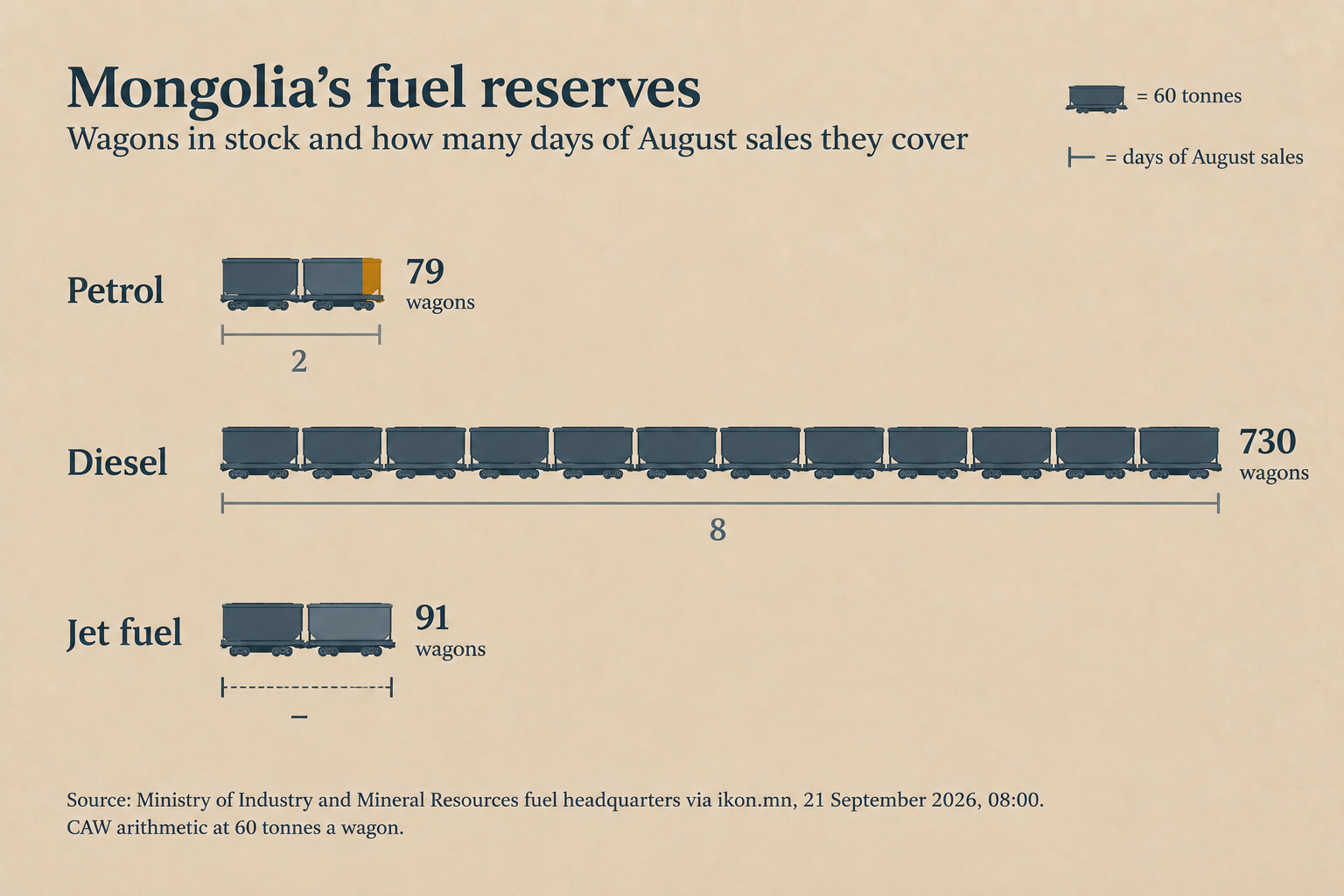
The headquarters’ account, carried by ikon.mn at 13:51 Ulaanbaatar time, gives the stock by wagon and product: 79 of AI-92, 730 of diesel, 91 of jet fuel, 900 in all, and 172,000 tonnes of oil products brought in as of 20 September, without naming the period. The ministry’s state secretary, B. Dashpurev, told the mineral resources and petroleum authority to unload the wagons quickly and keep every filling station in the country supplied, ordered fuel imports by road to be made possible at every border crossing, and reminded importers to build stocks, “with particular attention to diesel”.
Diesel is the deeper stock. On the same conversion, 730 wagons hold about 43,800 tonnes, 8 days of August’s 158,530 tonnes. Petrol is the thin one, and it is the product Russia’s own market is short of.
Moscow’s refinery had been shut since Sunday. Two units caught fire in the drone attack of the night of 19 to 20 September, Reuters’ sources said: AVT-6, with a capacity of 21,400 tonnes a day and 53% of the plant, and Euro+, with 18,800 tonnes and 47%. No wholesale products from the plant appeared on the St Petersburg exchange from 21 September, the sources said, and repairs could take several weeks; Gazprom Neft gave the agency no comment. The plant’s nominal capacity is about 14 million tonnes a year; in 2024 it processed 11.6 million tonnes and made 2.9 million tonnes of petrol and 3.2 million of diesel.
Petrol is the thin one, and it is the product Russia’s own market is short of.
On Monday afternoon Deputy Prime Minister Alexander Novak held a meeting on the fuel market, the government said. The energy ministry reported on stocks and refinery utilisation; the regions singled out were Tuva, Khakassia, Sakha, Novosibirsk and Krasnoyarsk, all east of the Urals; Tuva borders Mongolia. Novak told the ministries and companies to go on “saturating the domestic market” and to work out “possible risk scenarios” with measures ready, “including increased production of oil products and adjustment of fuel import volumes”, Interfax quoted the statement as saying.
The export instruments stand where they stood on Friday. The government’s page for resolution 854 of 8 July, which extended the diesel ban to producers, now lists a further resolution, 1097 of 28 August, that “extended the temporary ban on the export of certain fuels by producers”; the extension to 31 October that Vedomosti and RBC reported on 16 September has no published number.
Kyrgyzstan takes 100,000 tonnes of Russian fuel a month to the end of the year under an intergovernmental agreement, and its first deputy cabinet chairman told parliament on Monday that the state covers “practically 40%” of the pump price and cannot hold it next year. Mongolia’s alternative for September is Chinese: 17,000 tonnes from CNPC under the arrangement of 10 September. Neither book carries the Moscow refinery’s petrol.