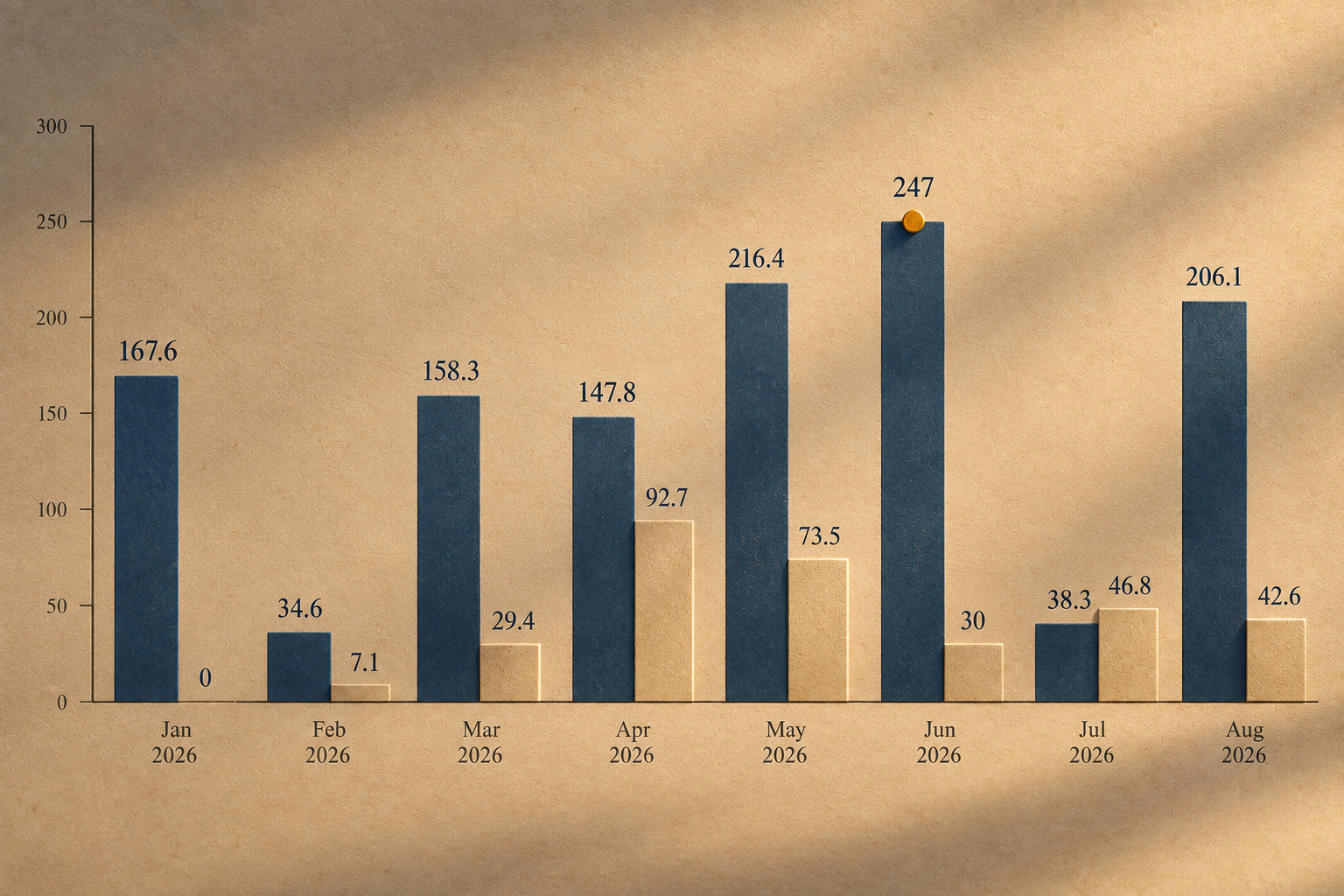
The monthly figures move in jumps. Imports, from Russia and Turkmenistan, ran at $167.6 million in January, fell to $34.6 million in February, came back to $158.3 million in March and $147.8 million in April, rose to $216.4 million in May and $247 million in June, dropped to $38.3 million in July and jumped to $206.1 million in August. June’s $247 million was the largest monthly bill of the year.
Propane is inside the total. Of the $1.21 billion, $124.3 million went on liquefied gas, a line that grew 3.5 times, as the Tashkent business outlet Spot carried the figures. The committee’s series is in dollars only, with no volumes and no split between the two suppliers, so the Russian share of the bill cannot be read from it.
June’s $247 million was the largest monthly bill of the year.
Exports moved the other way: deliveries stopped altogether in January and resumed in February at $7.1 million, rose to $29.4 million in March and $92.7 million in April, fell to $73.5 million in May and $30 million in June, and ran at $46.8 million in July and $42.6 million in August. July was the one month in which exports exceeded imports.
China’s customs count the same trade differently. Its figures put Uzbek gas imports at $306.06 million for January to August, $16.2 million below Tashkent’s export figure, against $566.2 million in the same months of 2025, and August’s $47.7 million was 20.4% above July and less than half of August 2025’s. Among China’s pipeline suppliers so far this year Uzbekistan is fifth, behind Russia at $6.53 billion, Turkmenistan at $5.51 billion, Myanmar at $996.6 million and Kazakhstan at $703.6 million.
The field data run the same way. Gas production in January to August was 24.2 billion cubic metres, 16.3% below the same months of 2025, oil 425,000 tonnes, down 2.2%, coal 4.4 million tonnes, down 10.2%, and gas condensate 648,300 tonnes, down 14.8%, by the committee’s report of 1 October.
The import line has a reader in Washington. The Lindsey O. Graham Sanctioning Russia and Iran Act, in force since 18 September, puts duties of up to 100% on the 5 largest importers by volume of Russian crude oil or natural gas over the 12 months before enactment, and it defines natural gas as the goods under Harmonized System code 2711, which covers liquefied petroleum gases as well as pipeline gas. Uzbekistan’s propane line is counted under the same code as its pipeline imports.
The volumes that count are not in the committee’s dollar series. Gazprom sold Uzbekistan 6.48 billion cubic metres in 2025, 15% more than in 2024, and the International Energy Agency expects more than 10 billion in 2026. Gazprom’s chief Alexei Miller said on 4 September that the company’s supplies to Kazakhstan, Kyrgyzstan and Uzbekistan together had risen by almost 70% since the start of the year, a figure for the three countries with no base stated.
The US Trade Representative’s written justification, with the methodology for counting, is due by Thursday 8 October, 20 days after enactment, and the first duties by 18 October. It had published nothing on the act by Monday morning.
Tashkent has said nothing official on the act, and no published ranking yet says whether its Russian volumes put it among the five. On the committee’s figures it already pays almost 4 dollars for imported gas for every dollar it earns from exports, and in June the bill was 8 times the receipts.