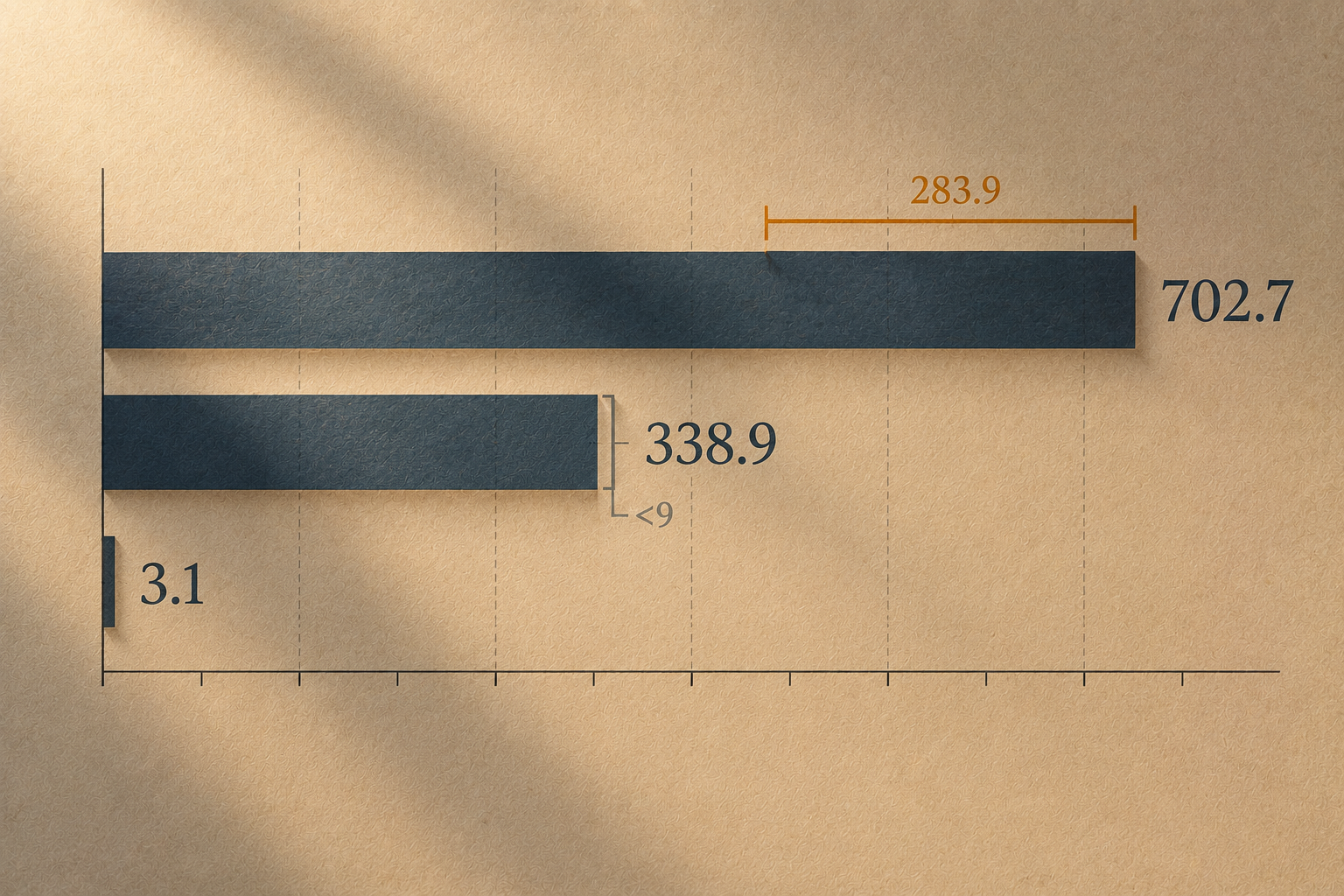
The buyer pays, and the figures give the average price. On the ministry’s figures that Asia-Plus printed on Friday, the Afghan deliveries earned 283.9 million of the 292.2 million somoni that all exports brought in the first half, which is 40 dirams a kilowatt-hour, about 4.4 US cents at the current rate. The 338.9 million kWh that went to Uzbekistan account for under 9 million somoni of the same total, and the terms of those deliveries are not on the record.
A plan and no number came out of the meeting itself, held in Dushanbe and reported by Afghanistan’s directorate of state-owned corporations. Barqi Tojik’s chief and his counterpart at Da Afghanistan Breshna Sherkat discussed more supply, more lines, voltage quality, tariffs and training, the directorate said.
The 338.9 million kWh that went to Uzbekistan account for under 9 million somoni of the same total, and the terms of those deliveries are not on the record.
In that account the Tajik side spoke of a 500 kV line and agreed to consider the request for larger volumes, without naming a volume or a date. The talks go on at the level of technical and commercial groups, the Afghan account says.
The surplus Afghanistan buys is a spring flood. About 90% of the half-year’s exports went out between April and June, when the rivers run, and the half-year total fell 7% from the first half of 2025. In summer the government cut exports to fill the reservoirs after a dry year.
CASA-1000 is the line built for this trade, and the Afghan section is the one still unbuilt. Construction is complete in Tajikistan, Kyrgyzstan and Pakistan, while the Afghan section stood at 65% in August and is planned for completion by spring 2027, with commercial supplies expected in the second half of that year.
The project runs about 1,300 km, costs about $1.2 billion, financed by the World Bank, the Islamic Development Bank, the EIB and the EBRD, and is rated at up to 1.3 GW from Central Asia to South Asia. Until it is finished, every kilowatt-hour Tajikistan sends south crosses on the existing lines, the ones Barqi Tojik now wants to reinforce.
The same week brought the gas. Pajhwok reported on Thursday that the TAPI pipeline had reached the outskirts of Herat city, that the governor and the project’s director general had discussed extending it into the city and the industrial park, and that technical teams had already drawn a distribution network for Herat’s parks, housing, offices and shops. The pipeline is planned at about 1,800 km and up to 33 billion cubic metres a year.
Energy reaches Afghanistan ahead of transport. The power has a buyer, a price and a line, and the gas has a pipe at the city limits.
Railways have memoranda, the newest signed on Wednesday by Kazakhstan, Uzbekistan and the UAE for a route to Pakistan’s ports with no financing attached, while Pakistan’s trade with Central Asia fell from $443.7 million to $219.1 million in the fiscal year to June 2026, with the Afghan crossings shut, Profit by Pakistan Today reported in August. Afghanistan’s links north are arriving as wires and pipes before they arrive as rails.
Unresolved are the 500 kV line’s route, cost, builder and date, the size of Kabul’s request, the tariff Afghanistan will pay after CASA-1000 opens against the 40 dirams it pays now, and the terms under which Uzbekistan receives Tajik summer power. What changes next: the technical groups’ talks, the Afghan section’s spring deadline, and the water of 2027, which decides whether a summer surplus exists to fill the line’s 1.3 GW.