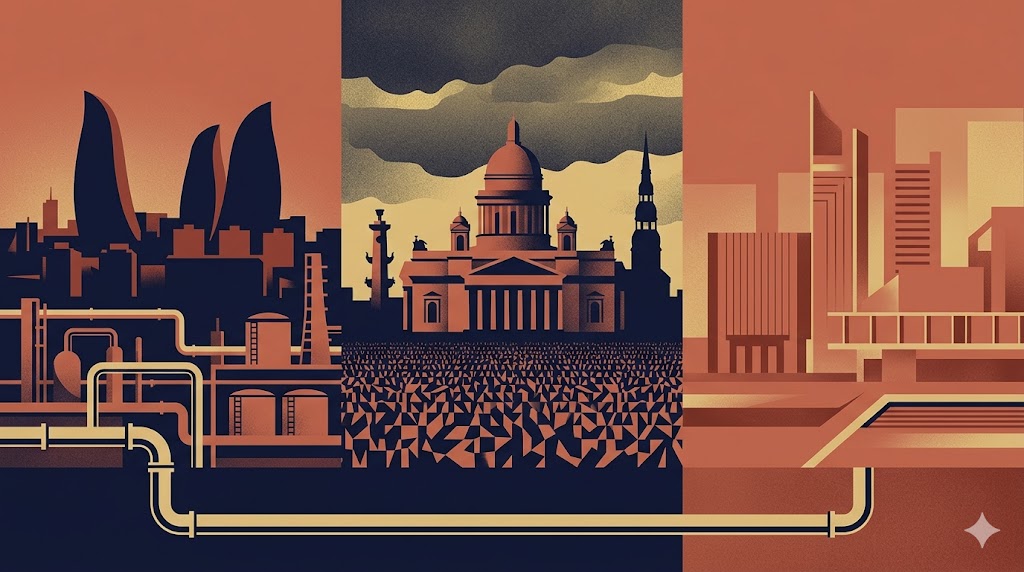
Somewhere in Baku on 2 June, Ilham Aliyev stopped by the Uzbekneftegaz stand. The President of Azerbaijan, at his own energy forum, visiting the Uzbek oil and gas company’s exhibition booth. This is not a detail that makes headlines. But it is the kind of detail that tells you something about a region in motion, the quiet reconfiguration of who is talking to whom, about what, and in which city.
It was a busy week for that kind of detail.
· · ·
Baku Energy Week ran 1 to 3 June. St. Petersburg’s forum ran 3 to 6 June. The EBRD’s annual meeting was in Riga, 5 to 7 June. Three forums, one week, one underlying subject: who controls the gas, the pipeline, and the money that pays for both.
In Baku, SOCAR signed $7.5 billion worth of agreements. The counterparties included the United States government, Turkey’s BOTAS, TotalEnergies, ADNOC, JP Morgan, Apollo Global Management, and Chevron. There was a 15-year natural gas supply framework tied to the offshore Absheron field. There was the first-ever Azerbaijan-US Economic Dialogue. There was strategic cooperation on the TANAP pipeline with Apollo, an American private equity firm now materially invested in the infrastructure that carries Caspian gas to Europe.
Azerbaijan signed $7.5 billion in deals at its own energy forum. Russia signed 1,084 agreements worth $84 billion at its forum two days later. The numbers are not comparable: the Russian figure includes domestic Russian capital and is measured in rubles at a favourable rate, but the juxtaposition is instructive. Both countries were, in the same week, demonstrating to different audiences that they remain at the centre of something important. The audiences barely overlap.
· · ·
In St. Petersburg, the theme was “Pragmatic Dialogue: The Path to a Stable Future.” The pragmatism was not hard to locate. Saudi Arabia was the guest of honour, 100 years of diplomatic relations, a 400-square-metre national pavilion, three cabinet ministers. The country that, two years ago, was coordinating oil production cuts with Russia through OPEC+ was now being feted in an ExpoForum convention hall as evidence that Russia still has friends with money.
The forum opened on the morning of 3 June. Several hours earlier, Ukrainian drones struck energy infrastructure approximately 16 kilometres from the venue, briefly disrupting operations at St. Petersburg’s airport. The forum proceeded as planned.
This fact was noted by the assembled press. At a session on 3 June, Maria Zakharova, the Russian Foreign Ministry’s spokesperson, a fixture at these events, turned to the BBC’s Steve Rosenberg, who is also a fixture, and asked why Western audiences never see footage of Ukrainian attacks on Russian civilians. Rosenberg, who has been asking uncomfortable questions at Russian forums since approximately the Medvedev era, did not visibly flinch. The exchange was filmed and circulated.
This too is a SPIEF tradition. The forum exists to project normality: that Russia is open for business, that partners are arriving, that the deals are being signed. The Zakharova-Rosenberg exchange exists to project that the West is hypocritical. Both projections happened simultaneously, which is how SPIEF works.
· · ·
In Riga, the EBRD held its annual meeting. It was quieter. The bank committed further financing for Kazakhstan’s Aktau port expansion, discussed hydropower in Tajikistan, and talked about green energy grids in Uzbekistan. No drones. No Zakharova. No $84 billion announcements.
The EBRD’s annual meeting is designed to move money. The difference between Riga and St. Petersburg this week is partly the difference between a press conference and a ledger entry. One of them is louder. The other one is where the commitments actually get made.
· · ·
What connects all three cities, and what the week makes visible, is a single infrastructure question that has been deferred for a decade and is now urgent. The Trans-Caspian Pipeline, the route that would carry Turkmen gas under the Caspian to Azerbaijan and onward to Europe, was present at Baku Energy Week as subtext throughout. The 15-year BOTAS-SOCAR deal is, in part, a placeholder for gas volumes that do not yet exist because the pipeline does not yet exist. The European Commission put TCP on its Projects of Common Interest list. The EU’s deadline for ending Russian gas imports is November 2027.
The pipeline’s absence was the most important thing at Baku Energy Week. Its funding is what Riga is supposed to help arrange. Its geopolitical logic is what St. Petersburg is supposed to complicate.
Meanwhile, in Ashgabat, President Berdimuhamedov was not in any of these cities. Turkmenistan’s gas, the gas that TCP is supposed to carry, the largest natural gas reserves in the region, currently flowing almost entirely to China, was the subject of considerable discussion in Baku, a little discussion in Riga, and almost none in St. Petersburg. This is a map of interests.
· · ·
I keep returning to Aliyev at the Uzbekneftegaz stand. It is the kind of moment that does not fit the standard framing of Eurasian energy politics, which tends to be bilateral (Russia-Europe, China-Central Asia, US-Azerbaijan) and misses the lateral connections that are quietly forming. Uzbekistan needs gas. Azerbaijan has a pipeline system. Both countries need each other not to be dependent on anyone else.
Three forums. Three cities. One week. The same pipeline, seen from three different angles, with three different interests in whether it gets built.
In Riga, they are working on the financing. In Baku, they are signing the deals that assume it exists. In St. Petersburg, they are hosting the country whose gas revenues depend on it not existing.
Peter Lidovsky writes on Eurasia and the politics of the spaces between empires. He contributes a weekly column to Central Asia Wire. The views expressed are his own.