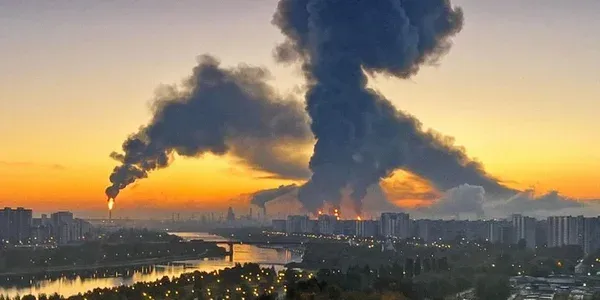
The ministry's morning statement on Sunday, carried by Interfax at 09:41, listed 20 regions and the Black Sea. It is the largest night total in the ministry's statements since at least 12 September, on CAW's log; the previous high was 641, on the night of 16 to 17 September. Monday morning's figure was 244.
Sergei Sobyanin, the mayor, wrote that “a facility on the territory of the Moscow refinery has been damaged” and that no one was hurt there. Moscow region's governor reported 2 dead and 20 people seeking medical help. Accounts of the damage differ: Neftegaz.ru wrote that the strike probably reached the tank farm and left the main site untouched, while Ukraine's General Staff claimed the AVT-6 primary unit, a combined processing unit and an isomerisation unit.
Gazprom Neft's refinery at Kapotnya can process about 12 million tonnes of crude a year on Neftegaz.ru's figure, 14 million on The Moscow Times's, which also puts its share of the capital's fuel at about a third. The Moscow Times, citing msk1.ru, reported that some Gazprom Neft stations in the city cut sales to 30 litres a car on Sunday, from 60.
What they cannot avoid is the price set on that exchange.
The export rules have not caught up. Kommersant reported on Friday 18 September that the government intends to extend the embargo on diesel exports by producers to the end of October, a decision taken at deputy prime minister Alexander Novak's meeting on 14 September, and that “there has been no official announcement of the extension”. Russia's diesel exports have fallen to 234,000 barrels a day, the paper wrote, and the exchange price of diesel, after falling 9% in the first week of September, has passed 70,500 roubles a tonne.
Deliveries under intergovernmental agreements, the channel through which Kyrgyzstan and Tajikistan receive Russian fuel, are exempt from the bans. What they cannot avoid is the price set on that exchange.
Tajikistan bought 91.1% of its imported oil products from Russia in the first half of 2026 and has pencilled in 1.55 million tonnes of imports for 2027 at about $1.12 billion. Kyrgyzstan's cabinet compensates importers against reference prices of $960 a tonne for AI-92 and $1,050 for diesel under resolution 579, and the first claims under it fall due on Friday 25 September.