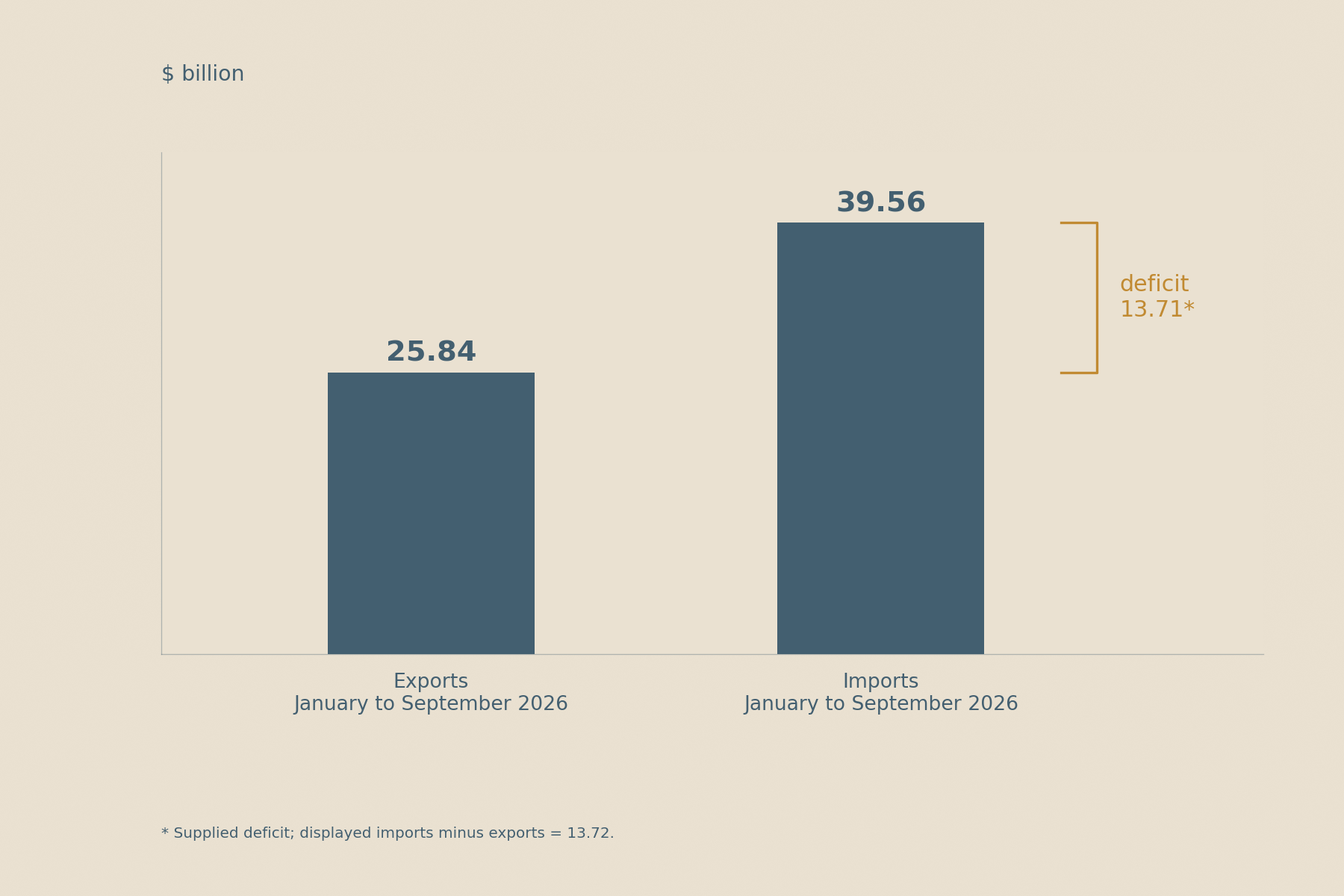
China took 23.2% of the turnover at $15.16 billion, up 27.6%, Russia $10.47 billion, up 10.5%, and Kazakhstan $4.25 billion, up 22.3%. Afghanistan rose 38.7% to $1.59 billion, Kyrgyzstan 59.4% to $1.07 billion, and Hong Kong multiplied 11.6 times to $1.27 billion, by Spot’s reading of the report at 20:49 Tashkent time.
Without gold, exports grew. Industrial goods rose 27.6% to $3.8 billion, chemicals 35% to $2.03 billion, machinery 40.6% to $1.07 billion, while food slipped 3.4% to $1.98 billion as fruit and vegetables fell 11%. Services exports reached $9.7 billion, up 31.1%: tourism $5.32 billion, transport $2.88 billion, IT $805 million.
Imports led by machinery. Machinery and equipment cost $12.85 billion, up 14.4%, with vehicles at $3.22 billion, up 26.4%. Food imports rose 37.5% to $4.22 billion, grain alone 59.4% to $1.1 billion. Fuel and energy cost $3.36 billion, up 21.6%: gas $1.6 billion, one and a half times last year’s, petrol $454.4 million, up 33.6%, and diesel $189.1 million, down 19%.
Gold has not moved since the August pause. Uzbekistan exported it only in April, $1.5 billion, and July, $1.3 billion, after a record above $9.9 billion in 2025. Reserves stood at $66.58 billion on 1 October, down 7.7% on the month, with gold at $60.08 billion for 14.34 million ounces, 446.2 tonnes, and foreign currency at $5.92 billion.