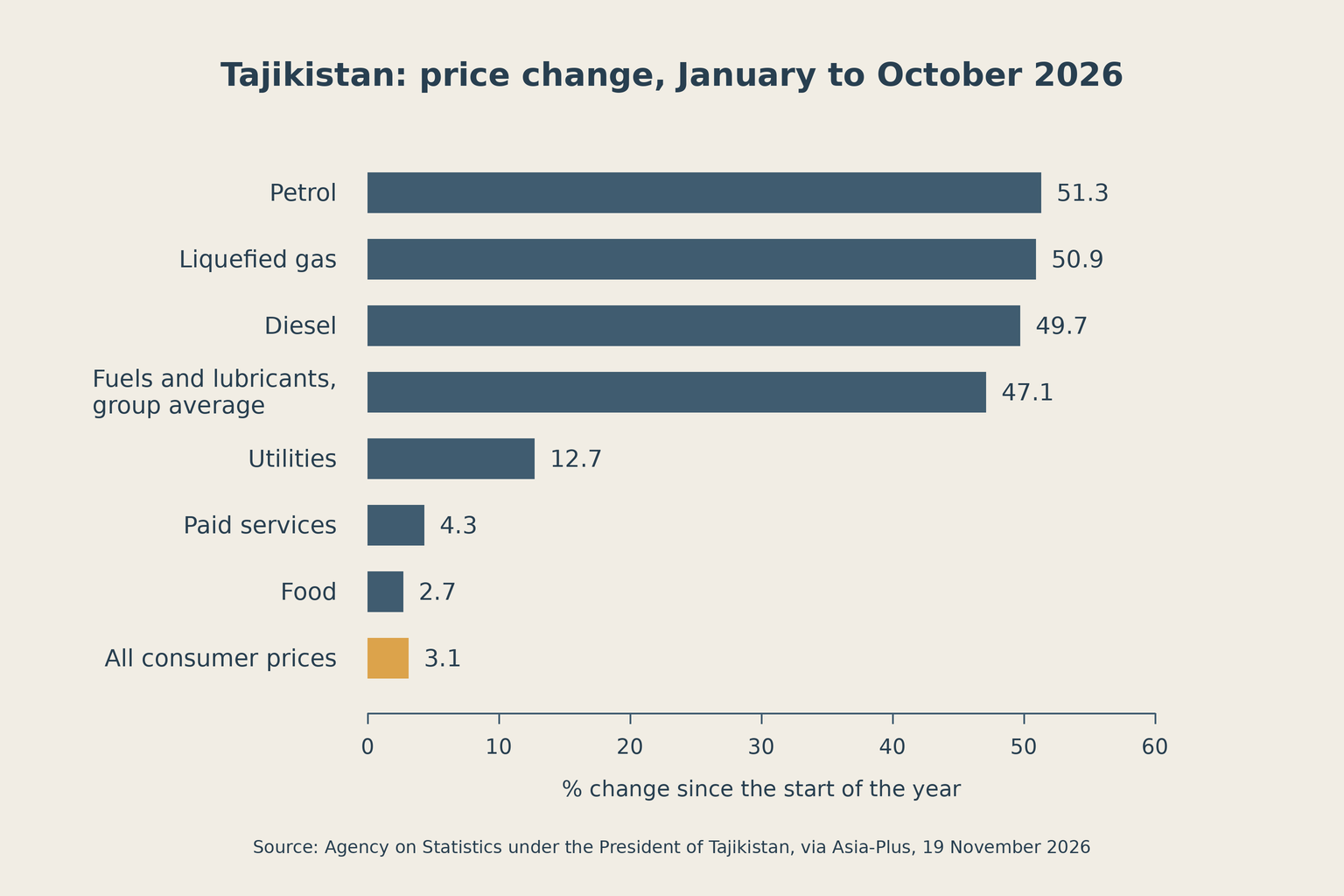
All three rose more than the group average, so the group contains products the report does not name. In October liquefied gas rose 10.8% and petrol 9.7%, while diesel fell 1.2%.
Consumer prices as a whole rose 3.1% over the ten months, against 2.6% a year earlier, with food up 2.7%, non-food goods 3.1%, paid services 4.3% and utility tariffs 12.7%. The report counts both the fuel figure and the index from the start of the year and does not say whether that means December prices or a January average.
It gives no cause for the rise. It does not give fuel’s weight in the consumer basket either, the number that would show how a 47.1% rise in one group fits inside an index that moved 3.1%.
Pump prices in Dushanbe were already climbing in the summer. AI-92 petrol went from about 10.90 somoni a litre in early June to 13.50 by the end of August and diesel from 11 to 16.50 somoni, as CAW reported on 18 November. Diesel’s rise of 50% over those three months, by CAW’s arithmetic, is close to the 49.7% the agency gives for the ten months.
Russia accounted for 91.1% of Tajikistan’s imports of oil products in the first half of 2026, by figures of the country’s Antimonopoly Service. Russia has had a ban on petrol and diesel exports in force since April, extended to the end of January 2027, the Uzbek business site Spot noted, and Uzbekistan’s Energy Ministry says it does not cover supplies under intergovernmental agreements.
Two measures date from November. Government resolution 744 of 10 November set a zero import duty to 31 December on oil products and petroleum gases from outside the CIS free-trade zone. Kazakhstan put 20,000 tonnes of AI-92 petrol for Tajikistan in its November supply plan, Energy Minister Yerlan Akkenzhenov said on 10 November, a little more than half an average month of Tajik petrol imports by Asia-Plus’s arithmetic.
Kazakhstan’s ban on road exports of petrol and diesel starts on 22 November, with an exemption for approved supply plans.