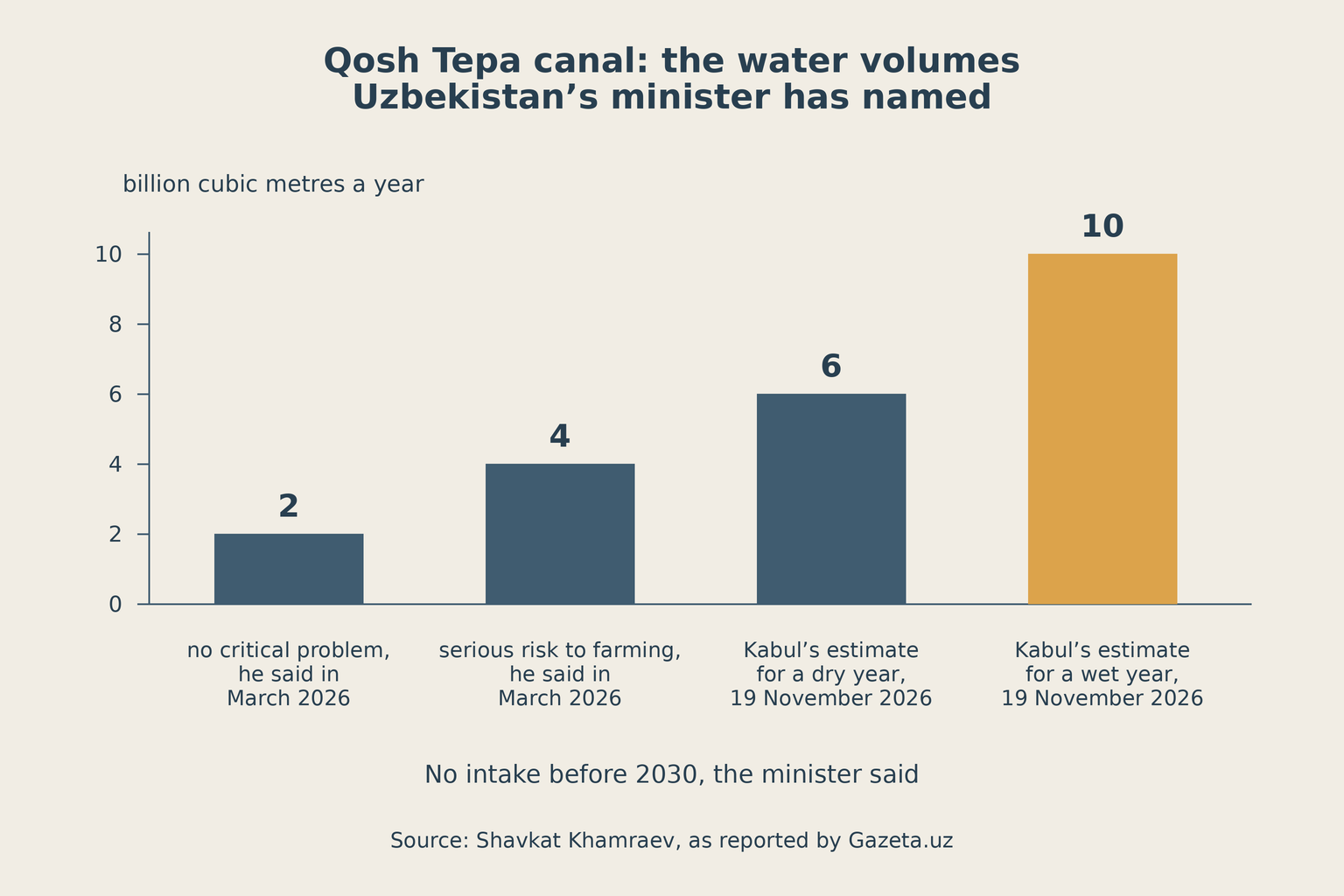
In March 2026 Khamraev said that 2 billion cubic metres a year would create no critical problem for Uzbekistan and that 4 billion could put its agriculture at serious risk, Gazeta.uz noted, adding that on 19 November he did not explain how the assessment had changed.
He tied the new figures to the river. The Amu Darya carries about 50 billion cubic metres in some years and up to 100 billion in others, by the estimates he cited, which makes 10 billion a fifth of a low year’s flow and a tenth of a high one, by CAW’s arithmetic. In a dry year Tashkent would ask its neighbour to take 6 billion, or even 4 billion, instead of 10 billion and would help with crops or other support if that caused it difficulty, he said.
Intake has not begun. The canal is still being built and has so far taken “not a single bucket” of water, Khamraev said, and intake will start only when construction ends, perhaps as late as 2050 and certainly not before 2030.
Public figures are scarce. Reliable public data on the canal’s actual intake, water losses and operating regime remain insufficient, the Institute for Advanced International Studies at Tashkent’s University of World Economy and Diplomacy noted in October 2026, according to Gazeta.uz.
Khamraev doubts Afghanistan can run the canal at its planned scale. Kabul counts on irrigating 500,000 to 600,000 hectares, he said, but gravity alone will carry water to no more than 200,000 to 250,000 and the rest must be pumped. Uzbekistan’s own Karshi main canal lifts water in six stages and uses 2.2 billion kilowatt-hours of electricity a year.
Construction began in 2022. The canal is planned to run about 285 km and to irrigate farmland in the northern Afghan provinces of Balkh, Jowzjan and Faryab, and its first section of about 108 km was completed in October 2023.
The two governments have an understanding that agreements on volumes and other terms will be signed once the canal is finished, Khamraev said. A delegation led by Afghanistan’s deputy agriculture minister visited Uzbekistan the week before.