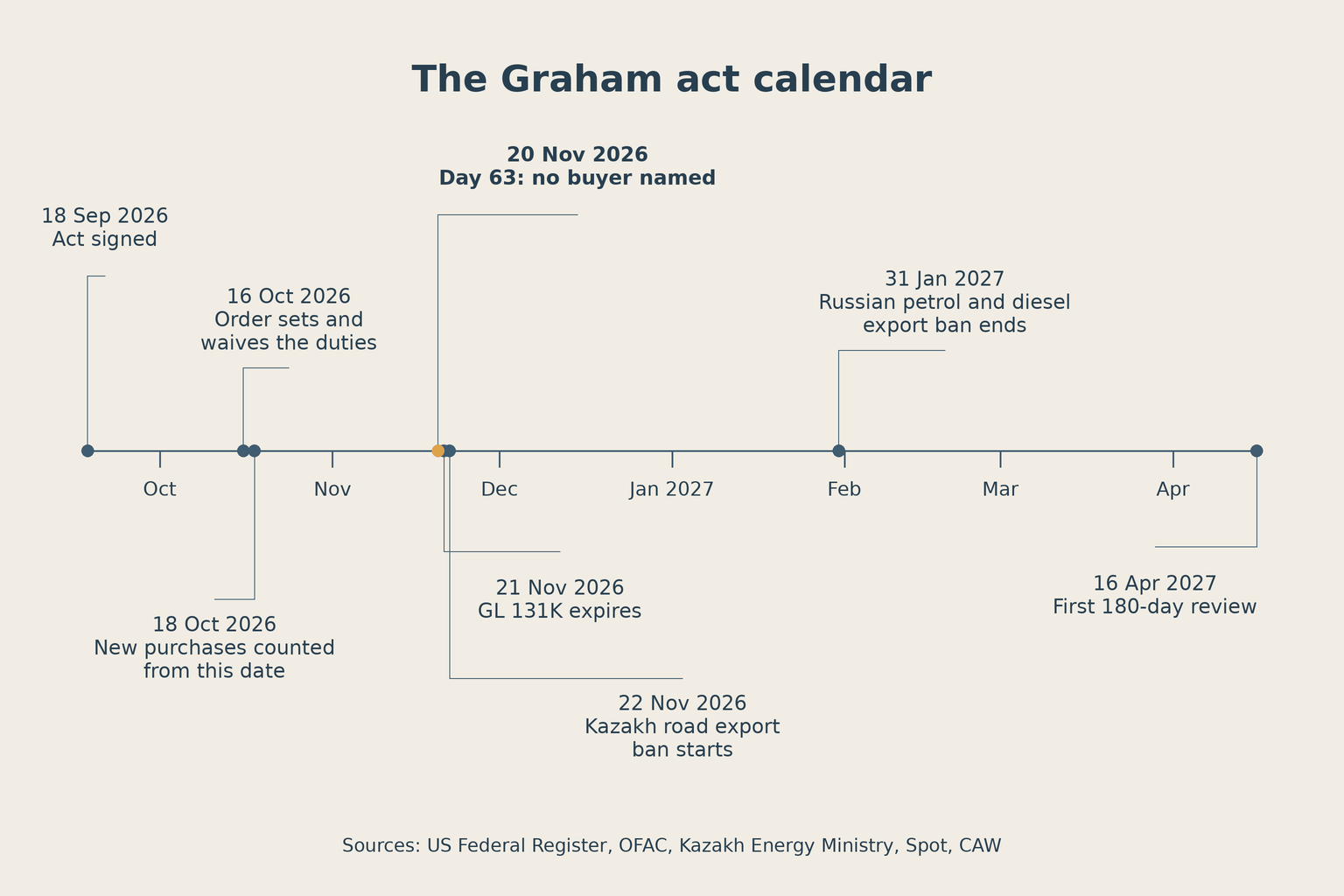
The Lindsey O. Graham Sanctioning Russia and Iran Act, signed on 18 September, provides for duties of up to 100% on goods from the five largest importers of Russian crude oil or gas. Its first ranking counts crude and gas together, and the reviews it orders every 180 days rank them apart.
Executive Order 14436, signed on 16 October and published in the Federal Register on 21 October, set the rates and waived them in the same text. It ties the 100% duty to knowing new purchases on or after 18 October, names no country, leaves the monitoring to the US Trade Representative and keeps every waiver in place until the president or the secretary of state decide that “further action is appropriate”.
Nothing has changed since. The newest Russia-related entry of the Treasury’s sanctions office is General License 131K of 21 October, and its latest action of any kind, on 18 November, concerns counter-terrorism. The trade representative’s office has published nothing on the five buyers, and the order remains the newest document under the act in the Register, all through 19 November.
Donald Trump said on 19 October that the option stays open. “I have the right to do that at any time, immediately,” he said at the White House of imposing the duties, three days after signing the order.
The Shenzhen text does not touch the question. The declaration that Xi Jinping, Vladimir Putin and Trump issued after meeting on 19 November has four points, by the full text Xinhua published: reform of the United Nations, energy, the limits of international courts and nuclear risk. It mentions neither sanctions nor tariffs, neither crude nor gas, and no country of Central Asia.
Its second point is the one that reaches the region. The three countries plan to “increase the production and supply of refined petroleum products” for the benefit of all nations, and they reaffirmed the importance of stable energy flows. The text gives no volumes, dates or mechanism, and does not say whose markets the fuel would reach.
Refined fuel is what the region is short of. Fuel prices in Tajikistan were 47.1% higher in October than at the start of the year, by the statistics agency’s figures that Asia-Plus reported on 19 November, and ordinary AI-92 petrol on Uzbekistan’s exchange jumped 7.1% in a day on 17 November.
The shortage shows in what governments are doing. Kazakhstan’s ban on exporting petrol and diesel by road takes effect on Sunday 22 November and runs to 22 May 2027, and Tajikistan has dropped its import duty on fuel from outside the CIS free-trade zone to the end of the year.
Russia is the supplier behind those numbers. It delivered about 708,000 tonnes of Tajikistan’s petroleum products in January to September, the largest share, as CAW reported on 12 November, and its own ban on petrol and diesel exports runs to the end of January 2027. Uzbekistan’s Energy Ministry says that ban does not cover supplies under intergovernmental agreements.
The clause touches that problem, and the list of gas buyers does not yet exist. Whether more Russian, Chinese or American fuel would reach Dushanbe or Tashkent, the declaration does not say. A duty on gas buyers changes nothing until someone signs a determination, and the order sets no date for one.
On gas alone, CAW’s count of 18 September placed Kazakhstan fourth or fifth among Russia’s buyers after China, Turkey and Belarus, beside Uzbekistan and within 1 billion cubic metres of France, Hungary and Japan, each at about 8 billion. Kazakhstan bought 4 billion cubic metres from Gazprom in 2025 and plans 11 billion in 2026, the energy vice-minister said on 16 September.
The act’s exemption for gas needs two things at once: a share below 15% of Russia’s gas exports and significant steps to reduce purchases. Kazakhstan meets the first, at roughly 7% on the same count, and with imports rising it has not shown that it meets the second. Astana’s official word, three sentences of 29 September, is that the tariff measures do not cover it.
General License 131K, which allows talks on the sale of Lukoil International GmbH, the holding for Lukoil’s assets abroad, expires on Saturday 21 November, and no successor had been published through 19 November.
The first 180-day review, the one that ranks gas buyers on a list of their own, falls on 16 April 2027.