The statement is the president’s first word since the National Security Committee said on 12 November that it had detained Nurlan Zhakupov, chief executive of Samruk-Kazyna, and Yelzhas Otynshiyev, head of the railway company Kazakhstan Temir Zholy (KTZ), as CAW reported on 13 November. Tokayev named neither man.
He called the detentions “an extremely serious signal” and said the law forbids disclosing an investigation that has only begun. The meeting had been announced as one on transport and logistics, a subject the published text does not touch.
What he added was a classification: this is, he said, the first big corruption case in state companies since the “Law and Order” concept was written into the constitution, which was adopted by referendum on 15 March and came into force on 1 July. No one is permitted to violate the constitution or to mock it, he said.
One sentence stands apart. Tokayev said the state had recently revised some agreements and contracts that, in his view, were signed in error. He named none of them, and the statement does not connect them to the two detained men.
The message to lenders echoed what Samruk-Kazyna told them on 12 November, that its obligations stand and are being met. The offices of the fund and of the state companies, the railway included, have not stopped work, Tokayev said, and the incident is no reason for disruption. He argued that the fight against corruption should raise the trust of investors and creditors in the fund.
The railway spoke for the first time on the morning of 13 November: KTZ said it was working normally and that passenger and freight trains were running without interruption, Kursiv reported, and it declined to comment on the detention of its chief or on the investigation. Samruk-Kazyna said on 12 November that no acting head had been appointed.
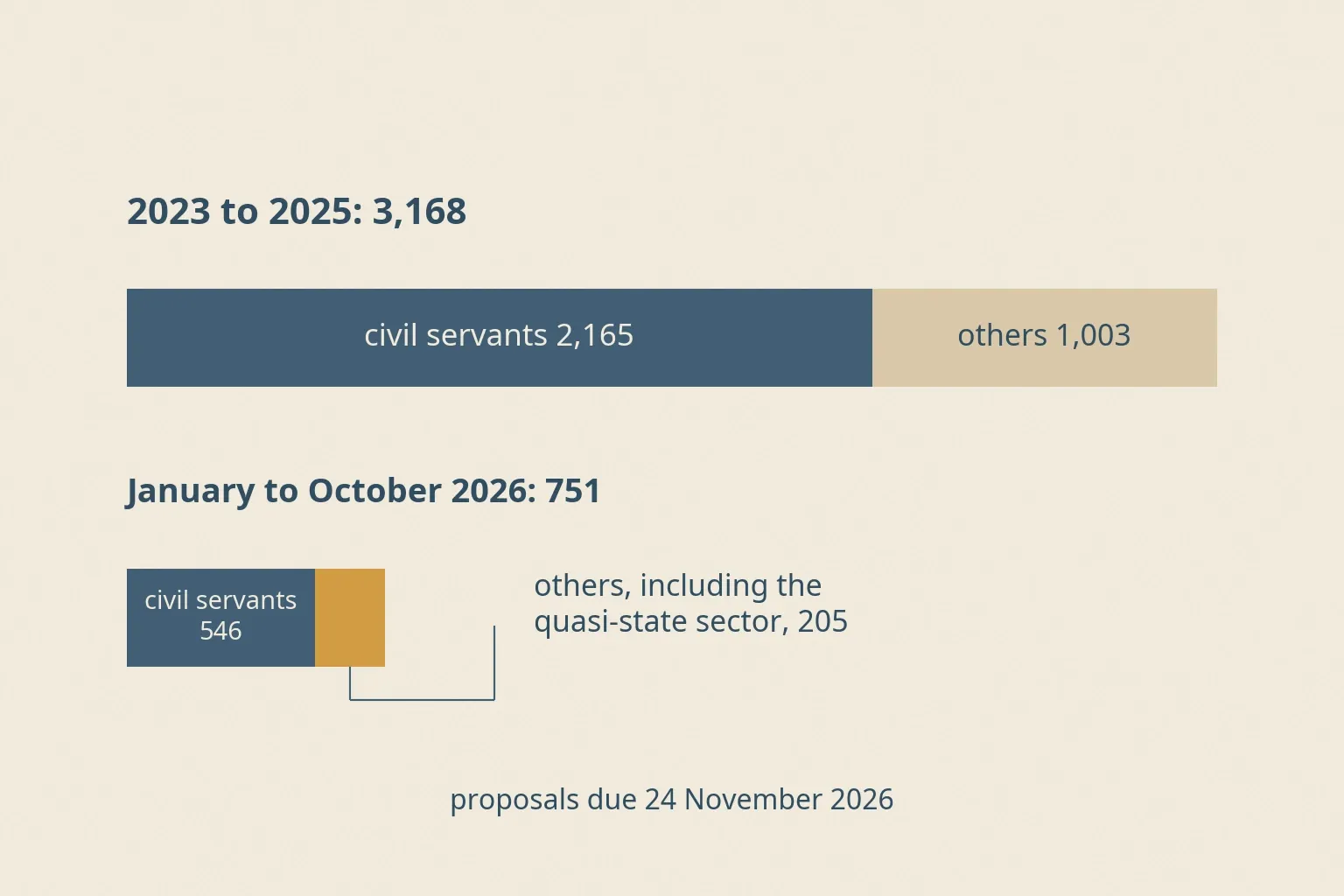
Tokayev gave figures that had not been part of the story. From 2023 to 2025 the authorities recorded 3,168 corruption offences, 2,165 of them by civil servants and the rest by others, including employees of the quasi-state sector. He put the total sum at more than 248 billion tenge and did not say what it measures.
In the first ten months of 2026 the count was 751, of which 546 were by civil servants and 205 by others. By CAW’s arithmetic that is about 75 a month against 88 in the three years before, and the share outside the civil service is 27% against 32%.
The committee’s Anti-Corruption Service will check every report about officials of any rank together with the Prosecutor General’s Office, he said, with no distinction between insiders and outsiders. No one may count on an exception from the law, he added, whatever their post, past merits or connections, family ties included.
Tokayev paired the warning with an assurance to private business. No restrictions will be imposed on businessmen, he said, and he recalled his instruction to declare a further three-year moratorium on inspections of small business from 1 January 2027.
From there the statement turned to money already recovered and money about to be spent. The Prosecutor General’s Office has secured the return of illegally acquired assets worth more than 1.3 trillion tenge, which went to 466 social and infrastructure projects, 383 of them finished. He questioned the quality of what was built, roads above all.
He tied the case to the state construction drive, which is to draw about 6.5 trillion tenge from the National Fund by the end of 2029, as CAW reported on 28 October. Corruption networks are already planning to discredit and undermine it, Tokayev said, without giving an example, and a special State Commission will see that public money is spent properly on roads, airports, clinics and schools.
Reports of 13 November by Tengrinews and Kursiv again carry no statement from either detained man or from a lawyer.
The commission’s membership is to be published early in the week of 16 November, and the government’s proposals on corruption in the quasi-state sector are due on 24 November.