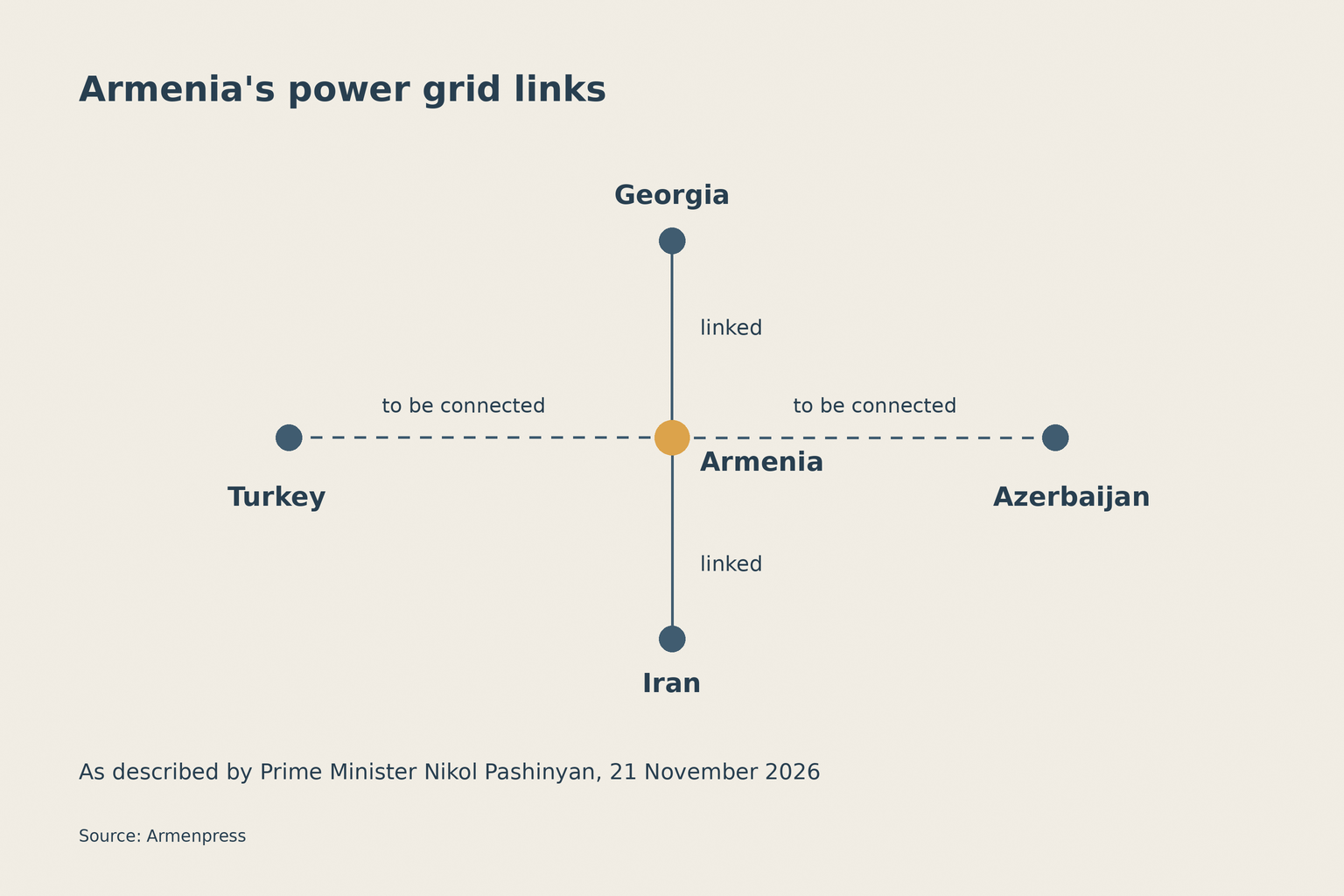
Pashinyan was speaking at the DigiTec 2026 technology conference, in a discussion with a vice-president of the chipmaker NVIDIA. He first gave the date as 22 November and corrected it hours later, Armenpress noted.
He described the project in terms of energy. “We will connect our grid to the electricity grids of Türkiye and Azerbaijan,” he said, adding that Armenia is already linked to Georgia and Iran.
The route is to carry a railway, a road, oil and gas pipelines and power and data lines across Syunik province, with building due to start in 2027. Under the Armenian-American agreement the United States will hold 74% of the development company for 49 years and Armenia 26%, as CAW reported on 13 November.
Electricity is already a working subject of the project. Armenian and Azerbaijani officials met in Goris on 8 October over where its power lines will run, and the trilateral planning groups that Washington, Yerevan and Baku created on 6 November begin with transport and electricity lines, as CAW reported on 9 October and 9 November.
The legal groundwork was laid this autumn. Parliament ratified the framework agreement with the United States on strategic cooperation on TRIPP on 28 October by 63 votes to 32, and President Vahagn Khachaturyan signed the ratifying law on 12 November. That same day the chamber passed seven bills for the development company by 64 votes to none, with the opposition absent.
In Baku on 22 November President Ilham Aliyev received Markwayne Mullin, the US secretary of homeland security, the Azerbaijani agency APA reported. Mullin said the route’s full operation would strengthen connectivity and trade between Azerbaijan and Armenia. Aliyev recalled the visit of Vice President JD Vance, during which the two governments signed a Charter on Strategic Partnership, and said the region had lived in peace for more than a year since the Washington summit of August 2025.
Deputy Secretary of State Christopher Landau reached Ashgabat the same day, the last stop of a tour of 16 to 24 November that had taken him to Tajikistan and Turkey. He began with representatives of US companies, the news site Turkmenportal reported, citing the US embassy. Washington intends to confirm its interest in diversifying Turkmenistan’s energy exports through the Trans-Caspian corridor and TRIPP, the site quoted the State Department as saying.
The government published the draft of a new constitution on the morning of 23 November, on a website made for the purpose, and Pashinyan said he would address the nation at 10:00 Yerevan time, Armenpress reported.
Calling a referendum on the new constitution takes 70 votes in the 105-seat National Assembly, and Pashinyan’s Civil Contract party holds 64. He has said he will resign if voters reject it.
Baku has made its signature on a peace treaty conditional on removing from the constitution’s preamble the reference to Armenia’s 1990 Declaration of Independence, which mentions the unification of Nagorno-Karabakh with Armenia. Security Council Secretary Alen Simonyan has said the treaty would be signed within days of the change, calling that his personal opinion, as CAW reported on 20 November.
One opposition faction, Strong Armenia, asked in October for the route to be held back until a peace treaty is signed, as CAW reported on 28 October.
The TRIPP bills passed on Civil Contract’s 64 votes alone. The constitution needs six more.