The upgrade covers the ratings in local and in foreign currency. S&P kept the short-term ratings at B and lifted its assessment of transfer and convertibility risk from BB+ to BBB-, according to Gazeta.uz’s account of the agency’s report.
Saida Mirziyoyeva, who heads the Presidential Administration, called it “the highest rating in the country’s history” on her Telegram channel.
S&P’s stated grounds are better budget and balance-of-payments figures, a relatively moderate public debt and reforms in energy and the state sector. The risks it names are dependence on gold, state-owned enterprises and external borrowing. It also calls Uzbekistan’s institutions comparatively weak and expects decision-making to stay centralised.
On 13 November the National Statistics Committee revised GDP for 2017 to 2025 after refining its enterprise statistics and bringing in the population and agricultural censuses. Nominal GDP for 2025 rose by 277 trillion soums, or $22 billion, to 2,127 trillion soums, $169 billion. The revision reflected fuller measurement and no new growth, the committee said at the time, as CAW reported on 13 November.
S&P now expects net general government debt to average 24% of GDP in 2026 to 2029, against the 30% it forecast before, an improvement that Gazeta.uz traces to the statistical revision, with the debt itself no smaller.
By the agency’s description the structure of that debt remains relatively favourable: official creditors hold 83% of external public debt, mostly on concessional terms with long maturities and low interest rates. About 84% of all public debt is in foreign currency, which ties its weight to the soum’s exchange rate.
S&P still expects the burden to rise, to net debt of 26% of GDP by 2029, from a position in 2017 in which the state held net financial assets.
Gold makes up 30% to 40% of Uzbekistan’s goods exports and 85% to 90% of its international reserves, by S&P’s estimate. Reserves have more than doubled since 2023, to about $64 billion at the end of October 2026, or 32% of GDP.
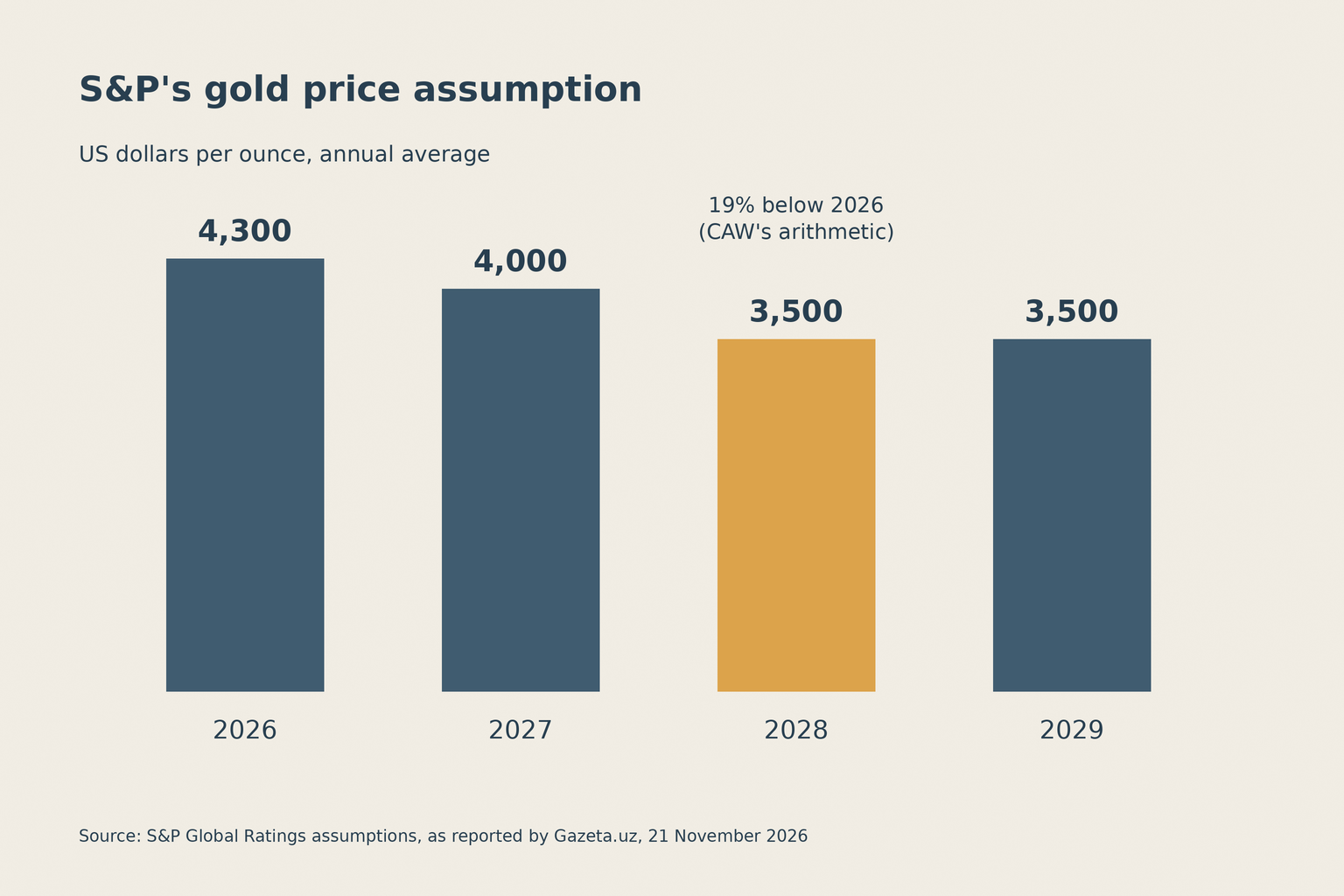
High gold prices are the second support the report names, and the agency’s own price path points down: an average of $4,300 an ounce in 2026, $4,000 in 2027 and $3,500 in 2028 and 2029. On that path the reserves S&P counts as usable peak at about $62 billion at the end of 2026 and then decline.
Neither of the two supports renews itself. A recount of this size happens once, and gold at $3,500 would stand 19% below this year’s assumed average, by CAW’s arithmetic.
Nigeria offers a precedent. Its rebasing of 2014 took public debt from 19% of GDP to 11% without a naira being repaid, while tax revenue came to under 3.5% of the new figure, as CAW’s columnist Peter Lidovsky wrote on 19 November.
Remittances sit in the same external account. Inflows rose 28% in 2025 to $18.9 billion, or 11.2% of GDP, and about 78% came from Russia, according to the report. S&P counts the closeness of those ties, in remittances, trade and possible secondary sanctions, among its geopolitical risks.
From 1 January 2027 Russia will annul the work patents of migrants whose employers report no income for them, as CAW reported on 18 November.
S&P raised its growth forecast for 2026 to 8% and expects an average of 6.7% in 2027 to 2029, driven by consumption and by state investment in energy, mining and infrastructure. Investment runs at about 36% of GDP. Output per head, about $5,200 in 2026 against $2,365 in 2019, remains low by international standards.
The agency expects the budget deficit to average about 3% of GDP in 2026 to 2029, against 3.5% in 2021 to 2024. A narrower deficit and less on-lending to state enterprises could lift the rating again, it says, and budget and external deficits above its forecasts could lower it.
The draft budget for 2027, the first written on the new base, puts spending at 464 trillion soums and revenue at 416 trillion, as CAW reported on 16 November.