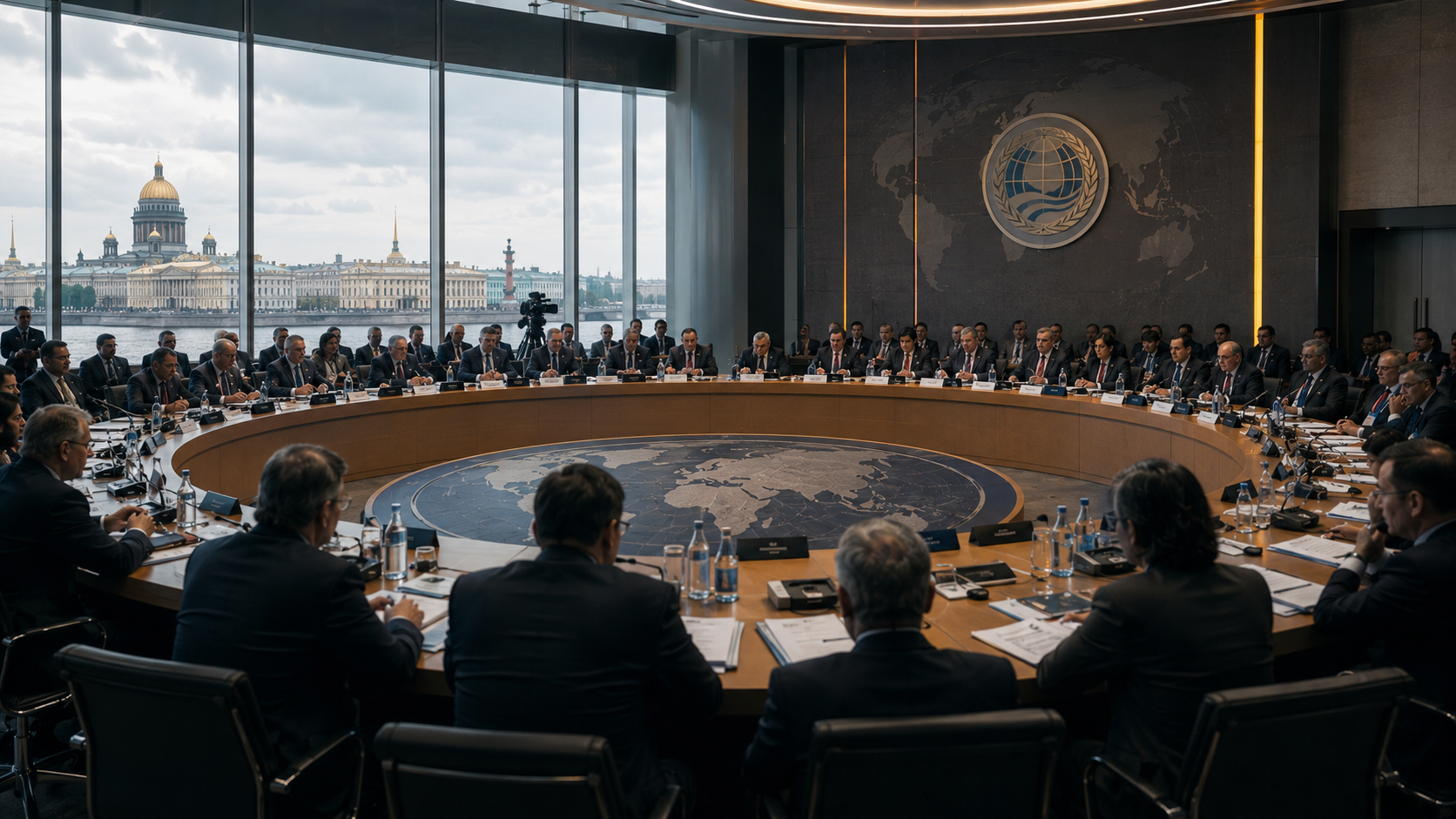
Twenty-five years ago, the Shanghai Cooperation Organisation was a border-management arrangement between six post-Soviet and Chinese neighbours. Today, at the St. Petersburg International Economic Forum, delegates from its member states gather for the SCO Business Forum to debate what the organisation becomes next. The anniversary session, “25 Years of the SCO: A New Stage of Trade, Economic and Business Agenda Development”, opens at 11:00 in the Congress Centre. The agenda is ostensibly celebratory. The real discussions will be more pointed.
What 25 years have actually delivered
The SCO today has ten full members, covers roughly 60% of the Eurasian landmass, and accounts for about 40% of the global population. For Central Asia, where Kazakhstan, Kyrgyzstan, Tajikistan and Uzbekistan are full members, and Turkmenistan participates as a dialogue partner: the organisation has served primarily as a security coordination platform and a framework for managing relations with both Russia and China simultaneously.
Concrete economic results have been limited. The SCO has no development bank, no free trade zone, and no common currency. Two institutions exist: a Secretariat in Beijing and the Regional Anti-Terrorist Structure in Tashkent. The organisation’s critics have a point: twenty-five years of summits, declarations and strategy documents have not built a single kilometre of new railway or capitalised a single development fund.
The 25th Summit in Tianjin last September changed at least one of those parameters. Kyrgyzstan, holding the 2026 SCO chairmanship, is pushing to formalise the launch of an SCO Development Bank during its presidency. The idea gained approval at Tianjin, where Xi Jinping called for launching the bank “as soon as possible.” The SPIEF session today is the first major multilateral business gathering since Tianjin. Whether the bank question moves forward, or gets buried in procedural hedging, is the real test of the anniversary’s meaning.
Russia’s awkward position
Russia is both convener and complication. Moscow hosts SPIEF and frames the SCO Business Forum as a showcase of multilateral engagement. But Russia has shown consistent scepticism toward the SCO Development Bank, preferring to keep economic cooperation within the Eurasian Development Bank, which it controls, rather than a yuan-denominated institution proposed by Beijing.
This tension reflects a structural asymmetry. China has the capital and the commercial interest in an SCO bank: yuan-denominated financing fits Beijing’s broader strategy of building parallel financial infrastructure outside the dollar system. Russia has institutional pride in the existing architecture and has alternatively suggested China buy a stake in the Eurasian Development Bank. A Chinese-capitalised SCO bank is not obviously in Moscow’s institutional interest, even if it serves Central Asian members.
“A major attraction for Central Asian SCO members is that development bank assistance would presumably come with few conditions attached.”
What Central Asian members want
Central Asian states sit in the middle of the Russia-China tension, and they are the ones with the most to gain from a resolution. They want infrastructure financing with fewer conditions. They want it in a form that does not make them fully dependent on either Moscow or Beijing. The SCO bank, whatever its limitations, represents that possibility.
Kyrgyzstan’s chairmanship priorities include the bank launch, trade and logistics integration, migration rights for Kyrgyz workers in member states, and digital cooperation. For Kazakhstan, which simultaneously chairs the EAEU, the key question is how the SCO’s economic ambitions relate to, or potentially compete with, the EAEU integration agenda. Tokayev has framed these as complementary: a version of Eurasian integration that is genuinely multilateral rather than Russia-centred. Kazakhstan also has a direct infrastructure interest: it sits at the intersection of virtually every major Eurasian transit corridor.
Uzbekistan’s position is revealing. Tashkent declined full EAEU membership in 2024, but remains a full SCO member, precisely because the SCO includes China as a full counterweight to Russia. The SCO is the preferred multilateral format for a country that does not want to be in a Russia-dominated bloc. The Regional Anti-Terrorist Structure is headquartered in Tashkent, giving Uzbekistan structural influence in the organisation well beyond its delegation level at any given forum.
Three scenarios for the bank by year-end
The SPIEF session will not launch the development bank, that requires a heads-of-state summit, which Kyrgyzstan will host later in 2026. But today’s forum is where competing visions of what the bank should be get aired publicly, and where business community pressure on governments becomes visible.
Scenario A Framework agreement at 2026 SCO summit; bank established with Chinese seed capital; yuan-denominated financing available 2027. Requires Russia to drop or soften its resistance.
Scenario B Russian objections produce a roadmap rather than a launch; bank joins the list of SCO aspirations that exist on paper. Reinforces ‘talking shop’ critique.
Scenario C Hybrid: bank established but co-capitalised with the Eurasian Development Bank, giving Russia a stake. Less efficient, more politically viable.
Beyond the bank
The session agenda also covers the SCO Development Strategy to 2035 and practical mechanisms for financing joint projects. For Central Asian members, the most consequential items are transport and logistics: specifically whether SCO frameworks can accelerate the North-South corridor and related connectivity projects that reduce dependence on any single transit chokepoint.
The Middle East crisis and the Hormuz blockade have made this question urgent in a way it was not at previous anniversaries. The Middle Corridor, UAP, TCP, all the infrastructure stories that CAW covers weekly, are the practical answer to the question the SCO has been discussing for 25 years.
Whether that answer finally gets institutional backing, in the form of a capitalised bank, a concrete summit commitment, or a specific project guarantee, is what today’s session in St. Petersburg is supposed to begin delivering. The Central Asian members, who need the infrastructure and the financing more than anyone else in the room, will be watching closely.