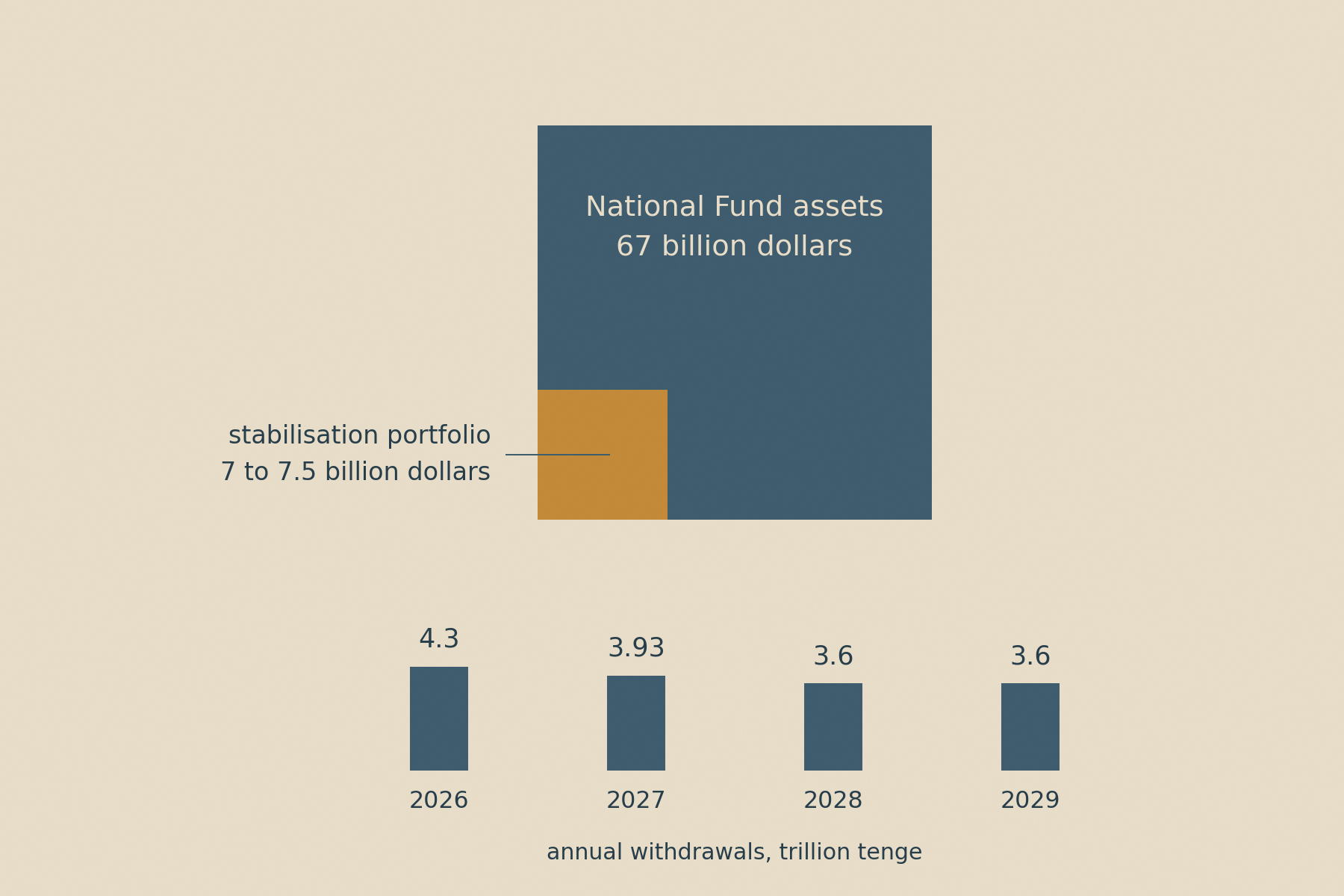
Vakhidov spoke at the National Bank’s expert discussion club at Narxoz Business School, Vlast reported at 19:08 Astana time. “At current oil prices the National Bank assesses the prospects of accumulating funds for future generations as good,” he said, in CAW’s translation. The fund has two functions, stabilisation and savings, and the first covers state projects including the infrastructure the president announced in his late-October address.
The four annual figures are lower in nominal terms than in earlier years, he said, and the risk of the fund financing spending outside the budget is closed by the budget rules on the guaranteed and targeted transfers and by the rules for selecting and appraising projects funded through bond loans.
Suleimenov took the macro side. The fund “cannot be strictly accumulative”, he said: the oil sector supplies a large part of budget revenue, and sending all of it to the fund would mean raising taxes on the rest of the economy, which is why a guaranteed transfer has returned part of the oil rent to the budget since the late 2000s. Transfers in the pandemic years were 4.6 to 4.7 trillion tenge and about 4.5 trillion is planned for each of the next three years, against a GDP that was smaller then and will pass 200 trillion next year.
In a second Vlast report at 19:34 Vakhidov drew the line between the two portfolios. All current withdrawals are made from the stabilisation portfolio alone, whose size is now $7 to 7.5 billion, Vakhidov told Vlast. Total assets stand at $67 billion, a long-term return of about 6.5% would bring in about $4.2 billion a year and oil inflows run at $4 to 5 billion, so he does not expect the fund to be “eaten”. He named privatisation and a people’s IPO as possible top-ups.
On inflation Suleimenov was measured. “We do not believe this will become some super-driver of big inflation. It will have an effect, certainly. The quality of these projects and of the spending is very important, so that the money is not simply spent but goes into the economy’s long-term potential,” he said, and closed with a proverb to the effect that the devil is less black than he is painted.
The address of late October set about 6.5 trillion tenge of National Fund money for infrastructure and social projects under the Khalyqtyq Qurylys initiative, including about 70 health facilities and 50 in education and sport, roads and power, Vlast recalls. On the exchange the dollar traded at 451.16 tenge on Thursday, by Vlast’s market line, against the National Bank’s official 452.91 for the day.