“An additional 4 to 5 trillion tenge of tax revenue a year. Less dependence on the National Fund. The budget will become self-sufficient.”
Serik Zhumangarin, Kazakhstan’s deputy prime minister and minister of national economy, said it to the Mazhilis on 9 April 2025, presenting the new Tax Code at first reading, in Kapital’s transcript. The price, he said in the same breath, would be extra inflation in a corridor of 2.5 to 3%, temporary, exhausted within a year.
The standard VAT rate went from 12% to 16% on 1 January 2026. Nine months of receipts under the new code are now in the finance ministry’s accounts, one quarter of them still at the old rate by the government’s own explanation below, and the accounts say something smaller than the promise.
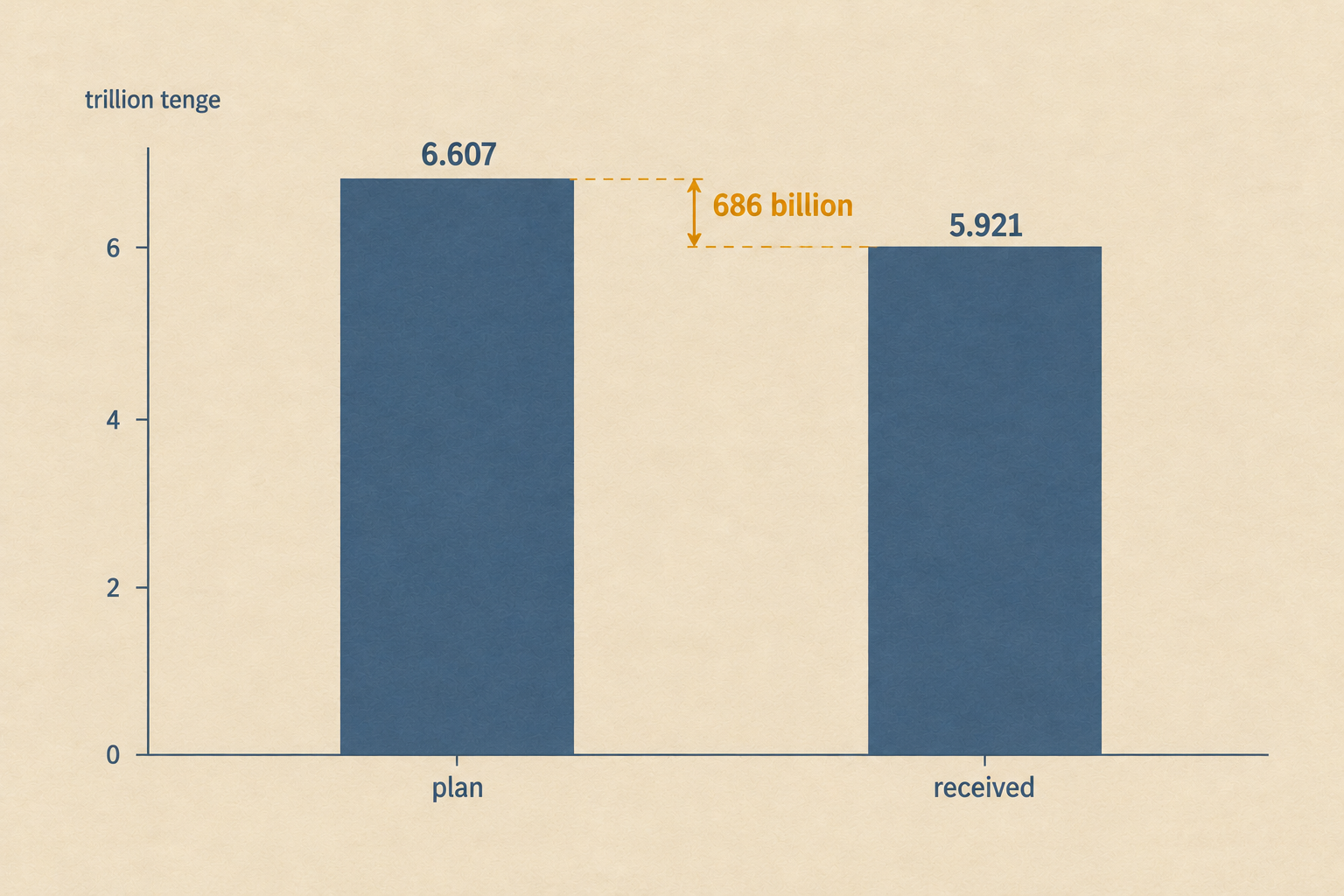
VAT paid into the republican budget in January to September came to 5.921 trillion tenge against a plan of 6.607 trillion, 89.6% of plan, by the finance ministry’s report as bes.media read it on 12 October. The gap is 686 billion tenge.
Nobody disputes the gap. Olga Perepechina, the deputy who presented the supplementary report on the 2027 budget at its first reading on 14 October, told the Kurultai that the rise from 12% to 16% “has so far not brought the 2026 budget the expected growth in revenue”, and that the 2027 forecast of own revenue growing by more than 16%, about 2.8 trillion tenge, is built on a lowered estimate of this year’s receipts.
Her reading of the Supreme Audit Chamber’s conclusion is that the growth planned for next year may go to make up this year’s shortfall instead of widening the base.
Each of the four tests that follow takes one official explanation of the gap and puts it against the figures.
The first is the promise itself. Was 4 to 5 trillion a year ever the VAT figure? It was the whole reform: a new code, 128 exemptions to go, worth more than 1.3 trillion, higher excises, a 25% profit tax on banks and bookmakers.
The finance ministry’s own draft of September 2025 put the VAT line alone at 10 trillion for 2026, 5.54 trillion from domestic turnover and 4.47 trillion from imports, against 19.2 trillion of total revenue without transfers. Against 10 trillion for the year, 5.921 trillion in nine months is 59%, by my arithmetic.
What the reform added year on year in tenge, the reports do not say. 24KZ prints a 37.3% rise in VAT receipts for the nine months without naming the base, and Zhumangarin, in the same outlet’s account, puts the rise in all tax revenue at about 3 trillion on the same months of 2025.
The second test is the exchange rate. Raushan Tasshoinova, a tax consultant, wrote on 24KZ on 15 October, citing the ministry, that the budget was built at 540 tenge to the dollar, and a stronger tenge shrinks import VAT once it is counted in tenge. The official rate has run between 448.45 and 454.14 since 9 October and stands at 452.12 this Monday.
On her reading the import line carries the shortfall. Her own growth rates say the opposite: domestic VAT rose 54.1% in nine months where the draft had planned 96% for the year, and import VAT rose 23.9% against a planned 39.6%. So the exchange rate explains the smaller of the two misses, and neither report splits the 686 billion between the lines.
The third test is the quarter that paid at the old rate. Azamat Amrin, first vice-minister of national economy, told the Kurultai on 17 September that VAT is paid quarterly, so the first quarter of 2026 was settled at 12% because it belonged to last year, and that the switch of that quarter to 16% will add about 338 billion tenge in 2027.
VAT paid into the republican budget in January to September came to 5.921 trillion tenge against a plan of 6.607 trillion, 89.6% of plan, by the finance ministry’s report as bes.media read it on 12 October.
Accept the mechanism, and the 2026 plan should have been written for three quarters at 16% and one at 12%. Whether it was, neither the ministry’s nine-month report as bes.media and 24KZ read it nor the answers of 17 September say.
The fourth test is the refunds. The September 2025 draft itself said that a higher rate raises refunds to exporters in proportion, and put the extra at about 437.7 billion tenge. Amrin says refunds are high this year and will be lower next year because exports will fall with the oil price assumed at $70 instead of $85.
A refund is money the budget counted, collected and returned. A refund figure for 2026 appears in neither outlet’s reading of the nine-month report.
Then comes the line everyone leans on: the overall tax plan was met. True, and the report as bes.media relays it puts no figure on the margin. The largest item above plan it names is the mineral extraction tax outside the oil sector, 1.308 trillion tenge against a plan of 753.3 billion, 554.5 billion over.
Copper and the rest of the ground paid for what consumption did not, and that tax moves with world prices.
The National Fund, whose transfers the reform was to make less necessary, had paid in its full 2.77 trillion for the year by the end of September, Tasshoinova writes, citing the ministry.
The second source of cover sits in a different ledger, the local budgets, and it is smaller and more telling. Fines, penalties and sanctions brought them 199.5 billion tenge in nine months against a plan of 139 billion, 43.5% over, and 145.5 billion of it came from police fines and other collections of the interior ministry.
The bill went to the consumer, by the ministry’s own design: the draft budget expected domestic VAT to rise 96% in 2026 on the rate, the economy and administration together.
Annual inflation was 9.3% in September, down from 9.8% in August, the fourth monthly fall in a row, by the statistics bureau’s release of 1 October. Zhumangarin’s 2.5 to 3% of extra inflation, exhausted within a year, cannot be told apart in that series, because the bureau prints no VAT line and no counterfactual.
The 2027 promise comes next. Amrin’s forecast is 9.5 trillion tenge of VAT, 2.5 trillion more than this year’s estimate. He itemised the domestic side: 575 billion from growth, about 40 billion from administration, 338 billion from the quarter that switches to 16%, and 440 billion from import growth.
Those four come to 1,393 billion. The other 1.1 trillion of the 2.5 has no line in his answer, and the 2026 estimate the 2.5 is measured from is the number Perepechina calls lowered.
By subtraction, that estimate is about 7.0 trillion, against the 10 trillion the September 2025 draft wrote for the same year. The 2026 VAT plan has been cut by about 3 trillion before the year is out, by my arithmetic, and no document I have seen says when.
The two documents fit together as a 2026 plan the receipts did not meet, a 2026 estimate cut to what the receipts will reach, and a 2027 growth rate of 16% measured from the cut. Perepechina’s point, as Informburo put it, is that the growth rates as presented may give a distorted picture of how fast the revenue base is growing.
What would settle it is short. A table from the finance ministry showing the 686 billion split four ways, by rate, by exchange rate, by refunds and by import volumes, and the 2026 VAT plan as it was adopted, with the quarter at 12% shown or not shown and the date of its cut. Tasshoinova writes that without detailed calculations the split cannot be made.
The ministry’s nine-month report, in the two readings of it published so far, prints the receipts, the plan and the percentage, and nothing of the kind. Until it does, the 16% stays what it is on your receipt: a rate, with its promise unaudited.