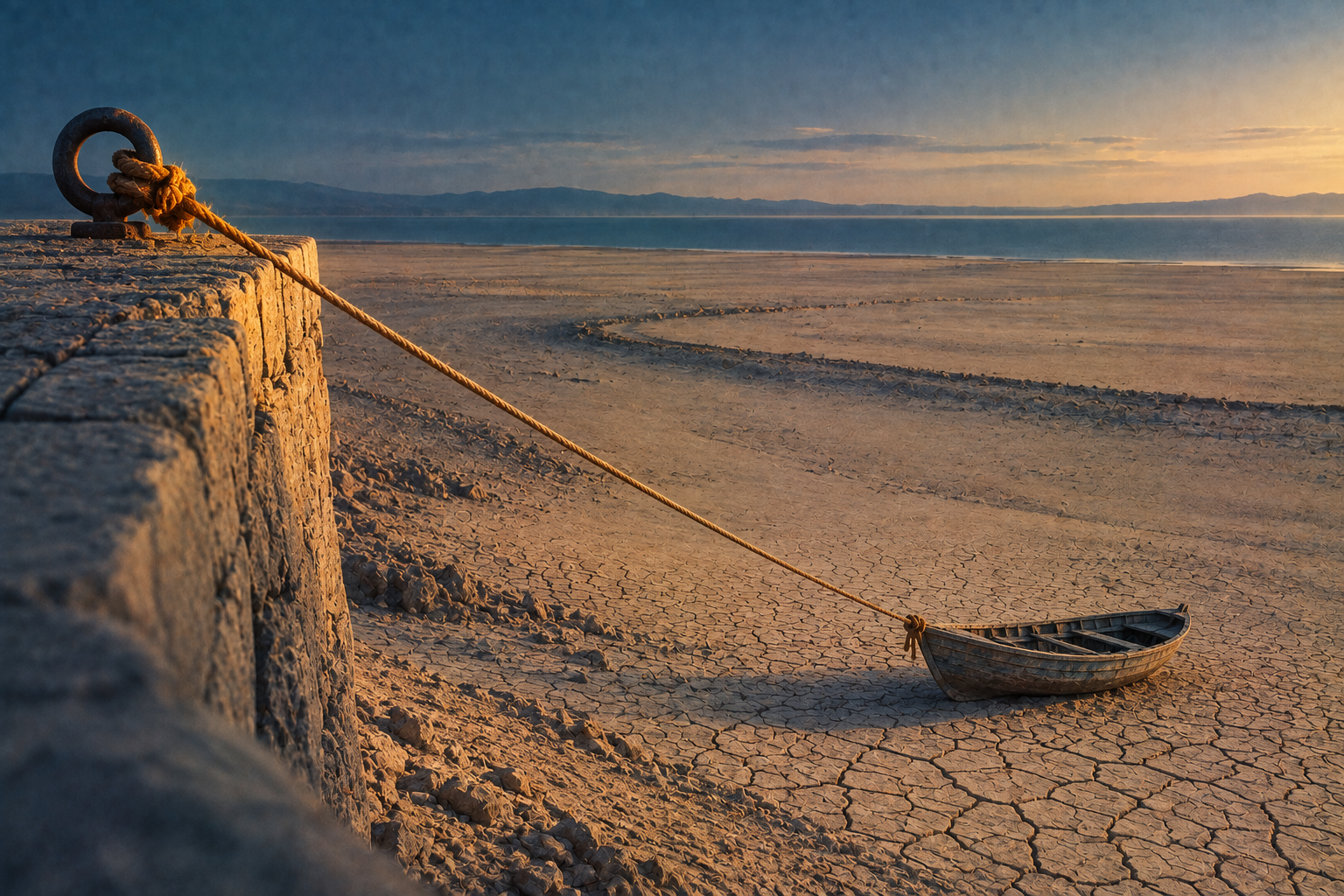
Days ago, from an aeroplane over the north-eastern Caspian, a volunteer named Daniyar Akimzhanov photographed an island near Kulaly that was not on the chart. The sea uncovered it, which is the Caspian’s way of making news now: in July the Kulaly station recorded a mean level of minus 29.42 metres, the lowest in the whole period of observation, and the Kazakh Caspian Sea Research Institute, which keeps the record and was set up a year ago on Tokayev’s instruction, says the sea has given up about 16,384 square kilometres of the north-eastern corner it monitors since 2000. That is nearly the area of Kuwait, handed back without a ceremony.
This week the ceremonies come to the other shore. Avaza, Turkmenistan’s national tourist zone near Turkmenbashi, receives the foreign ministers of the CIS on Wednesday, the presidents of Central Asia and Azerbaijan on Thursday and the CIS summit on Friday, with the five Caspian leaders speaking the same day at what the Kremlin’s Yuri Ushakov calls a Caspian Ecological Summit and, a sentence later, a Caspian political summit.
The resort has hosted a bigger crowd: in August 2025 the United Nations brought 5,700 participants from 103 countries here for a conference of landlocked developing countries, and its envoy said Awaza, a city associated with wellness, now symbolised new hope. A seaside conference for the landlocked. The joke wrote itself and nobody laughed.
Consider the programme. The state portal’s post on Avaza as a centre of international dialogue was published on 9 May, its modification stamp has been renewed five times since 1 October, the last at 16:35 on Tuesday, and it still lists for the Caspian only a ministers’ meeting on Wednesday.
The summit of the five presidents lives on two other pages of the same portal under two other names, a Caspian Ecological Summit in an August note on a telephone call and a meeting of heads of state on the sea’s ecological questions in the foreign ministry’s report of a conference in Tehran, the latter re-stamped at 03:45 and again at 10:42 this morning. A summit with three names and no slot in the programme is a draft, and drafts are what this coast produces best.
The Kremlin’s physics are worth quoting in full, because they will be the physics of Friday’s declaration. The level is cyclical, Ushakov said, its swings reach several metres in a decade, and Russian specialists see the main factor in climate, which cuts the inflow and raises evaporation. All true, and beside the point.
The inflow that climate is cutting arrives mostly by one river, the Volga, which enters the sea from Russia and is dammed, drawn and apportioned on Russian territory. A declaration dedicated to the ecological problems of the Caspian, including its shallowing, will therefore be adopted by five states, four of which can do nothing about the main variable and one of which did not mention it.
A summit with three names and no slot in the programme is a draft, and drafts are what this coast produces best.
There is a rhyme for this, and it is close by. In 1993 the heads of state of Central Asia founded a fund to save the Aral Sea, with a board, an executive committee, two commissions and a management scheme adopted in 1997. The fund exists, and so, as a word, does the Aral, now attached to a desert with a port in it, except for the northern lobe Kazakhstan dammed back to life.
Summits followed, and produced declarations of the same shape as Friday’s: the environment, sustainable development, the rational use of water resources, each sentence signed by the people who allocate the water. The comparison is unfair to the Caspian, which is the world’s largest inland water body, as Ushakov reminded the press, and which loses eight or nine centimetres a year by the Kazakh institute’s arithmetic, where the Aral lost a shoreline a season. Only the shape of the paper is identical.
What is different is the guest list, and it is the best thing about the week. At Avaza everyone is somewhere the map says they should not be: Iran attends a Commonwealth it never joined, as a special guest, Azerbaijan sits in a Central Asian format as a full participant since Tashkent last November, and Turkmenistan, an associate member of the CIS, chairs the Commonwealth this year.
Putin meets Pezeshkian after the sessions and has no meeting planned with Pashinyan, whom the Kremlin nevertheless expects somewhere in the building, since a contact “cannot be ruled out”. The categories are dissolving faster than the shoreline, and that, more than any declaration, is the week’s finding. A sea with a special legal status that is neither sea nor lake is the right place for it.
On Friday the five presidents will be photographed against the water, the declaration will be adopted, and the ministers’ decisions of Wednesday will be passed up to them and on to the heads of government in Moscow in December. If the institute’s thirty-year average holds, the water will stand eight or nine centimetres lower this time next year, which is about the thickness of the stack of documents the week will leave on the shore. The island off Kulaly will be larger by then, and the sea will have made the only discovery of the year.