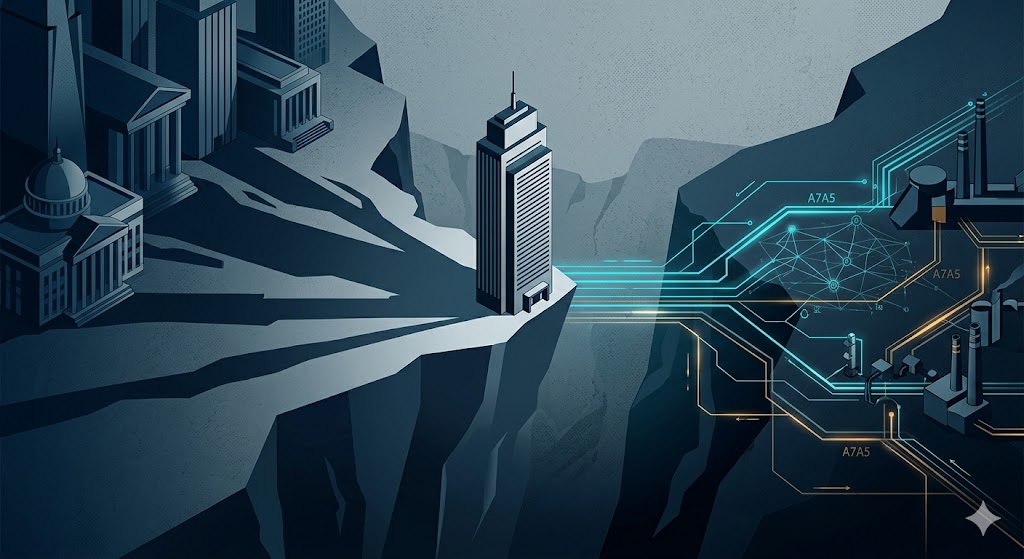
The US and UK sent Bishkek a list of fifty-one companies. Kyrgyzstan’s authorities reviewed it, conducted their own investigation, and closed fifty. Deputy Prime Minister Amangeldiev confirmed this publicly. Nobody in the Western press asked about the fifty-first.
I am not suggesting the remaining company deserved to be closed. Maybe the investigation genuinely found nothing. But the detail matters because it is the only visible sign in this entire episode that Kyrgyzstan made a decision rather than executed an instruction. One company. Out of fifty-one. That is a narrow margin for sovereignty, but it is the margin that exists.
· · ·
The Western account of what happened in Kyrgyzstan over the past six weeks runs roughly as follows: a small country was caught facilitating Russian sanctions evasion on an industrial scale, Brussels finally deployed its anti-circumvention tool for the first time in history, and Bishkek scrambled to comply. All of that is accurate. It is also incomplete.
What the account leaves out is that Kyrgyzstan did not become a sanctions hub by accident or by the malice of a few rogue traders. It became one because the economics made sense at every level. When your largest single source of national income is remittances from workers in Russia, $3 billion in 2024, equivalent to 24% of GDP: your entire economy is structurally oriented toward maintaining access to Russian money flows. The companies that moved goods eastward and Russian payments westward were the system.
By 2025, the Kyrgyz government was collecting more tax revenue from cryptocurrency transactions than from the largest wholesale market in the country. That market, Dordoi Bazaar in Bishkek, is one of the largest in Central Asia, employing tens of thousands of people. The fact that crypto overtook it in tax terms tells you something about the scale and speed of what was being built. It also tells you something about who in Bishkek had reasons not to look too hard at how it was being used.
· · ·
The EU’s anti-circumvention tool, deployed here for the first time against any country, bans exports of CNC machine tools and telecommunications equipment to Kyrgyzstan on the grounds that these items were being re-exported to Russia for use in drone and missile manufacturing. The Council cited a “systematic and persistent failure” of Kyrgyz authorities to prevent this. That phrasing is legally precise and politically significant: it is not an accusation of complicity, but it is close.
Keremet Bank and Capital Bank are now subject to EU transaction bans. Four additional Kyrgyz banks were designated in the same package. The crypto exchanges Grinex and Meer, linked to the A7A5 stablecoin, a ruble-backed instrument that processed over $100 billion in transactions, were sanctioned by the EU, US and UK simultaneously. The architecture of the parallel financial system that Kyrgyzstan had been hosting is now under direct institutional attack from three directions at once.
· · ·
Here is what I want to say to the Western analysts who are writing about this as a compliance success story: you are not wrong, but you are looking at the wrong question.
The question is not whether Kyrgyzstan will close fifty companies and call it done. It will not, because the economic incentives that created those companies have not changed. Russia remains the destination for Kyrgyz labour. Remittances remain the foundation of household incomes across the country. The EAEU gives Kyrgyz goods preferential access to the Russian market. None of that disappears because Brussels activated a legal instrument that most Kyrgyz business owners had never heard of before April.
The question is whether there is any realistic alternative being offered. Complying with Western sanctions costs Kyrgyzstan something real and immediate. The Western offer in return is access to European goods markets, which Kyrgyzstan does not have the industrial base to supply, and the promise of being treated as a trustworthy partner rather than a circumvention hub. That is not nothing. But it is also not a remittance.
· · ·
Amangeldiev was in St. Petersburg this week for SPIEF, the same week the closures were announced. He represented Kyrgyzstan at the highest level of any Central Asian delegation, the only deputy prime minister in the room. He spoke at the Russia-Kyrgyzstan Business Dialogue about digital sovereignty and EAEU industrial cooperation. The closures and the forum appearance are not contradictions. They are the same policy: manage the Western pressure enough to avoid escalation, while maintaining the relationship that the economy actually depends on.
Fifty companies closed. One kept. The bilateral dialogue in St. Petersburg. These are Kyrgyz policy.
· · ·
I have no particular sympathy for the companies that were moving sanctioned goods. Some of what flowed through those channels ended up in Russian weapons systems that killed people. That is not abstract.
But I also know that the people making decisions in Bishkek are not choosing between principle and pragmatism. They are choosing between different survival strategies for a small, landlocked, poor country that shares a customs union with Russia and has no other border with a market large enough to replace it.
The fifty-first company is still open. Someone in Bishkek decided, after reviewing the evidence, that it did not meet the threshold. That decision will probably be reversed under future pressure. But for now, it exists. And in a situation where the margin for any independent judgment is this narrow, I think it is worth noticing.
Aigerim Bekova writes on the political economy of Central Asia for Central Asia Wire. The views expressed are her own.