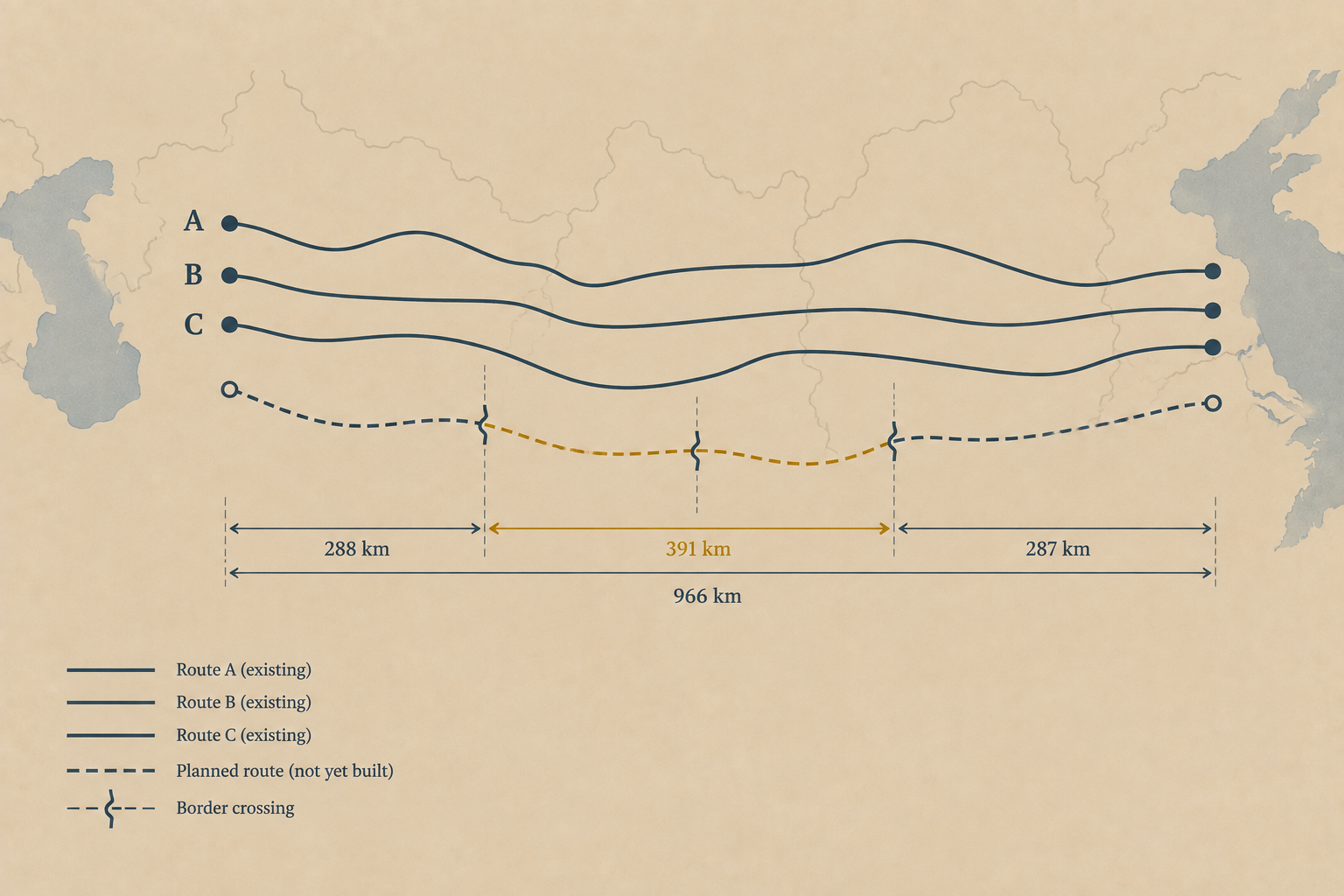
Line D was designed to carry 25 to 30 billion cubic metres of Turkmen gas a year through Uzbekistan, Tajikistan and Kyrgyzstan to China, on a route of 966 kilometres, 391 of them in Tajikistan. The Tajik section runs through the mountains, with 42 tunnels totalling 63.3 kilometres. Its intergovernmental agreement dates from September 2013.
The venture was expected to bring more than $3 billion of direct investment and work for more than 3,000 Tajik citizens, in the figures Asia-Plus carries from the project’s launch. A decade on, the ministry’s readout of last week’s meeting speaks of progress, problems and coordination, and names no date.
The gas line is the one with a Chinese partner, a 2014 balance sheet and no schedule.
The map has changed around it. Turkmenistan’s gas reaches China through Lines A, B and C across Uzbekistan and Kazakhstan, and Uzbekistan, a transit country on all three, has become an importer itself, at more than 10 billion cubic metres this year on the IEA’s forecast.
For Dushanbe the meeting is one of 3 energy conversations in a week. On Monday the president opened a 250 MW solar plant at Asht and ordered 700 MW more for 2027; on 15 September Asia-Plus reported a contract of about $1 billion for Rogun’s right bank in the World Bank’s procurement plan, with a completion date in February 2028. The gas line is the one with a Chinese partner, a 2014 balance sheet and no schedule.