The Central Bank approved the regulation itself. Once it decides to resolve a bank, it assumes the powers of the shareholders’ meeting, the supervisory board and the management, and it may appoint new managers or a special administrator. It has no duty to agree its steps with shareholders, creditors or state bodies, and it must disclose the decision the same day.
Three tools are listed: the transfer or sale of assets and liabilities, loans and deposits included, a bridge bank that may run for up to 12 months with a one-year extension, and the write-off of debts or their conversion into shares.
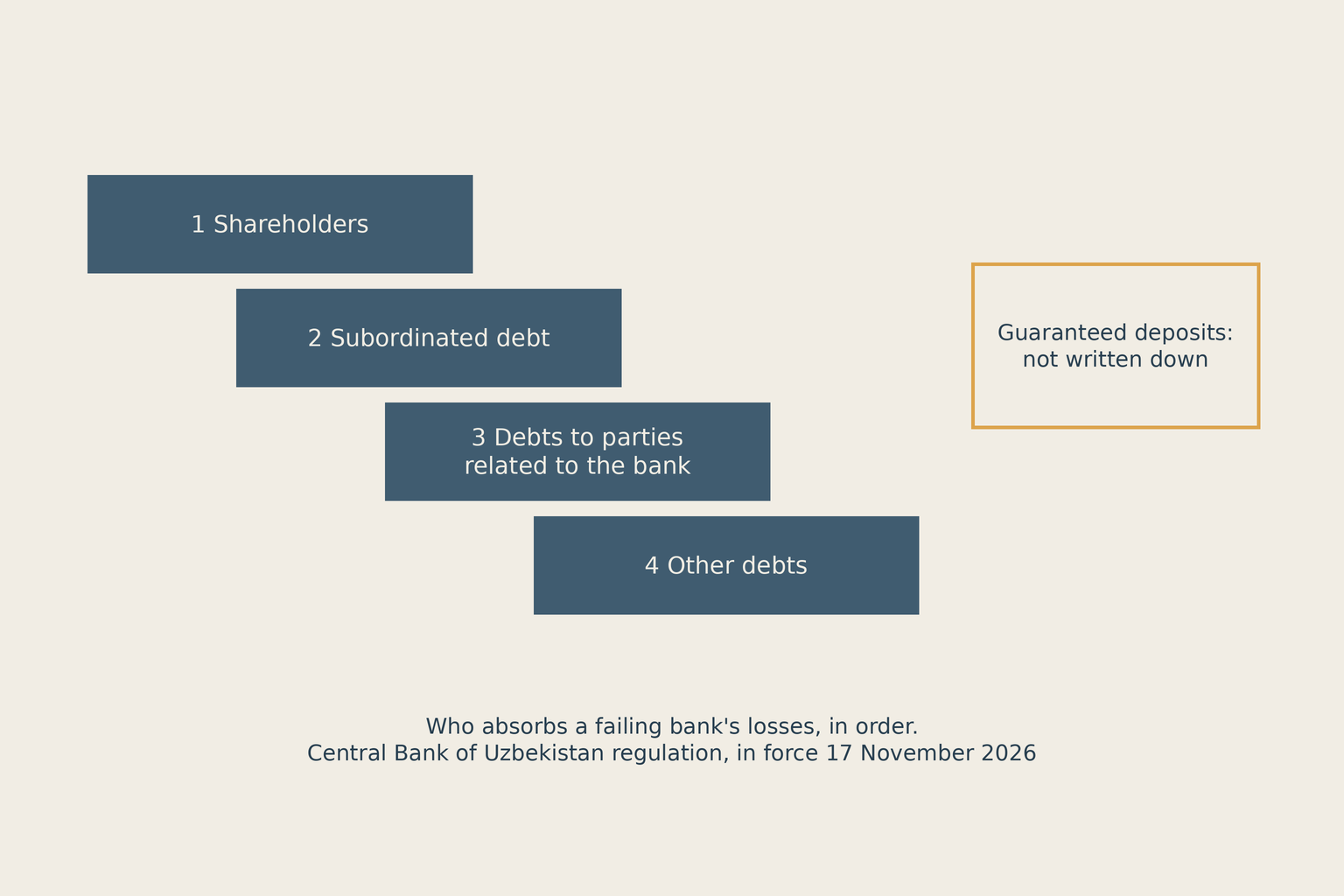
Losses fall first on shareholders in proportion to their stakes, then on subordinated debt, then on obligations to parties related to the bank and last on other debts.
Guaranteed deposits are not written down, including the part above the guarantee limit, by Spot’s account of the text. Staff pay and pensions, taxes, everyday contracts with suppliers and obligations to the Deposit Guarantee Agency are protected as well. Bonuses are excluded from that protection.
Creditors must be warned in advance, and none may lose more than in a liquidation. Budget money can be used only with the consent of the Cabinet of Ministers.
The Ministry of Justice registered the regulation on 16 November under number 3976, the national legal database Lex.uz shows. The powers it regulates come from the law on the resolution and liquidation of banks, in force since 25 September 2025.
Banks with state ownership held 60.8% of the banking system’s assets on 1 October, as CAW reported on 18 November.