The proposal sits in the Bank of Mongolia’s draft monetary policy guidelines for 2027. Uchral was briefed on the draft on 16 November with Finance Minister Z. Mendsaikhan, Economy and Development Minister J. Enkhbayar, central bank governor S. Narantsogt and B. Zayaabal, who chairs parliament’s standing committee on the economy.
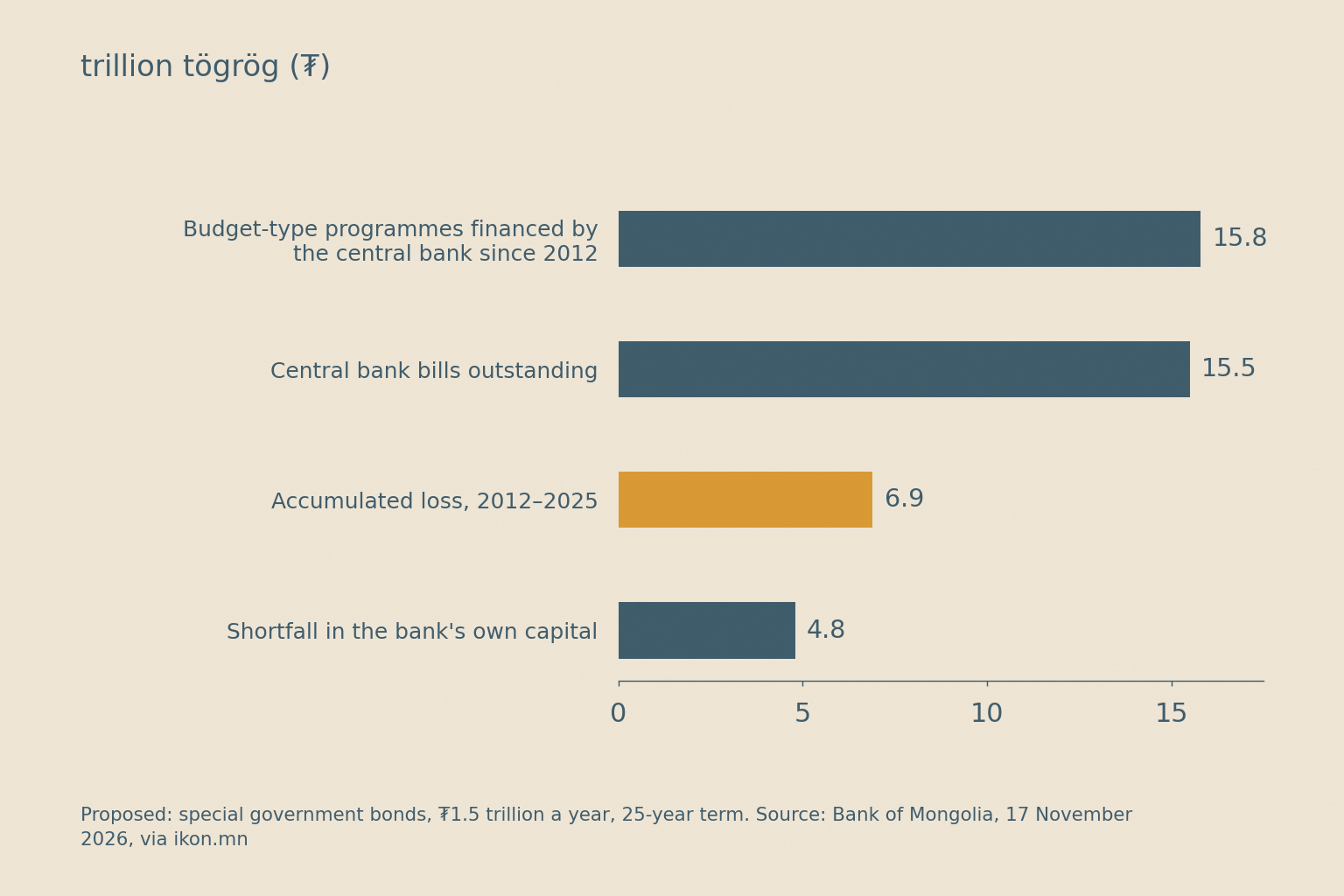
The bank’s presentation put its accumulated loss for 2012 to 2025 at ₮6.9 trillion and the shortfall in its own capital at ₮4.8 trillion. Its outstanding bills, which it sells to absorb excess liquidity from banks, stood at ₮15.5 trillion.
The presentation traces part of the loss to quasi-fiscal programmes, spending of a budgetary kind that the central bank financed itself. Since 2012 they have totalled ₮15.8 trillion, ₮15.7 trillion of it in 2012 to 2016. The list covers price stabilisation, mortgages, the government schemes branded “Good”, a programme to cut banks’ bad assets, a loan to the Deposit Insurance Corporation, housing supply and bonds of the state coal miner Erdenes Tavan Tolgoi.
The remedy is a recapitalisation with government paper. Each year the government would issue ₮1.5 trillion of special securities with a term of 25 years, to be held by the central bank. Payments of principal and interest are waived for the first five years, so the state budget bears no direct cost in 2027 to 2031, by the bank’s calculation.
From 2032 the securities would cost the budget about ₮0.5 trillion a year, the bank estimates. Without them, it says, inflation would add an average of ₮1.3 trillion a year to current budget spending from the same year. The report gives no method for either estimate.
At ₮1.5 trillion a year, covering ₮6.9 trillion, about $1.9 billion at the central bank’s rate of ₮3,603.85 to the dollar on 17 November, takes between four and five annual issues, by CAW’s arithmetic. The report gives no interest rate for the securities and no number of issues, and does not say how they would count against the limits on the deficit and on public debt.
The government will keep to the fiscal rule that caps the budget deficit at 2% of GDP, Uchral said. He also said quasi-fiscal operations through the central bank should be banned by law and told the finance ministry to draft the bill with the bank.
The same presentation records how that rule has fared. Since it took effect, deficits above the 2% cap have accumulated to ₮12.6 trillion. The budget for 2027, adopted on 13 November, sets spending at ₮41.5 trillion against revenue of ₮39.2 trillion, a gap of ₮2.3 trillion, as CAW reported that day.
The briefing covered bringing inflation down and coordinating budget and monetary policy as well as the bank’s loss, ikon.mn reported. Annual inflation reached 13.4% in October 2026 and has been at the central bank’s target in only five of the past 15 years, Uchral said. The economy grew by 7.6% while real household income fell by 4.8%, the report says without giving the period, and Uchral said rising prices were eroding purchasing power.
Uchral also supported the bank’s plan to reduce its part in the currency market in stages and to act as the market’s regulator. The draft lists measures against six channels that feed inflation, among them writing the coordination of budget and monetary policy into law and moving quasi-fiscal programmes into the government’s remit.
Pressure to spend came from parliament the following day. On 17 November a joint sitting of the standing committees on petitions and on the economy backed a working group to study a bill that would transfer ₮857,000 to every citizen from what the petition calls a ₮3 trillion profit from the Oyu Tolgoi copper mine, ikon.mn reported. The petition was filed on 23 October by a private citizen and gathered 100,000 votes, and Zayaabal is one of the working group’s nine members.