The two figures cover different periods and the committee says they should not be compared directly, since September incomes were not fully compiled when the median was calculated. The committee gives no share of the workforce that the figures cover.
The average grew 18 percent from 6.17 million soums a year earlier, the committee’s release of 27 October says.
By region the average runs from 12.3 million soums in Tashkent city, up 18.3 percent, and 8.82 million in Navoi region to 4.97 million in Kashkadarya and 4.99 million in Surkhandarya, a gap of almost 2.5 times. Namangan region grew fastest at 20.3 percent and Samarkand slowest at 11.5 percent.
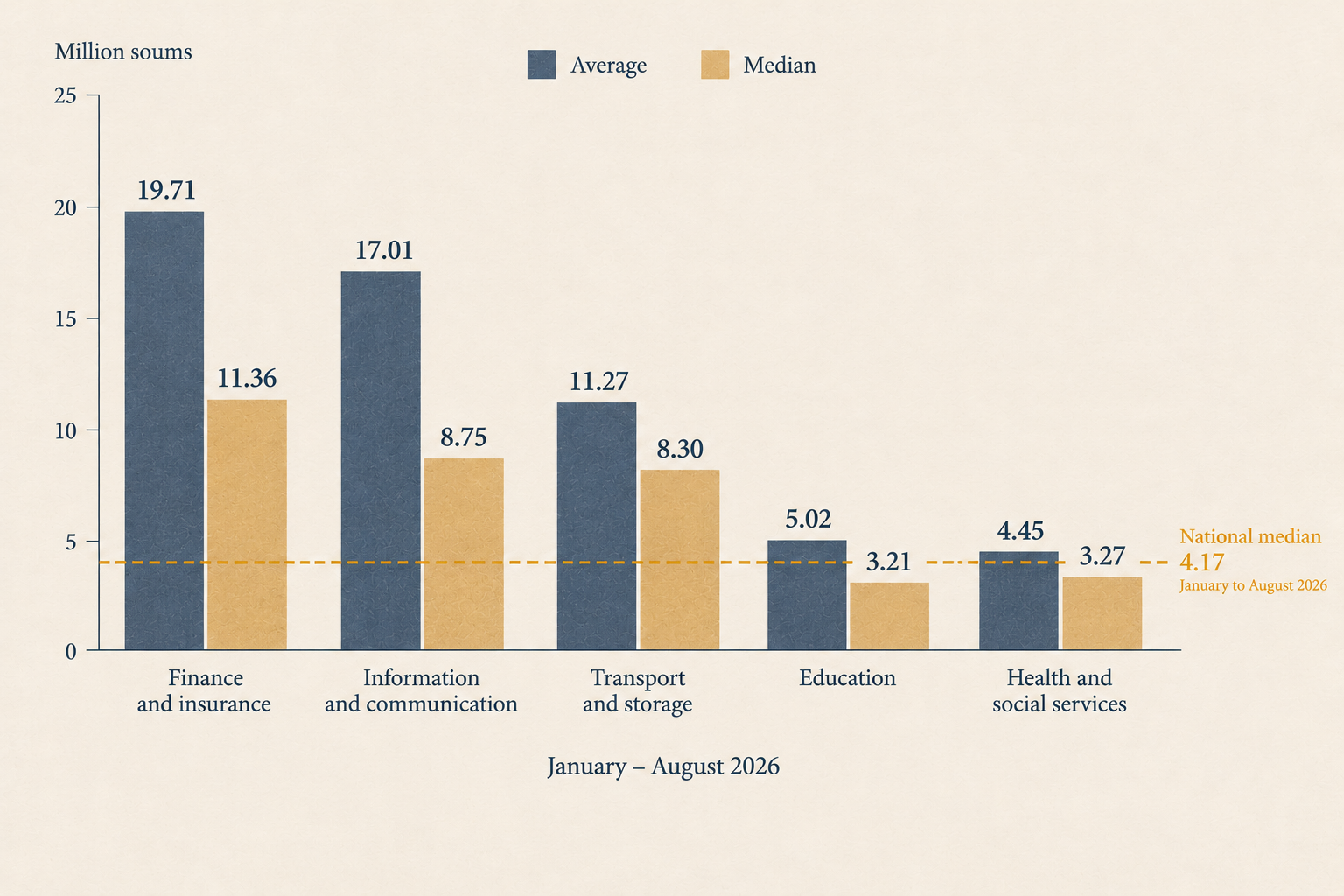
By sector the highest average is in finance and insurance at 19.71 million soums, then information and communication at 17.01 million, where computer programming alone reaches 22.28 million. Transport and storage pays 11.27 million, health and social services 4.45 million and education 5.02 million, from 2.85 million in preschools to 11.52 million in higher education.
General secondary education, the schools line, pays 4.79 million soums, or 65.9 percent of the national average, against 67.1 percent a year earlier, by Gazeta.uz’s arithmetic. School wages rose 15.8 percent while the national figure rose 18 percent.
The median is calculated from administrative data on pre-tax incomes over eight months. It is 6.79 million soums in Tashkent city, 6.21 million in Navoi region and 4.32 million in Tashkent region, and 3 million in Syrdarya region, the lowest. By sector the median is 11.36 million in finance, 8.75 million in information and communication, 3.21 million in education and 2.86 million in accommodation and food.
“The average wage does not mean that most workers receive exactly that amount,” the committee said in Gazeta.uz’s Russian text, and recommended reading the two together. The calculation is experimental and is not yet in the annual state statistics programme.
The committee’s example: five employees paid 3, 4, 5, 6 and 22 million soums have an average of 8 million and a median of 5. Whether the median is repeated depends on its entry into that programme, which the committee has not announced.