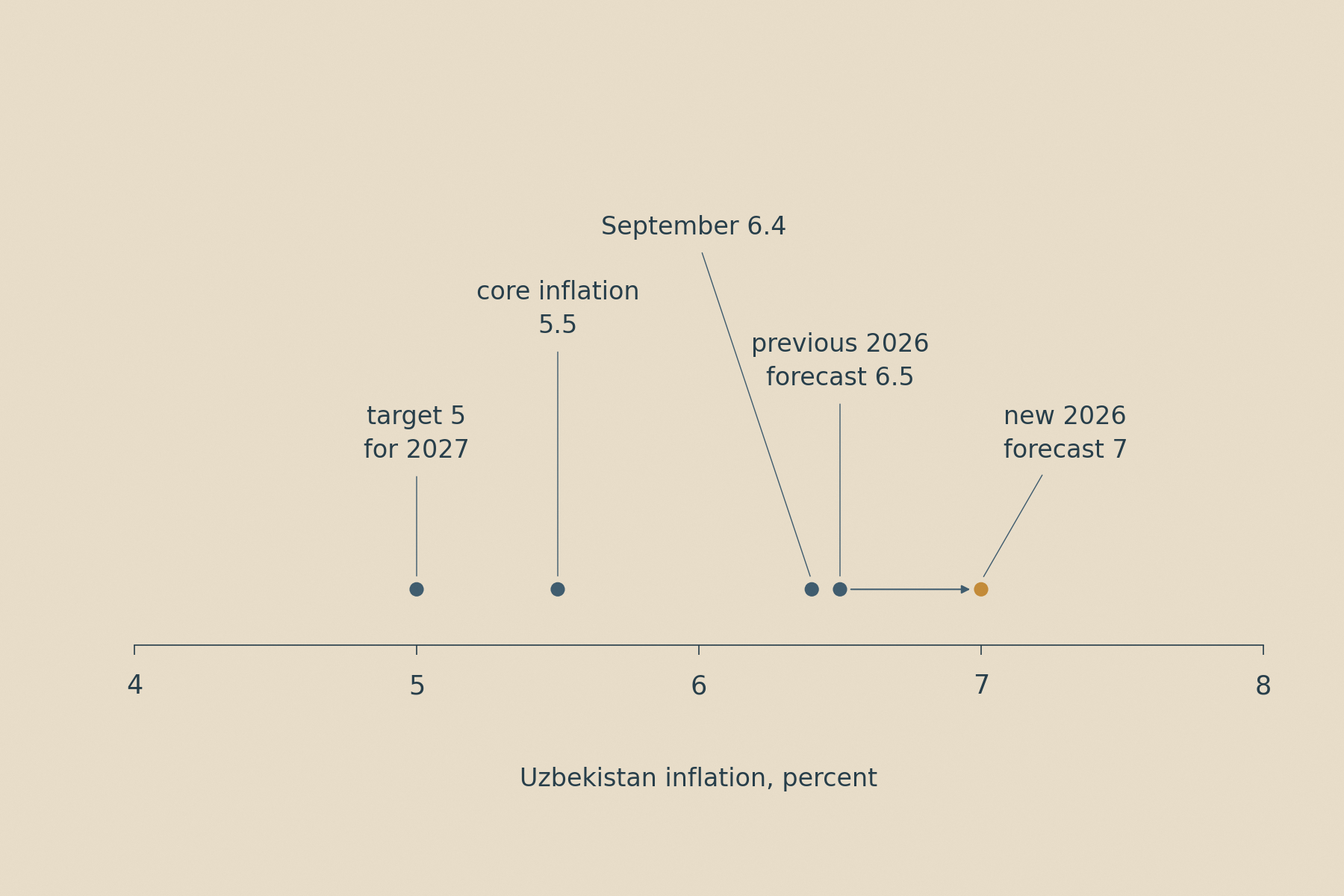
Samigjon Inogamov, who heads the bank’s monetary policy department, gave the reason, in CAW’s translation of Kun.uz: the rise in hot-water and heating prices was in the original forecasts, but the announced tariffs came out higher, so the year-end inflation forecast moved “from 6.5 to 7%”. Deputy chairman Nodirbek Achilov said all announced regulated-price changes, heating tariffs and liquefied gas included, are in the current forecast and in next year’s. Inflation was 6.4% in September.
The target date holds, for now. “In current conditions a revision of the target horizon is not envisaged,” Achilov told Spot, which had asked whether the 5% goal would slip to 2030. The bank keeps the aim of 5% in the second half or by the end of 2027. So 2027 stands. He credited a smaller budget deficit in recent years and a surplus this year with easing pressure on prices.
Lending rates are falling slowly, by his account. Average loan rates in October were 2 to 3 points below August 2025. Mortgages that cost 24 to 25% three or four years ago can be had at 18% in some cases, he said. Deposits grow about 45% a year, with few banks now paying above 18%. Consumer, short-term, unsecured and online loans stay the dearest.
The policy rate stays at 14%, which he called a response to inflation and to expectations. Since 2022 core inflation has fallen from 14.5 to 15% to 5.5%, the lowest on record and close to the 5% target, Achilov said. The bank works with the IMF and the EBRD on floating-rate instruments and a money market. He expects the credit market to reach equilibrium within three to four years.
The gold line comes from the World Gold Council’s central-bank statistics for September, as Kun.uz read them: Poland and China led the buyers and Uzbekistan was third with 7 tonnes. Kazakhstan, Jordan, the Czech Republic and Bolivia were also net buyers. Global net purchases for 2026 to date were 228 tonnes, 7% less than a year earlier, and Uzbekistan’s August purchase was 8 tonnes. The Council counts only publicly reported changes of a tonne or more.