The programme Turkmenistan’s state portal published for the Avaza week gave the sea one day. On Wednesday 7 October ministers of the five Caspian states met there on the sea’s environmental tasks, a day before Thursday’s consultative meeting of the Central Asian presidents and Azerbaijan and two days before the CIS summit.
The ministers’ subject was the water the Middle Corridor has to cross. The Trans-Caspian International Transport Route carries freight from China across Kazakhstan, onto ferries at Aktau and Kuryk, over the sea to Baku and on through Georgia and Türkiye. Every tonne of it crosses the Caspian, and the Caspian is getting shallower.
Avaza itself is the resort strip outside Turkmenbashi, one of the route’s ferry ports. Azerbaijan Caspian Shipping, ASCO, says its ferries on the Turkmenbashi run carry far fewer rail tank cars and wagons than they used to, because the water is too shallow to sail full.
How far the water has gone
Azerbaijan’s National Hydrometeorological Service records a low of 29.05 metres below the Baltic datum, the reference used across the former Soviet Union, in 1977, the Kazakh outlet Newtimes.kz reported on 2 October. By 1995 the level had climbed back about 2.65 metres.
Since then it has lost about 2.5 metres in 30 years, Seid Safarov, who heads the Caspian geography laboratory at Azerbaijan’s Institute of Geography, told the outlet, which called the present level the lowest since 1978. On parts of Kazakhstan’s coast the shoreline has retreated 18 kilometres since 2006, the same report said.
Officials give the pace. Rauf Hajiyev, Azerbaijan’s deputy ecology minister, told Reuters in August 2025 that the sea had fallen 0.93 metres in five years and was dropping 20 to 30 centimetres a year.
In April this year Mukhtar Babayev, the Azerbaijani president’s special representative on climate change, told a regional summit in Astana that the inflow was at a historic minimum and that the Volga supplies up to 80% of it, media.az reported.
Kazakhstan’s own gauges did not show a further fall this summer. Kazhydromet’s monthly reviews for the Kazakh coast put the mean level at 29.03 metres below the datum in August and 29.10 in September, against 29.09 and 29.18 a year earlier: 6 and 8 centimetres higher, by CAW’s arithmetic. Those are Kazakhstan’s own coastal gauges, a different series from the Azerbaijani service’s, and the two cannot be laid side by side.
A season’s swing of a few centimetres sits inside a trend measured in metres.
A 2020 study in Communications Earth & Environment by Matthias Prange, Thomas Wilke and Frank Wesselingh projected a fall of 9 to 18 metres by the end of the century under medium to high emissions, with the sea’s surface shrinking by 23% to 34%. Closer in, Russian scientists expect another metre’s fall within five to six years if the trend holds, 24KZ reported in July 2025.
What the ports are paying
Kazakhstan has been digging. Kapital.kz reported in November 2024 that at Kuryk, the ferry port south of Aktau, the dredger Vesalius of Jan De Nul Kazakhstan had removed more than 990,000 cubic metres of seabed in four months and left the basin and its approach channel at 7 to 8 metres.
Aktau’s first stage is about 1.3 million cubic metres of heavy ground. The transport ministry allocated 21 billion tenge to it, about $46 million at the National Bank’s rate of 7 October, and the depth is to rise by 1.5 metres, Inbusiness.kz reported in February 2025. On 5 October the ministry said the main works had begun, with China Harbour Engineering Company as the general contractor, the same 1.3 million cubic metres to be removed by the end of the year and the basin to be deepened to 6 or 7 metres, Lada.kz reported, and it expects the deeper water to lift the route’s volumes by up to 30% and cut sea freight costs by 10% to 15%.
The same reports show what the shallows already cost in cargo. Vadim Novikov, the Aktau port’s chief dispatcher, told Inbusiness.kz at the time that dry-cargo ships were leaving 600 to 1,300 tonnes short of a full load and tankers 2,000 to 2,500 tonnes short.
Every tonne of it crosses the Caspian, and the Caspian is getting shallower.
In May 2025 Yerbolat Tlepiyev, a department head at the port, told BES.media that ships rated at 12,000 tonnes were loading 9,000 to 10,000. If the sea kept falling, he said, they would load only half.
The ferries are where the corridor feels it. In March 2025 Tariyel Mirzayev, deputy chairman of Azerbaijan Caspian Shipping, told a forum in Baku that shallower ports and channels kept the company’s Ro-Pax ferries, which carry rail wagons and trucks as well as passengers, from sailing full, APA reported: on the Kuryk run its rail tank-car traffic had fallen 22% and its wagon traffic 10%, and on the Turkmenbashi run 37% and 19%.
Alakbar Azizli of ASCO said one ferry leaving Kazakhstan now takes about 80% of the cargo it used to carry, Anhor.uz reported in September 2025, without a base year. A fifth of that hold is lost before any border wait or tariff enters the cost.
The World Bank’s corridor report, published on 28 September, finds the same problem at Baku. Since the port moved to Alat in 2018 the authorities have not dredged its entrance channel or the approaches to its berths, the report says in the summary JAMnews published on 1 October: “The falling level of the Caspian Sea requires urgent action.” Draft restrictions, it adds, can stop ships loading to full capacity.
Alat handled 107,000 TEU in 2025, every container through the port and not only the route’s, about 71% of its container capacity of 150,000, by the same account. This year is busier. In January to July 2026 it handled more than 72,000 TEU, 20% more than a year earlier, Azerbaijan Railways said, Ports Europe reported.
Moscow’s arithmetic
Russia has priced the same water differently. The 188-kilometre Volga-Caspian Sea Channel, Astrakhan’s route to open water, was to be deepened from 4.2 to 4.5 metres.
On 31 July 2025 deputy prime minister Vitaly Savelyev wrote to Vladimir Putin that dredging for a 4.5-metre draft was “not in demand and economically not justified” and that 4.2 metres would not cut the channel’s cargo, Kommersant reported on 20 August 2025.
Dredging on the channel took 10.2 million cubic metres in 2023 and 6.8 million in 2024, Kommersant reported. The smaller of those two years is about five times Aktau’s whole first stage.
The letter’s figures explain the proposal. Rosmorport, the state port agency, spent 3.51 billion roubles of its own money on the channel in 2024, about $41 million at the Bank of Russia’s rate of 6 October, and collected 310 million roubles in channel fees: one rouble back for every 11 spent.
Only 2 ships drawing 4.5 metres called at Astrakhan and Olya that year, and vessels drawing 4.2 to 4.5 metres were no more than 6% of the channel’s traffic, so the extra depth would have served a small share of the ships.
Kazakhstan has made the opposite call at its own ports, where the depth of Aktau’s port waters is to rise by 1.5 metres.
What the corridor carries
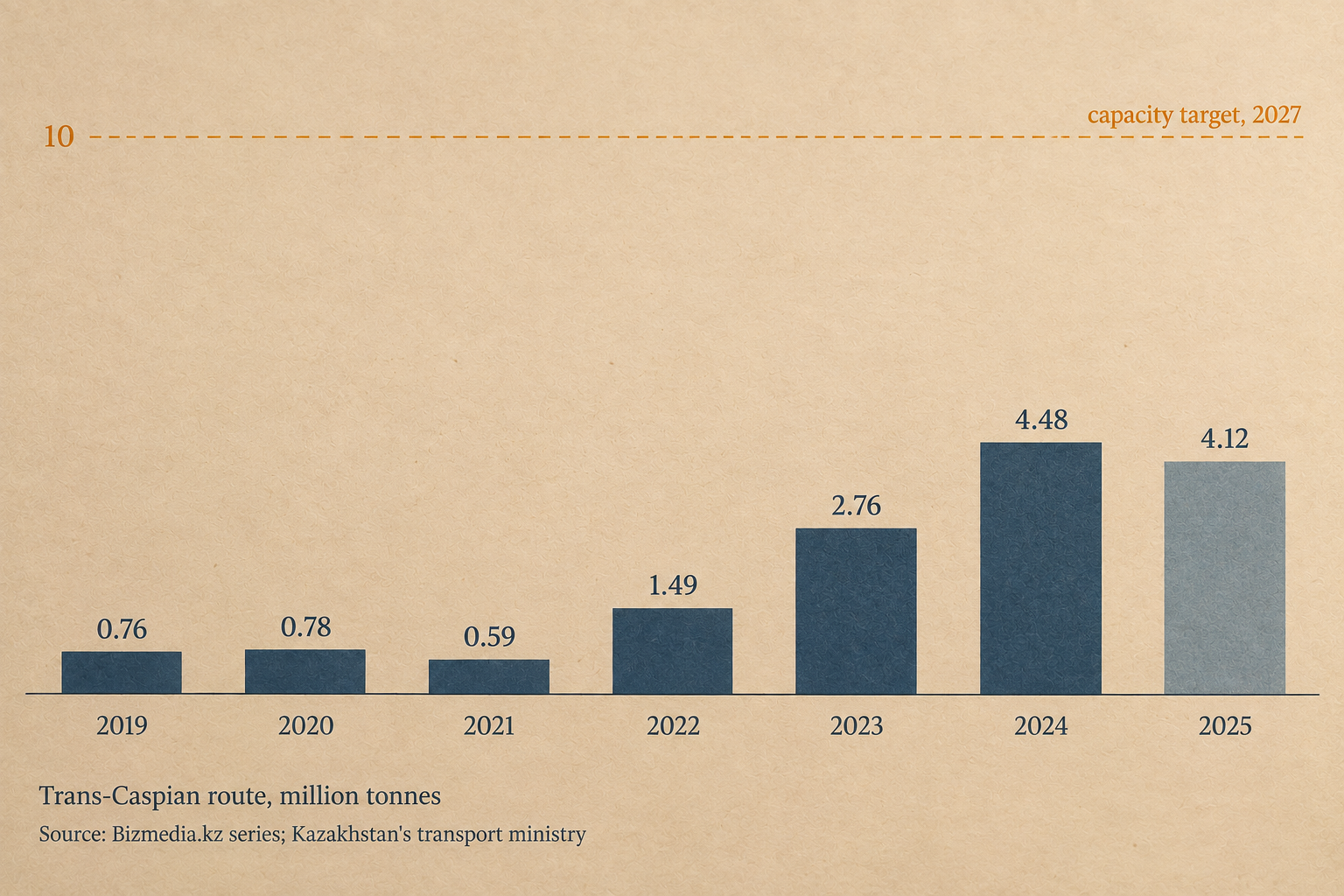
The corridor’s volumes are small next to the money pledged for it. Kazakhstan’s transport ministry counted 4.5 million tonnes on the route in 2024 and planned capacity of 10 million tonnes a year by 2027, Kazinform reported in June 2025.
Bizmedia.kz’s year-by-year series, published in March, put 2025 at 4.119 million tonnes, below 2024’s 4.484 million, with containers at about 77,000 TEU and a target of 300,000 TEU by 2029.
This year has been better. Deputy transport minister Zhanibek Taizhanov reported freight on the route up 22% in January to August, without a tonnage, Trend reported on 9 September. ADY Express, the container arm of Azerbaijan Railways, counted 53,574 TEU in the same eight months, 11% more than a year earlier, Report.az said.
The ports on the Kazakh shore have room to spare. Aktau can handle 11.8 million tonnes a year and shipped 4.909 million last year, with a plan of a million more in 2026, 24KZ reported on 17 September.
Its container side handled 63,000 TEU against a capacity of 93,000. Aktau’s total runs above the route’s because much of it is oil: 1.54 million of the 2.023 million tonnes the port handled in January to May 2026, Lada.kz reported.
Kuryk can take 7 million tonnes a year, 6 million of it at the ferry complex, by the same report. In the first half of 2026 it handled 884,800 tonnes, Kazakhstan’s national railway company said in August.
The World Bank’s report put Alat’s use of its overall cargo capacity at 55%, in JAMnews’s summary. The tight point is at the other end of the route: Poti’s container terminal runs at 98% of capacity, the Bank’s transport specialist Luis Blancas told Trend on 8 September.
Hulls are being added too. ASCO has commissioned 32 vessels since 2014 and plans 11 more, Mirzayev said in March 2025. Ten cargo ships now run between Aktau and Baku, three of them added in August, and Kuryk’s fleet is to gain five ferries by 2028, 24KZ reported.
None of this shows that the shallows hold the route’s tonnage down. Demand, rail and Poti all play their part. Where the shallows do show is in the load of each ship that reports on them, from Aktau’s tankers to ASCO’s ferries.
What the money buys
Ursula von der Leyen told the European Parliament on 16 September that Brussels plans to attract up to €12 billion of public and private investment to the corridor, Report.az reported.
The World Bank’s report, “Integration: World-Class Trade Logistics Along the Trans-Caspian Transport Corridor”, prices 16 priority projects at $25.1 billion, 75% of them under way or about to start, Trend reported on 28 September. With about $30 billion of enabling investment, the Bank’s bill to 2040 comes to some $55 billion, by CAW’s addition of its two figures.
The physical part targets “railway networks, seaports, and access roads”, Report.az quoted the report as saying. The enabling part covers connecting roads and railways, logistics hubs and inland terminals, rolling stock, cargo-handling machinery and digital systems.
Its headline judgment, as Trend quoted it, is that “the main constraint on further development of the Trans-Caspian Corridor is likely to be operational efficiency rather than a lack of infrastructure.” Its pages on Baku call the falling sea a matter for urgent action.
That diagnosis assumes the sea stays usable at today’s drafts. Water is the one input on the route that no railway, port or bank sets, and the money that has gone into it so far is national: the transport ministry’s 21 billion tenge at Aktau, Rosmorport’s own revenue on the Volga approach.
Wednesday’s table
The five governments already have a plan on paper. The Tehran Convention, signed in 2003 by all five shore states, Iran among them, is the treaty they use for the sea’s environment.
At a high-level dialogue on the Tehran Convention in Astana on 23 April, an Action Plan of the Caspian States on Sea Level Fluctuation for 2026 to 2036 was introduced, the convention’s secretariat reported. The secretariat’s account of the session does not say whether the five governments have adopted the plan, or what it would cost.
The Astana session itself grew out of a proposal. Kassym-Jomart Tokayev told the SCO summit in Tianjin on 1 September 2025 that the situation around the Caspian was approaching an ecological catastrophe and proposed a regional environmental summit in Astana in April 2026 with the United Nations, Expert.ru reported.
Vladimir Putin, whose country holds the Volga, said in June 2025 that more than 80% of the sea’s water comes from the river, Kazinform reported.
Two plans now run on the same water to different years: the Caspian states’ to 2036 and the World Bank’s corridor to 2040. The 2020 projection runs to the end of the century.
Update, 10 October: the Caspian Ecological Summit at Avaza on 9 October ended with a decision by the five heads of state to set up a Caspian commission of deputy prime ministers from Azerbaijan, Kazakhstan and Turkmenistan and senior representatives of Iran and Russia, with three months to name them and a first meeting in the first half of 2027 in Azerbaijan, by the Turkmen foreign ministry’s account.