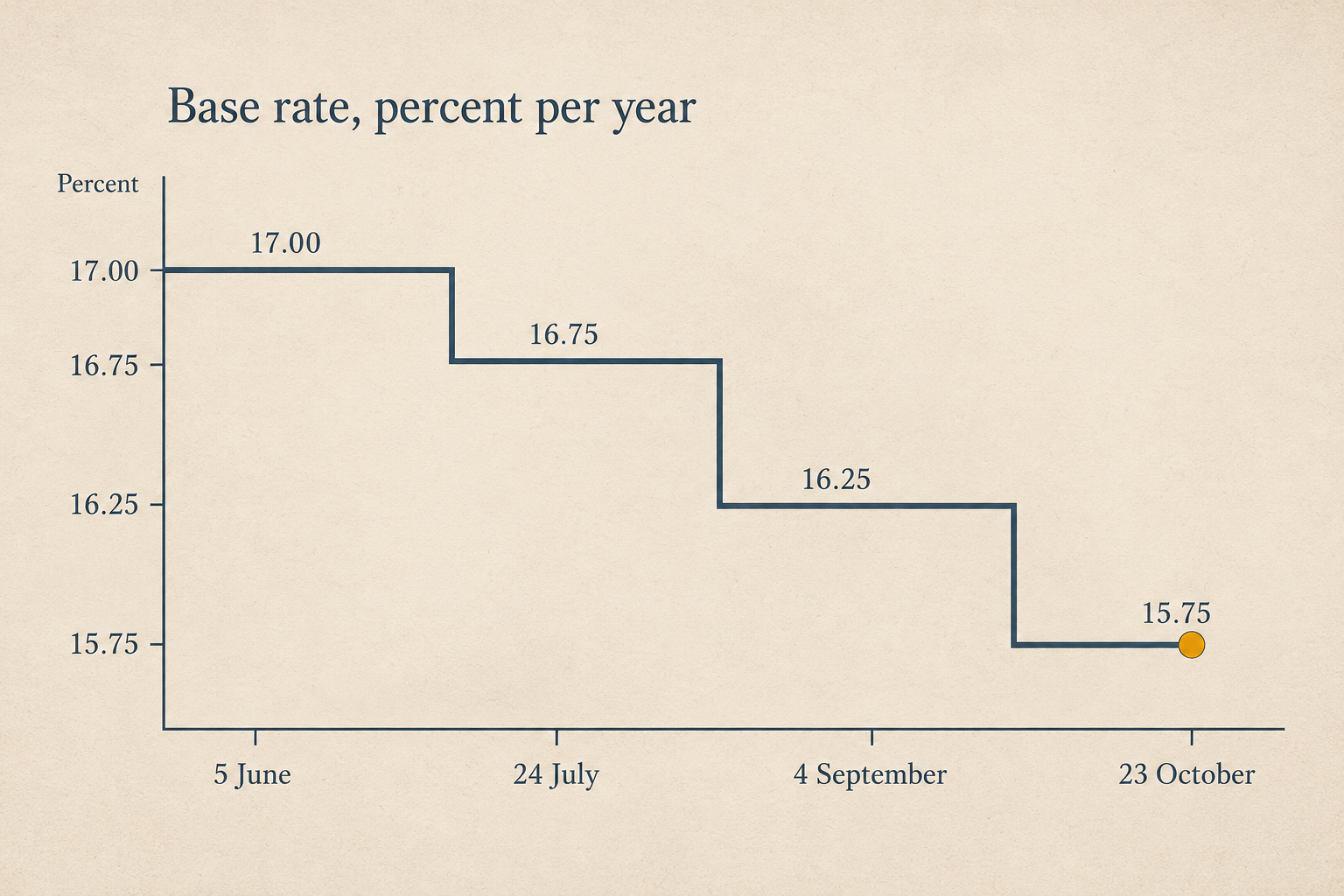
The National Bank of Kazakhstan set its base rate at 15.75 percent on 23 October, down from 16.25 percent, with the corridor kept at one percentage point either side. In one sentence the release carries the bank’s own guidance: the probability of a change in the base rate before the end of 2026 remains low. The next scheduled decision falls on 4 December at noon Astana time.
This is the third cut since June. The rate stood at 17 percent after the decision of 5 June, went to 16.75 percent on 24 July and to 16.25 percent on 4 September, at the close of a forecast round.
In one sentence the release carries the bank’s own guidance: the probability of a change in the base rate before the end of 2026 remains low.
Annual inflation was 9.3 percent in September, the twelfth month of decline in a row. Food prices rose 8.5 percent year on year after 9.5 percent in August, non-food goods 11.0 percent after 11.4 percent, and services 8.9 percent. That is the room the cut used.
The monthly series is less tidy. Prices rose 0.6 percent in September, the same as in August, and the seasonally adjusted figure eased to 0.7 percent from 0.9 percent. Households’ expectations for the year ahead came down to 11.8 percent from 12.1 percent, and professional forecasters now put inflation at 9.5 percent at the end of this year and 8.3 percent at the end of 2027.
Those figures are also the case for the pause: the monthly rate has stopped falling, expectations sit near 12 percent, and forecasters see the annual figure slightly higher in December than in September.
The bank sees the risks skewed to the upside. Fiscal and quasi-fiscal stimulus, high expectations, fuel prices and regulated tariffs are listed as pro-inflationary, together with world energy and food prices. The FAO food price index stood at 136.0 points in September, 5.8 percent above a year earlier.
Against them the bank sets its own tools: moderately tight monetary conditions, the tenge’s dynamics, liquidity-draining operations and higher reserve requirements, and the regulation of consumer lending. The target remains inflation of 5 percent in 2028.
One technical point in the release matters for the winter. The moratorium on utility tariffs that ran from October 2025 to the end of March 2026 opened with a cut of 14 percent in the fourth quarter of 2025, and that low base drops out of the annual comparison towards the end of this year. The bank expects the annual figure to rise as a result and puts no number of points on the effect.
Output rose 4.2 percent in January to September, led by construction, manufacturing and transport, fixed investment rose 7.0 percent, and investment outside the resource sector and the budget rose 25.0 percent, by the release’s count. Growth gives the bank no reason to hurry.
Other central banks figure in the release’s account of external conditions: the European Central Bank has raised rates twice this year and the Federal Reserve raised for the first time since 2023, while the Bank of Russia held.
The tenge moved the same day. The official rate for 24 October, set from trading on 23 October, came out at 451.05 tenge to the dollar after 447.94 the day before, a move of 3.11 tenge, or 0.69 percent by CAW’s arithmetic.
Through the week the rate had firmed from 452.59 on 20 October to 450.69, then 448.61 and 447.94 on 23 October, so the rate for 24 October is still stronger than the 452.59 of 20 October. The rate set for 24 October applies through 26 October.
The fiscal side is the one the bank cannot set. In his speech at the Republic Day ceremony on 23 October, two days before the holiday, President Kassym-Jomart Tokayev said he would set out the state’s priorities in his Address to the nation this week. He said gross domestic product is approaching $350 billion and growth since 2019 came to about 30 percent, and that the government is examining social benefits, some of which he called a waste of funds.
The 4 December decision will be the first after that Address.